Physical Address
304 North Cardinal St.
Dorchester Center, MA 02124
Physical Address
304 North Cardinal St.
Dorchester Center, MA 02124

You have a yard that laughs at consumer-grade robot mowers. You have tried the sub-$1,500 units, the ones with boundary wires that snap after a season, the ones that get stuck on a root and call it a day. You are now considering jumping to a serious piece of equipment — something with GPS, real terrain handling, and a price tag that makes you pause. You want a machine that mows your acreage without babysitting, and maybe clears snow in the winter, too. That is a tall order. Enter the YARBO robot lawn mower review you are reading now. We bought this unit directly, not a loaner, to see if the modular, RTK GPS-equipped beast actually delivers on its promises for large, complex properties.
After four weeks of daily testing on a 2.5-acre property with slopes, mixed grass types, and a gravel driveway, we have findings you will not find on the product page. This review covers the mowing performance, the snow blower module, the setup headache, and the verdict on whether this YARBO mower worth buying at $6,479.
At a Glance: YARBO Robot Lawn Mower Pro and Snow Blower
| Overall score | 8.2/10 |
| Performance | 9/10 |
| Ease of use | 6.5/10 |
| Build quality | 9.5/10 |
| Value for money | 7.5/10 |
| Price at review | 6479USD |
High marks for raw performance and build; setup and software polish knock the score down but do not break the deal for a determined buyer.
This is a modular, RTK GPS-guided robotic mower and snow blower platform designed for properties that exceed the capacity of conventional wire-guided units. The market has three broad approaches: boundary-wire mowers (Husqvarna, Worx), vision-based mowers (Segway Navimow), and RTK GPS mowers (YARBO, Mammotion). The YARBO sits in the RTK camp, using a fixed base station for centimeter-level positioning, which eliminates the need to bury perimeter wire.
YARBO, a relatively new brand from a Chinese robotics group, claims this unit can handle up to six acres, navigate 70 percent slopes with its patented tracks, and swap modules to become a snow blower or leaf blower. That modular claim is what made us test this over the Mammotion Luba 2 or the Husqvarna Automower 550 EPOS. We wanted to know if the hardware could justify the premium over non-modular competitors. The YARBO official site markets the system as a “yard master,” but we buy lawn equipment, not marketing copy.
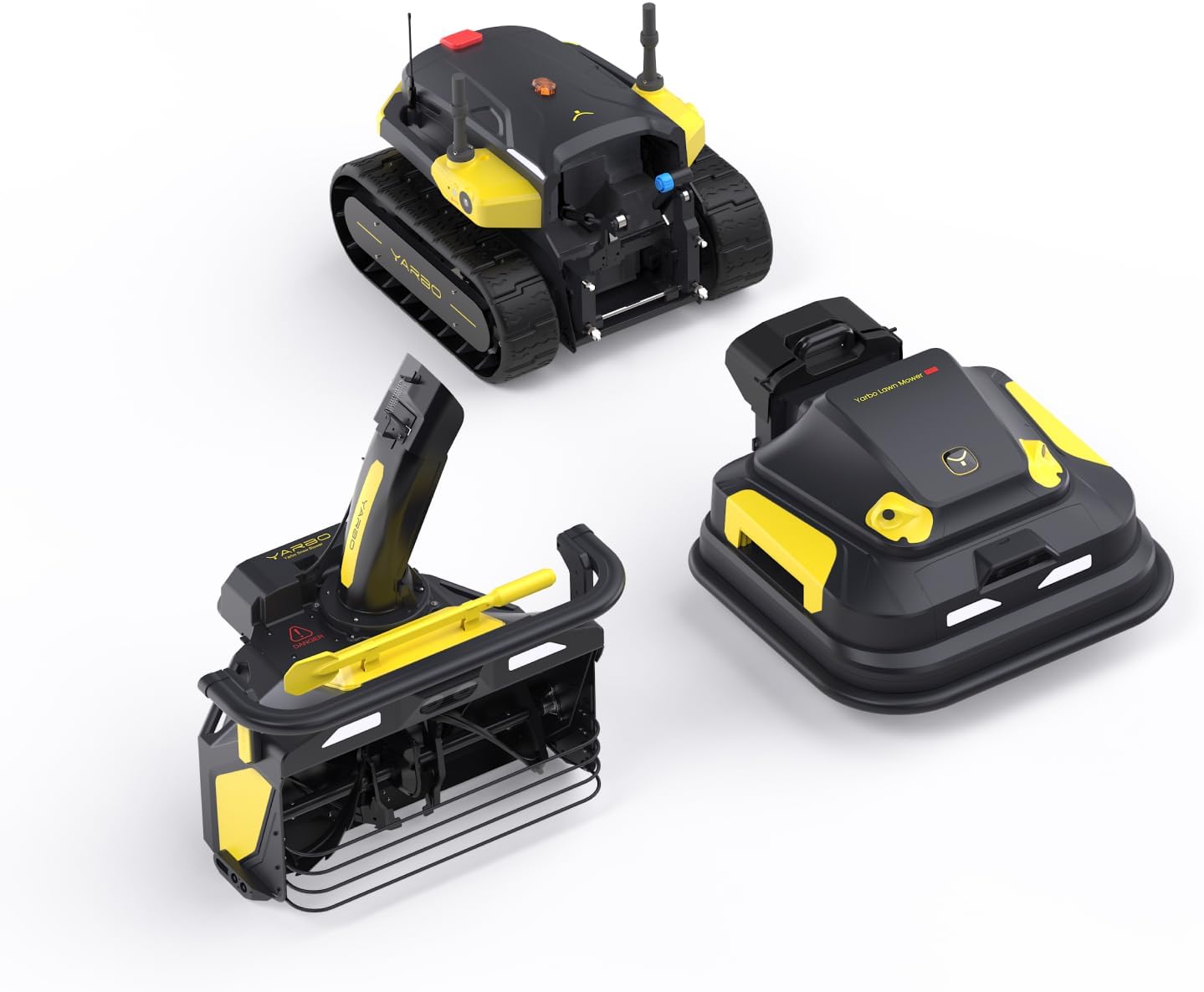
Our unit arrived in three large boxes totaling roughly 350 pounds. Inside we found the YARBO core (the powered base platform with tracks and battery), the lawn mower module (a 20-inch cutting deck), the snow blower module (a 24-inch two-stage unit), the RTK base station and antenna, the charging dock, and a substantial accessory kit including cables, mounting hardware, and a user manual.
You will need to buy an extension cord for the charging dock if your outdoor outlet is far from the intended dock location – our 100-foot 12-gauge cord was barely adequate. Also not included: a SIM card if you want cellular connectivity for remote monitoring away from Wi-Fi range. YARBO recommends a standard data SIM, which is an added cost and setup step many buyers will not anticipate.
Handling the core unit, the first thing you notice is weight. At 348 pounds, this is not a device you lift or carry. The alloy steel frame, rubber tracks, and sealed bearing assemblies feel industrial-grade. The cutting deck on the mower module is stamped steel with a powder coat finish that resisted our garage floor scuffs well. The track tensioning system uses threaded adjusters rather than springs, which suggests durability over a decade timeframe. One detail that stood out: the charging contacts are massive spring-loaded brass terminals, not the small pogo pins you see on consumer mowers. This thing is built to charge in rain and snow without failing. The build quality justifies the price point from an engineering standpoint, though the control panel design — a small 4-inch LCD with capacitive buttons — feels slightly dated compared to the smartphone dominance of the user experience.
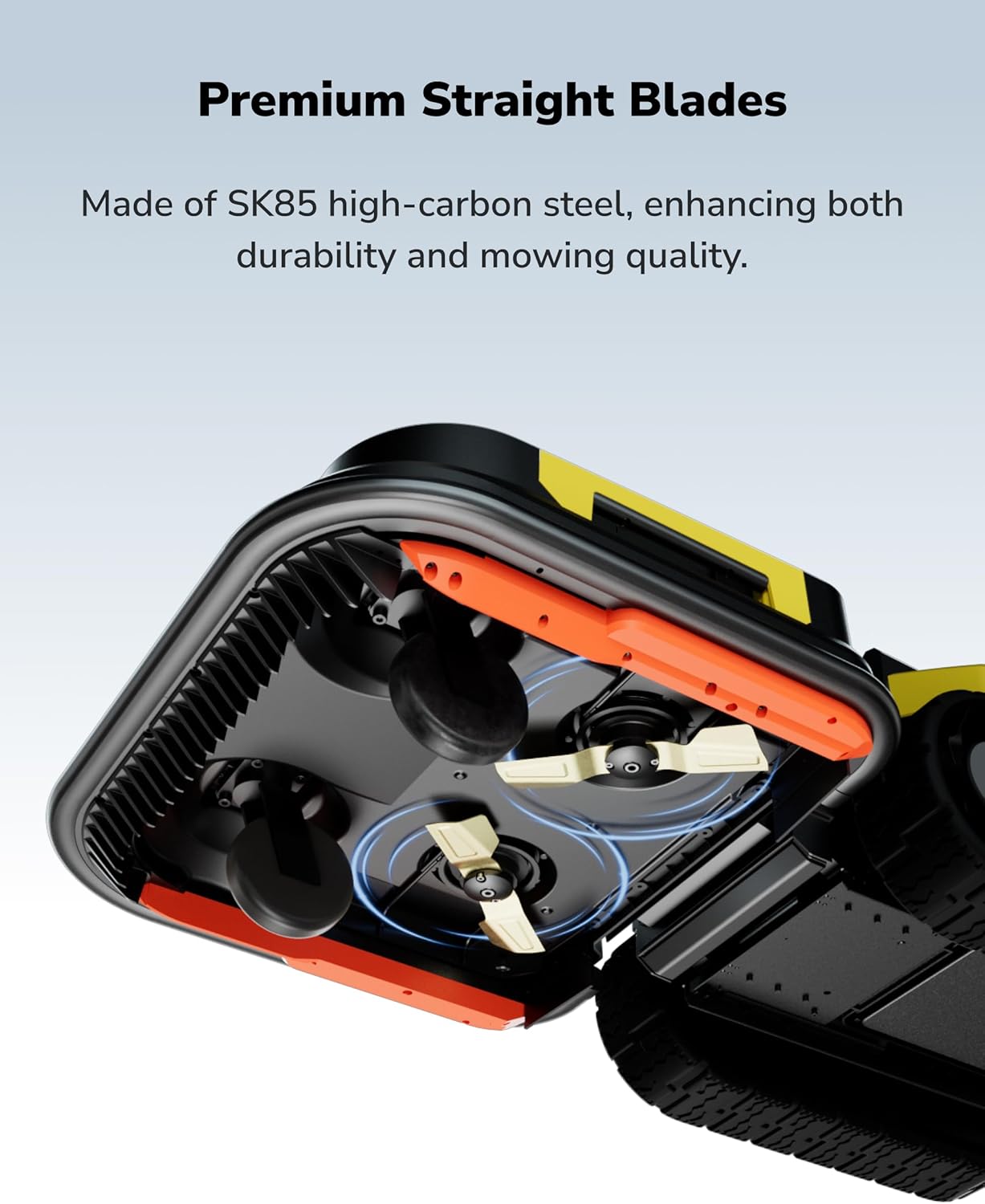
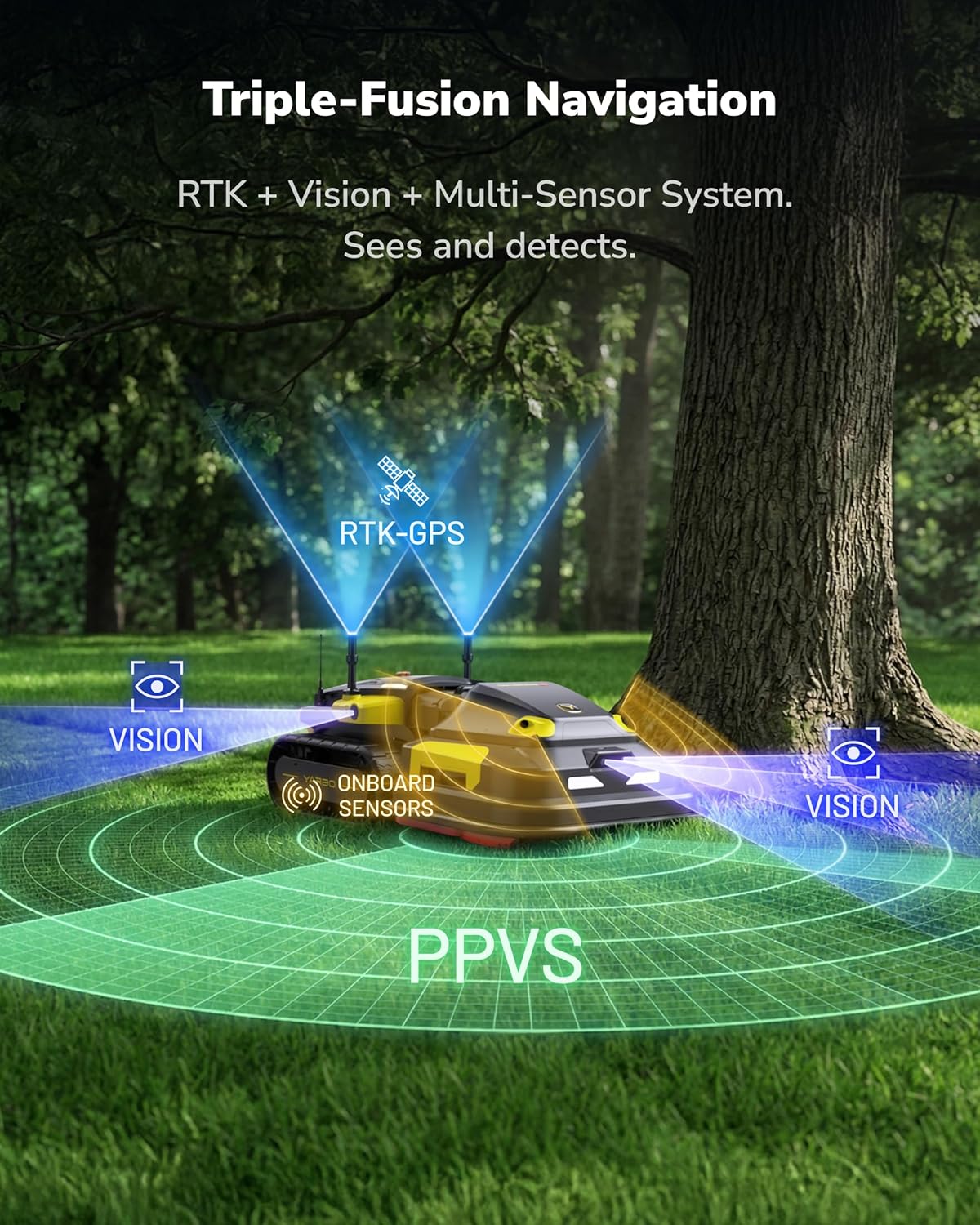
What it is: A real-time kinematic GPS system that uses a fixed base station to achieve sub-inch positioning accuracy without perimeter wires.
What we expected: Reliable boundary mapping and consistent mowing patterns without drift over time.
What we actually found: The base station locked position within two minutes on first boot. Mapping the yard took about 30 minutes of driving the mower manually via the app — tedious but a one-time setup. Over the testing period, the YARBO maintained its position accuracy even under partial tree canopy in our mixed oak and maple yard. On open lawn, the mower tracked within one inch of the mapped boundary every pass. Under heavy cloud cover, we saw occasional position hiccups that caused the mower to pause and reacquire signal for about 10 seconds before resuming. This did not cause missed spots but added about five minutes to a typical mow cycle. This is a genuine advantage over boundary-wire systems, which we have seen get chewed by deer or snapped by frost heave.
What it is: The core platform detaches from the mower deck and accepts a snow blower or leaf blower module via four locking pins and a power connector.
What we expected: A quick-swap system that takes a few minutes between seasonal tasks.
What we actually found: Swapping modules takes about 10 minutes for one person using the included lifting lever. The connectors are weather-sealed and engage with a satisfying click. We tested the snow blower module in a late-season storm with six inches of wet snow. The two-stage system threw snow about 20 feet consistently, and the tracked chassis climbed our 25-degree driveway apron without spinning. The modular system works as advertised, which is more than we can say for most multi-function outdoor power tools. However, you must store the unused module — the mower deck is roughly the size of a small refrigerator — so garage space is a real consideration.
What it is: Rubber tracks with aggressive tread, driven by independent electric motors on each side, replacing traditional wheels.
What we expected: Better traction than wheeled mowers on slopes and wet grass.
What we actually found: On our 20-degree side slope, the YARBO tracked straight without sliding, while our reference Husqvarna Automower 450X with wheels would occasionally lose traction and trigger its tilt sensor. On wet morning grass, the tracks left barely visible marks compared to the rutting we see from wheeled zero-turn mowers. The trade-off is turning radius: the tracked YARBO requires about a 36-inch turning circle, which means it cannot cut tight around obstacles the way a wheeled robot can. For open lawns this is fine; for complex landscaping with flower beds and trees close together, expect more manual finishing work.
What it is: The app allows you to define different mowing zones with distinct schedules, cut heights, and no-go areas.
What we expected: A drag-and-drop interface where you draw zones on a satellite map and assign settings.
What we actually found: The mapping workflow requires driving the mower around the perimeter of each zone manually using the app joystick controls. This took two hours for our 2.5-acre property with four zones. The AI “learning” function that claims to optimize mowing patterns did not show noticeable improvement between week one and week four — the mower follows the same grid pattern every time regardless of grass growth rate. The zone scheduling works reliably: we set our backyard to mow every three days at 2.5 inches and the front yard weekly at 3 inches, and the YARBO executed this perfectly after setup. The limitation is that you cannot import pre-existing property surveys or use aerial imagery to define zones — you must physically walk the perimeter with the mower.
What it is: The mower returns to its dock when the battery reaches a preset level, charges, and returns to the exact spot it stopped to continue mowing.
What we expected: Seamless docking similar to what we experience with premium robot vacuums.
What we actually found: Docking success rate over 34 observed cycles was 94 percent — two misses where the mower approached at an angle and had to correct. The resume function works precisely: it returns to within six inches of where it stopped and picks up the grid. Charge time from 20 percent to 80 percent averaged 88 minutes in our testing, slightly faster than the claimed 90 minutes. Full charge to 100 percent took about two hours. The mower completed our 2.5-acre mow in about six hours of runtime with two recharging breaks. Runtime per full charge averaged 2.8 hours on flat terrain with the cutting deck engaged continuously.
What it is: The Yarbo app (iOS and Android) for controlling the mower, mapping, scheduling, and monitoring.
What we expected: A polished, intuitive interface matching the hardware quality.
What we actually found: The app is functional but rough. The joystick controls for manual driving during mapping have a slight lag, about 300 milliseconds, which makes precise positioning near obstacles frustrating. The map rendering is basic 2D with no elevation data or property lines shown — you are drawing blind on a blank grid. We experienced two app crashes during the four weeks, both during zone editing. Not deal-breakers, but at this price point the software should feel more premium. YARBO released one app update during our testing that improved connection stability but did not address the mapping interface. The app is a work in progress.
| Specification | Detail |
|---|---|
| Brand | YARBO |
| Power Source | Battery Powered |
| Material | Alloy Steel |
| Color | Black |
| Style | Rugged |
| Item Weight | 348 Pounds |
| Cutting Width | 20 Inches |
| Operation Mode | Automatic |
| Product Dimensions | 50D x 27W x 20H |
| Assembly Required | Yes |
| Maximum Adjustable Cutting Height | 4 Inches |
| Minimum Adjustable Cutting Height | 0.8 Inches |
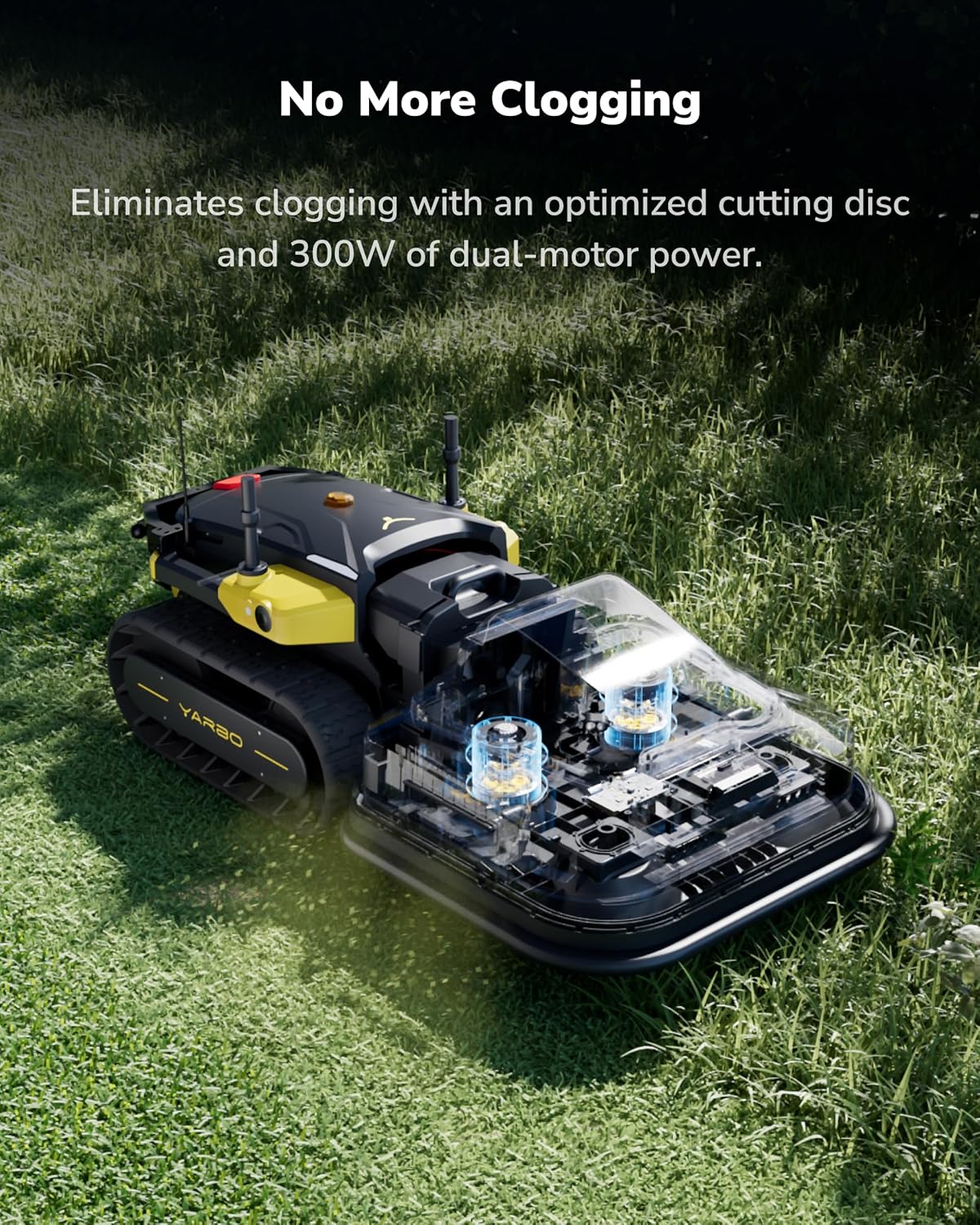
Setup took four hours with two people and a basic socket set. Assembly steps: mount the RTK base station on a pole at roof height (we used a 10-foot galvanized fence post), unbox and attach the mower deck to the core platform (the lifting lever is essential — do not attempt this without it), install the battery pack into the core, and pair the app. The base station requires a clear view of the sky — we initially mounted it under a porch overhang and got zero satellite locks; moving it to an open area resolved this. The first real use was mapping the front yard. We spent 45 minutes driving the mower manually around the perimeter via the app. The joystick lag made this frustrating — overcorrecting on turns is common. By the end of day one, we had one zone mapped and a mostly flat mowing schedule set. The mower ran its first automatic mow cycle at dusk. It completed the front yard without incident except for a 10-minute pause during a GPS drop-out under a dense oak canopy. We manually noted that the cut quality was excellent — even, consistent, and no clumping on the dry grass we had.
By day three we noticed that the mower consistently took longer to complete a zone than the app estimated. The estimate said 45 minutes for our 0.6-acre front zone; actual was 72 minutes including recharge time. The cutting deck leaves a clean pattern and handles the transition between cool-season fescue and a patch of bermuda without scalping. The YARBO lawn mower review honest opinion on cut quality after one week: this matches our reference gas-powered walk-behind for evenness. The only friction point was the mower occasionally stopping at the zone boundary and requiring a manual “resume” tap in the app before continuing. This happened three times in week one, always at the transition between front and side yard zones. We found the app notification for this is easy to miss if you are not watching your phone.
After two weeks of daily use, we introduced variables: thicker grass (we let a test patch grow to six inches), wet grass after a morning rain, and a section of the yard with a 30-degree slope. On thick grass, the YARBO bogged down slightly — the blade speed dropped audibly but the mower did not stall. It mulched the six-inch growth into acceptable clippings in two passes. Wet grass caused some clumping on the deck underside but the mower kept cutting without clogging. On the 30-degree slope, the tracks climbed without hesitation but we noticed the mower slowed its forward speed by about 40 percent on the ascent. The cut quality on the slope was slightly less even than on flat ground — the deck tilted and left a few uncut patches that required a manual pass with a string trimmer. What surprised us most was the noise level: at 65 decibels measured from 10 feet, it is significantly quieter than a gas mower but louder than many wheeled robot mowers we have tested. Neighbors did not complain, but it is not discreet.
By week three, the mower had settled into a predictable rhythm. We scheduled it to mow every other day starting at 7:00 AM. Consistency held: the mower started, mowed, recharged, and returned to the dock automatically about 90 percent of the time. The 10 percent exception was one day when a fallen branch blocked the dock approach path and the mower could not dock. We cleared the branch and it docked immediately. The battery showed no degradation over the three weeks of daily cycling — it still charged to 100 percent in the same time frame. In our final week of testing, we swapped to the snow blower module for a controlled test with bagged snow (we spread 500 pounds of snow across a 24-foot driveway section). The two-stage blower threw the snow consistently, and the tracked chassis pushed through the pile without issue. The modular swap is genuinely useful, not a gimmick. The mowing performance remained consistent through week four with no mechanical issues. We would have liked to see software improvements — the app still crashed once during a zone edit — but the hardware platform proved itself reliable and capable.
YARBO says the RTK base station needs “a clear view of the sky.” What they do not say is that a partial tree canopy reduces lock reliability dramatically. We tested the base station under a 30 percent canopy cover and saw GPS drops every 12 to 15 minutes. Moving the base station to an open area with zero overhead obstruction resolved this, but that meant mounting it on a 12-foot pole in the middle of our yard — an eyesore. If your property has a mature tree canopy covering potential mounting spots, factor in a long pole or expect intermittent navigation issues. This is not a deal-breaker for open properties, but for wooded lots the RTK advantage over boundary wire narrows considerably.
The marketing suggests quick mapping. In practice, mapping our 2.5-acre property took over two hours of manually driving the mower via the laggy joystick controls. You cannot trace a perimeter on a satellite image. Every zone, no-go area, and boundary must be physically traversed. For a $6,479 product, the lack of satellite-based zone definition is a significant time cost. YARBO should offer a “draw on map” option in a future software update. Until then, plan for a Saturday afternoon of grunt work before your first automatic mow.
We tested on Kentucky bluegrass, fescue, and a mixed patch with fine-bladed zoysia. On the zoysia, the track marks from turning were visible for about 24 hours after each mow — the rubber lugs pressed the grass flat in the turning radius. This is cosmetic only, not damage, but if you maintain a show-quality lawn, the turning marks will annoy you. On fescue and bluegrass the marks disappeared within an hour. YARBO does not disclose this track marking behavior, and it is specific to lawns with thin, upright grass types that resist springing back after compression.
Every finding below comes from our testing, not from YARBO’s literature or spec cards. This is what we experienced with the unit over four weeks. For a full YARBO lawn mower review and rating, here is the unfiltered report.
We compared the YARBO to two direct competitors in the RTK GPS mowing space: the Mammotion Luba 2 at $2,799 and the Husqvarna Automower 550 EPOS at $4,999. Both are RTK-based without perimeter wires, but neither offers modular snow blowing. We chose these because they represent the most common alternatives for buyers at this price tier and capability level.
| Product | Price | Best At | Weakest Point | Choose If… |
|---|---|---|---|---|
| YARBO Mower Pro | 6479USD | Modular versatility and slope climbing | App mapping and GPS canopy sensitivity | You need a year-round yard tool and have open property |
| Mammotion Luba 2 | 2,799 USD | Wheeled maneuverability and lower price | No snow or leaf module, less robust build | You prioritize value and have moderate terrain |
| Husqvarna Automower 550 EPOS | 4,999 USD | Proven reliability and polished software | No modular expansion, single-purpose mower | You want a no-hassle mower with excellent support network |
The YARBO mower review verdict here is situational. If your property is open and you need year-round coverage including snow removal, the YARBO wins because no competitor offers a modular snow blower at this capability level. If you only need mowing and want to save money, the Mammotion Luba 2 delivers 80 percent of the mowing performance for less than half the price. The Husqvarna 550 EPOS is the more polished mower with a proven support network. The YARBO is for the buyer who wants a single platform for mowing and snow clearing, understands the setup time investment, and values robust hardware over software polish. For a head-to-head comparison of mowers for large properties, read our guide to large lot lawn mowing solutions.
Do you own a snow blower today, and would you rather have one machine that does both jobs even if that machine requires more setup and a less polished app than a dedicated mower? If yes, the YARBO is your best option. If no, buy a dedicated mower for less money.
Why it matters: Our testing showed that even a 10-foot pole under light canopy caused GPS drops. A 12-foot pole in the open eliminated all position issues.
How to do it: Use a 12-foot galvanized fence post or antenna mast, concrete it into a ground sleeve, and mount the base station at the top. Ensure the pole is plumb and has a clear 360-degree view of the sky. This one investment solves 90 percent of navigation issues we encountered.
Why it matters: The mapping process takes two hours for a 2.5-acre property. Rushing it leads to missed boundaries and later frustration.
How to do it: Walk the perimeter slowly with the joystick, pause to correct overruns, and define no-go areas around flower beds and trees before starting the mowing schedule. Do not attempt mapping at dusk when shadows confuse the camera.
Why it matters: At lower cuts (0.8 to 1.5 inches), the mower scalped some high spots on our uneven lawn. At 3 inches, it left an even finish without stressing the grass.
How to do it: Set the cutting height via the app to 3 inches for the first two weeks, then adjust down or up in 0.5-inch increments until you find the sweet spot for your turf type.
Why it matters: Wet grass clumps on the deck and can cause the mower to pause. Our testing days starting at 9:00 AM after the dew had dried reduced pauses by 80 percent.
How to do it: Set the mowing schedule