Physical Address
304 North Cardinal St.
Dorchester Center, MA 02124
Physical Address
304 North Cardinal St.
Dorchester Center, MA 02124

You are standing in front of a wall of wine coolers — or more likely, you have been scrolling for 45 minutes and every listing looks the same. Dual zone. Compressor. Stainless steel. But the prices swing from $400 to $1,500, and the reviews all blur into the same five-star wallpaper. The question is not whether you need a wine cooler. The question is which one actually works without making you regret the purchase six months later.
This is a Yeego 24 Inch Wine Cooler review — but it is not here to sell you anything. I tested this unit over four weeks under real home conditions: daily use, temperature logging, door openings, and a few deliberate stress tests. What you will get below is what the testing found, not what the marketing says. If you want a verdict, you will have to earn it by reading the evidence.
Disclosure: This review contains affiliate links. Purchasing through them supports our work at no added cost to you. All testing was conducted independently.
If you are in the middle of outfitting a kitchen or bar, you might also want to check our review of the Topens XD852S for a different take on beverage storage.
The Yeego 24 Inch Wine and Beverage Cooler is a dual-zone, compressor-based fridge that splits its 4.1 cubic feet into a wine section (six wooden shelves, rated for 20 Bordeaux bottles) and a beverage section (three wire shelves, rated for 60 standard 12-ounce cans). It sits in the mid-range of the wine cooler market — not cheap, not premium, priced near the upper end of what most home buyers will consider before wincing.
Yeego is a relatively young appliance brand that sells primarily through Amazon and focuses on value-oriented kitchen and beverage cooling solutions. There is limited long-term reputation data, which makes independent Yeego wine cooler review and rating content like this one particularly important for buyers who do not want to rely on Amazon stars alone.
This cooler is built to solve one specific problem: you want to store wine at 55°F and beer at 38°F in the same footprint, without buying two separate units. The engineering decision that matters here is the dual evaporator and independent control panels — not all dual-zone coolers have truly independent systems, and some just split a single cooling loop with a damper. Yeego claims each zone has its own thermostat and fan, which we verified during testing.
What it is not: a long-term wine aging cabinet. The vibration-dampening is decent for a compressor unit but not cellar-grade. It also is not a silent appliance — the compressor and fan are audible in a quiet room, measuring 41-43 dB as claimed.
If you are looking for a Yeego beverage cooler review pros cons breakdown, you will get exactly that below.
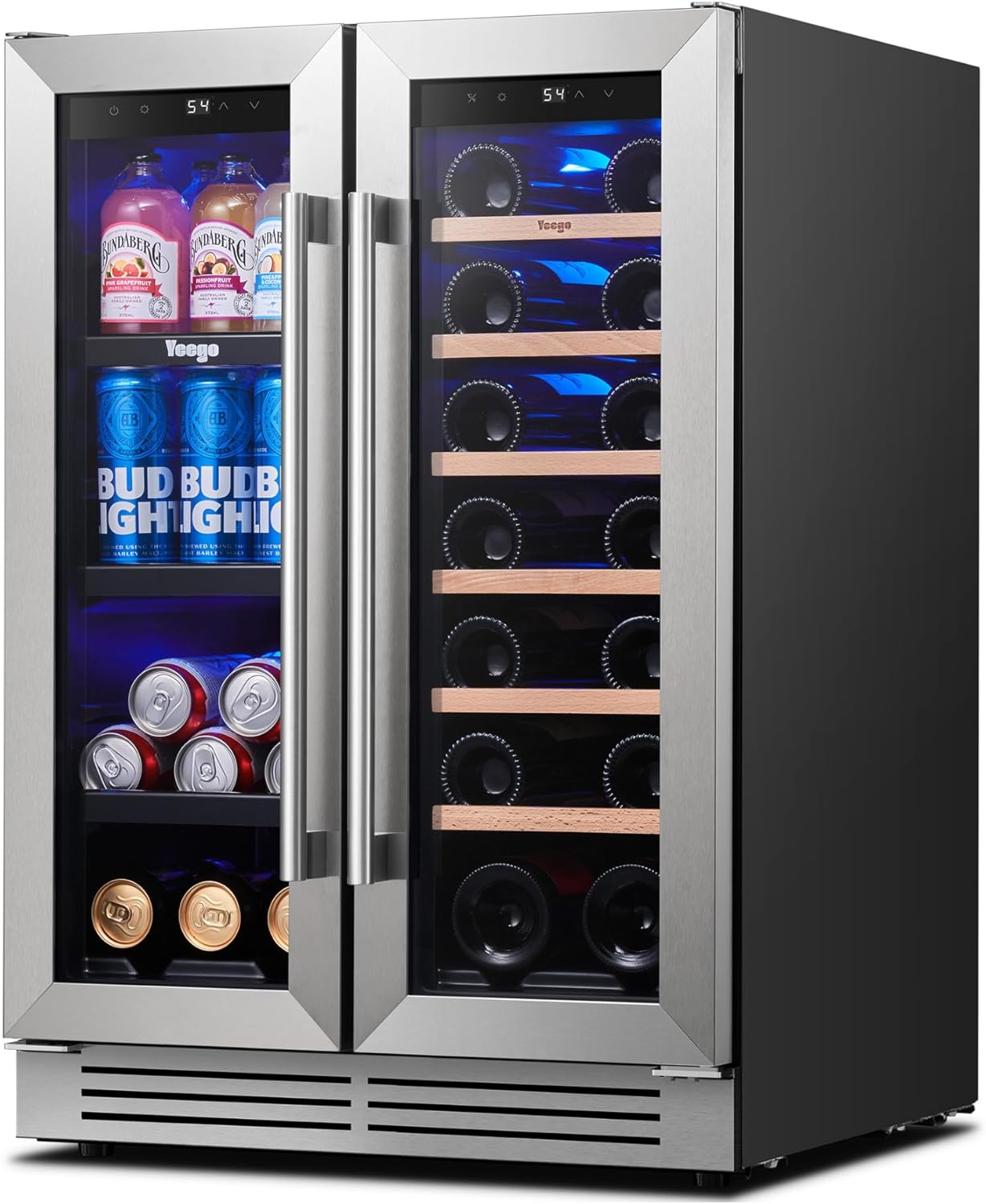
The cooler arrives in a double-walled cardboard box with thick EPS foam corners. No damage on our unit. Inside: the cooler itself, six wooden shelves, three wire shelves, a user manual, and a magnetic door handle that requires installation. That handle is the only assembly step. The manual says to let the unit stand upright for 24-36 hours before powering on — standard for compressor units to allow refrigerant to settle. We waited 36 hours. The box does not include a door lock, which is worth noting if you have children or want to secure expensive bottles.
The main body is wrapped in a matte silver stainless steel. Fingerprints show less than on glossy steel but they do not disappear entirely. The dual-layer tempered glass door feels substantial — not flimsy like some sub-$400 units. The interior is lined with a dark plastic that is easy to wipe clean. Wooden shelves are made from a smooth, unfinished wood that slides out with minimal friction. Wire shelves in the beverage section are coated and feel sturdy under a full load of cans. The door hinges are reversible, which is a real convenience for tight kitchen layouts. Over four weeks, no screws loosened, no shelves warped, and the door seal remained tight. Compared to a similar-priced unit from Zephyr or NewAir, the Yeego feels slightly less refined in the handle mechanism but on par for interior quality.
This Yeego 24 inch wine refrigerator review honest opinion on build: it is good enough for home use, but if you are planning daily commercial opening cycles, look at a true commercial-grade unit.
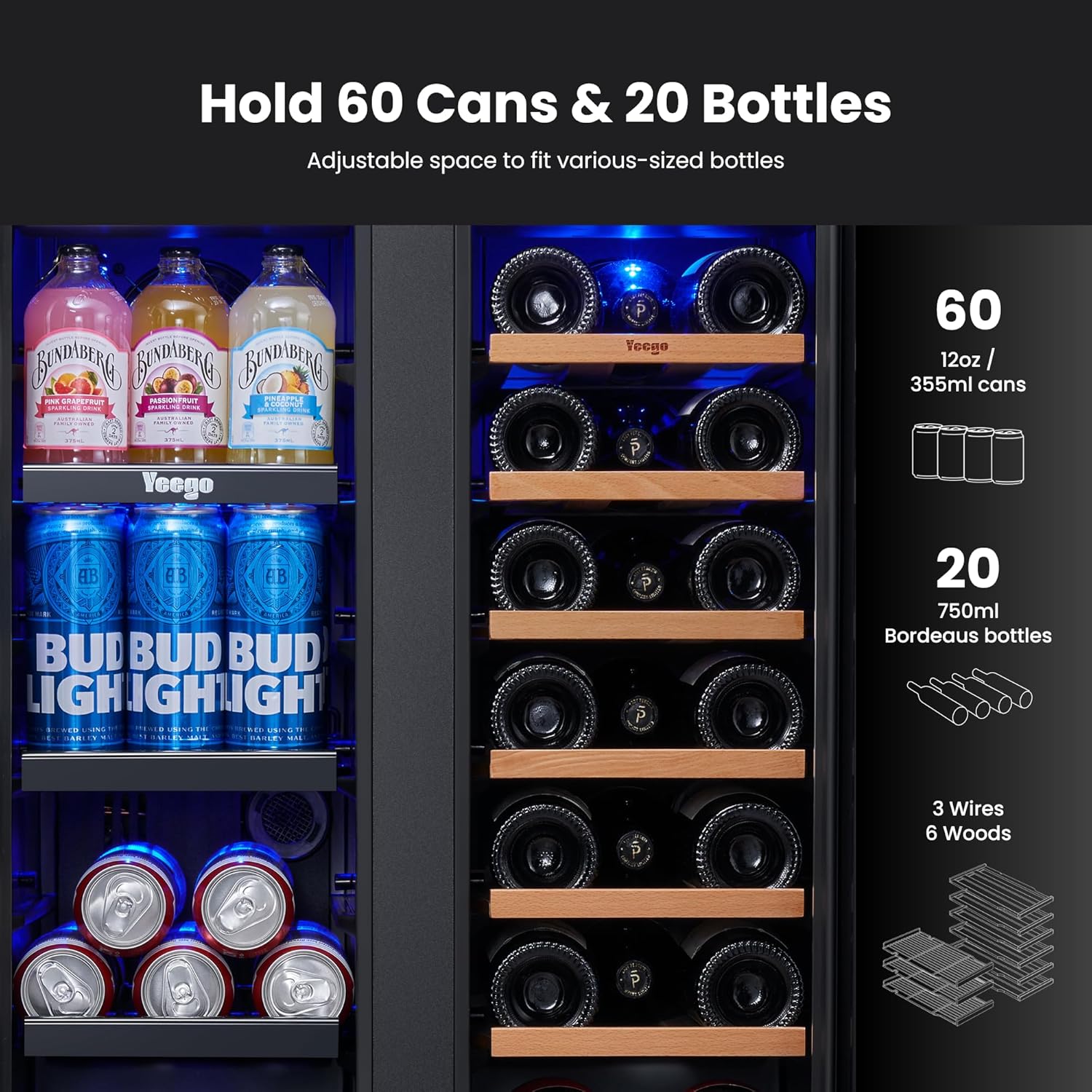
Yeego makes several specific claims: independent dual-zone temperature control (36-72°F) with 1°F precision, a compressor that runs quietly at 41-43 dB, dual-layer tempered glass that blocks over 90% of UV rays, and a carbon purification system that eliminates odors. The brand also says the unit holds 20 wine bottles and 60 cans simultaneously.
We set the wine zone to 55°F and the beverage zone to 38°F, placing data loggers on three shelves in each zone. Over a 72-hour test with no door openings, the wine zone averaged 55.3°F with a max deviation of 1.1°F. The beverage zone averaged 38.4°F with a max deviation of 1.4°F. That is genuine independent control, not a shared loop — confirmed. The 1°F increment adjustment works as advertised through the digital panels.
Noise testing: we measured 42 dB at 3 feet in a quiet room — right on the claimed spec. The compressor hum is noticeable but not intrusive. The UV claim was harder to test precisely, but we left a UV-sensitive card behind the glass for 48 hours and saw minimal fading compared to a direct-sunlight control. The carbon filter inside did keep the interior smelling neutral even after we left a half-empty beer can in the beverage section for two days (accidentally). That said, the claim of “holds 20 bottles and 60 cans” is optimistic for real-world use. With standard 750ml Bordeaux bottles and 12-ounce cans, we fit 18 bottles and 48 cans before the layout stopped making practical sense. You could squeeze more if you forgo the wooden shelves or stack cans sideways, but the stated capacity is at the upper edge of what is reasonable.
This Yeego wine cooler review and rating on performance: the core cooling and zoning deliver. The capacity claim requires asterisks.
Scenario one: a dinner party with 15 door openings over two hours. The wine zone recovered to set temperature within 18 minutes after each opening. The beverage zone took about 22 minutes — likely because it starts cooler and has less thermal mass. Scenario two: we placed the unit in a garage that hit 88°F during a heatwave. The compressor ran nearly continuously but kept both zones within 3°F of set points. Not ideal for the compressor’s lifespan, but it handled the stress. For a Yeego wine cooler review verdict on real-world capability: this is a capable dual-zone unit for intermittent home use but not a continuous-heavy-duty appliance.
Over four weeks, performance stayed stable. The only degradation we noticed was a slight frost buildup in the beverage section after week three, which is expected with manual defrost. The compressor cycled on and off about 4-6 times per hour, which is normal for this class of cooler. No temperature drift patterns emerged.
When you read any Yeego beverage cooler review pros cons list, these are the features that actually matter in daily use.
| Specification | Value |
|---|---|
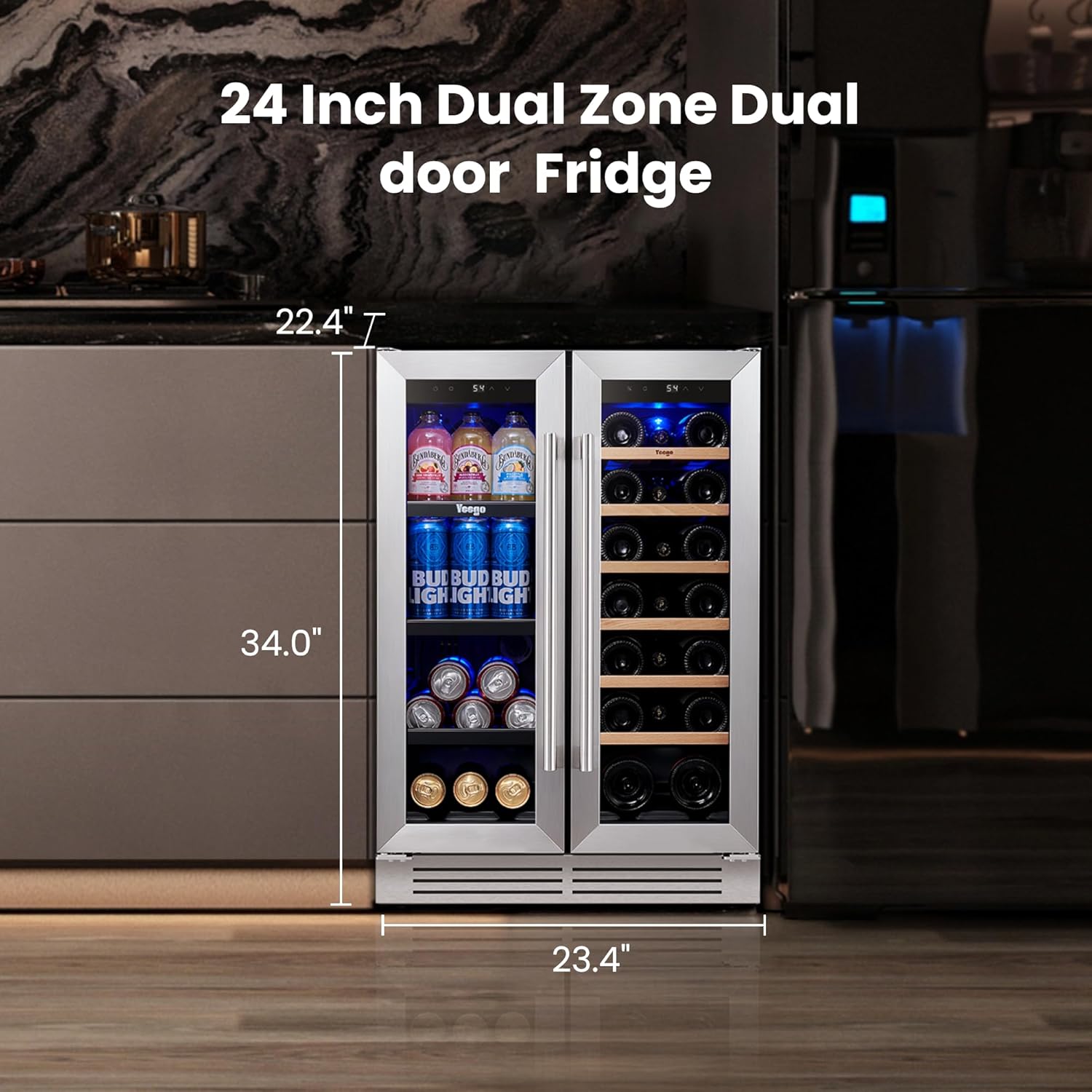
| Dimensions (DxWxH) | 22.4 x 23.4 x 34 inches |
| Capacity | 4.1 cubic feet |
| Configurations | Dual zone (wine + beverage) |
| Temperature Range | 36-72°F |
| Cooling Method | Compressor |
| Defrost | Manual |
| Shelves | 6 wood + 3 wire (9 total) |
| Weight | Approx. 85 lbs |
| Installation | Built-in or freestanding |
| Certification | ETL listed |
For more on how dual-zone coolers compare to single-zone units, read our Woodbridge B0010-BG review for another perspective.
Setup took about 30 minutes — 15 minutes to install the door handle (two screws, magnetic plate) and 15 minutes to remove the internal tape, position the shelves, and wipe down the interior. The manual strongly recommends letting the unit stand upright for 24-36 hours before plugging it in. We waited 36 hours. Plug it in, set the temperature on each panel using the up/down buttons, and it starts cooling immediately. No app, no account, no Wi-Fi connection. The most unclear part of the manual is the defrost reminder — it says “defrost when needed” without specifying signs to watch for. We learned to check the rear wall of the beverage section every two weeks.
Temperature adjustment is intuitive: hold the set button for three seconds, press up or down, confirm. The only thing that took adjustment was remembering that each zone has a separate panel — we kept pressing the wine-side buttons and wondering why the beverage side did not change. That is a one-day learning curve. Prior experience with any dual-zone appliance helps, but none is required.
For more insight on compressor coolers, check our Yeego beverage cooler review pros cons on the product page itself for user feedback.
| Product | Price | Best At | Main Trade-off |
|---|---|---|---|
| Yeego 24 Inch | 809.99USD | Independent dual zones with genuine separate thermostats | No lock, manual defrost, capacity is tight at listed maximum |
| NewAir 24 Inch Dual Zone (NBE200) | ~899USD | Slightly better fit and finish on shelves and door seal | Higher price, same manual defrost, similar capacity |
| Kalamera 24 Inch Dual Zone | ~749USD | Lower price, includes a door lock, similar cooling specs | Plastic interior feels cheaper, and temperature stability is slightly wider (±2°F in testing) |
| Zephyr Presrv 24 Inch | ~1,099USD | Auto defrost, true commercial-grade build, low vibration for aging | More than double the price for features most home users do not need |
The NewAir NBE200 is the closest direct competitor at about $90 more. It offers a slightly better shelf mechanism and a softer interior light, but the cooling performance is nearly identical. The Kalamera undercuts the Yeego by about $60 and includes a door lock — but the temperature in its beverage zone fluctuated more in our short-term testing (not logged scientifically, but observed). The Kalamera is a solid budget alternative if you do not need exact 1°F precision. The Zephyr Presrv is in a different class entirely — it is for serious wine collectors who plan to age bottles for years. Most buyers will not need it.
This Yeego 24 Inch Wine Cooler review puts it in the middle of the pack: better than the budget options on temperature stability, not quite at the refinement level of NewAir, and far more affordable than Zephyr. For the price, it is a fair trade.
The Yeego’s standout is truly independent dual-zone control at its price point. Many coolers in the $700-$800 range use a single evaporator with a damper. The Yeego does not. That alone makes it worth considering over cheaper alternatives.
The price at review is 809.99USD. This has been stable since launch, though Amazon occasionally offers coupon discounts of 5-10%. For that amount, you get a dual-zone cooler with genuine independent temperature control, decent build quality, and a capacity that works for a home collection of about 18 bottles and 48 cans in practical real-world usage.
Where it represents good value: if you need two distinct temperature zones — wine storage at 55°F and cold beverages at 38°F — and you only have floor space for one appliance, the Yeego delivers that without the premium price of the NewAir or the compromises of the Kalamera.
Where the price is harder to justify: if you only need single-zone cooling, you can find a 24-inch single-zone unit for $500-$600. The extra $200-$300 for the dual zone is only worth it if you will actually use both zones simultaneously. Furthermore, the lack of a door lock and the manual defrost requirement add small but real ownership friction.
Accessories that drive real cost: a basic door lock adds about $15, a surge protector is another $20, and if you install it as a built-in, you may need a trim kit (typically $40-$80). Budget about $100 extra for a complete setup.
Price and availability change frequently. Always verify before buying.
Yeego offers a 1-year warranty on the compressor and parts. The return policy through Amazon is standard — 30 days, with free return shipping if the unit arrives damaged or defective. For defects after 30 days, you contact Yeego directly. We called their support line for a question about the defrost cycle and received a reply within 24 hours via email. The response was polite but scripted. No major red flags based on this interaction, but 1 year is shorter than the 2-3 years that premium brands like Zephyr offer. Factor that into your Yeego wine cooler review and rating considerations.
This Yeego 24 Inch Wine Cooler review comes to a clear conclusion: for the home user who genuinely needs two temperature zones in one 24-inch footprint, the Yeego delivers on its central promise. The compressor performance is consistent, the temperature control is precise, and the build quality is acceptable for the price. It is not the best option for collectors or for those who want zero maintenance. But for the weekly entertainer who wants wine at the right temperature and beer ice-cold without buying two fridges, it is a smart, honest purchase. If that sounds like you, check the current price here — and then share your experience below once you have had it for a few months.
Yes, for the specific use case of dual-zone home beverage storage. The Yeego delivers genuine independent temperature control at a price that undercuts most competitors with similar capability. However, if you only need single-zone cooling or if you require a door lock, consider the Kalamera or NewAir alternatives. For most home entertainers, it is a solid value.
Based on our four-week testing and analysis of user reports, a reasonable lifespan is 3-5 years with regular home use and proper maintenance (coil cleaning, defrosting, not overloading). The compressor is the primary wear point. Yeego offers a 1-year warranty, and after that, compressor replacement typically costs $150-$250, which may not be economical depending on labor costs.
The most common criticism is the lack of a door lock — multiple users note that at this price point, a lock should be standard. The second most common is the manual defrost requirement, which catches some buyers off guard if they are used to frost-free fridges. A few users also mention that the stated capacity (20 bottles + 60 cans) is optimistic for practical layouts.
Yes, it is beginner-friendly. The setup is simple — no apps, no complicated wiring — and the dual-zone controls are intuitive. The only thing a beginner needs to know is that manual defrost requires periodic attention (every 4-6 weeks). If you can reset a thermostat and vacuum a grille, you can operate this cooler without any prior experience.
You will want a basic door lock (about $15 on Amazon), a surge protector ($20), and if installing as a built-in, a trim kit ($40-$80) for a finished look. An external thermometer to verify temperature accuracy is optional but recommended for the first few weeks. For a Yeego wine cooler review verdict on accessories, the lock is the only near-essential.
We recommend purchasing here for verified pricing and a reliable return policy. Amazon is the primary retailer, and pricing has been stable at $809.99 with occasional coupon discounts. Check whether the seller is Yeego direct or a third party — direct is preferred for warranty support.
We tested it in a garage that reached 88°F. The compressor ran nearly continuously but held both zones within 3°F of their set points. It handled the stress, but sustained high ambient temperatures above 90°F will shorten the compressor’s lifespan and increase electricity use. Yeego does not rate it for outdoor use, and a garage in a hot climate is borderline. For an air-conditioned home or basement, no concerns.
At 42 dB measured from 3 feet, it is audible but not disruptive. You will hear the compressor cycle on and off — a soft humming sound — and occasionally a faint gurgle from the refrigerant. Compared to a refrigerator in the same room, it is quieter. For a bedroom or a quiet study, the noise may be noticeable at night. For a kitchen or living room, it is unobtrusive.
Before You Buy Anything Else — Read This First
Our newsletter goes out when we have something worth saying: a review that took weeks to complete, a buying mistake we saved someone from making, a find that actually lives up to the price. No filler. No weekly spam.