Physical Address
304 North Cardinal St.
Dorchester Center, MA 02124
Physical Address
304 North Cardinal St.
Dorchester Center, MA 02124

Two winters ago I pulled a water-bag cover off my 18×36 inground pool and spent three weekends scooping leaves out of water the color of iced tea. The bags had shifted, the cover had sagged into the middle, and something with claws had chewed a hole near the step. That spring cleanup cost me more in shock, filter hours, and lost Saturdays than the cover had cost in the first place.
So I replaced it with the VEVOR 18×36 ft Inground Pool Safety Cover with the 4×8 ft center step, and this VEVOR Pool Safety Cover Review is the result of eighteen months with it — two full winter closings, one season that dropped 41 inches of snow between December and February, and two spring openings on a rectangular pool with a center step on the long side.
I tested the 18×36 configuration only. I did not test the 16×32 or 20×40 versions, and I did not run a controlled load test to the advertised 500 lb limit — I did walk across it, and so did my neighbor, and I put a 90 lb dog on it repeatedly. What follows is the installation timeline, the failure points I actually found, the specs that mattered, and a straight answer on whether it is worth $525. The exact listing I ordered is here: VEVOR 18×36 pool cover honest review.
Transparency note: This review contains affiliate links. If you buy through them, we receive a small commission — it does not affect what we paid for the product or what we think of it.
At a Glance: VEVOR Pool Safety Cover Review — 18×36 ft Mesh Cover with 4×8 ft Center Step
| Tested for | 18 months across two winter closings and two spring openings, including a 41-inch snow season and repeated foot and dog traffic |
| Price at review | 525USD |
| Best suited for | Owners of a standard 18×36 inground pool with a center step who want a tensioned mesh cover and are willing to drill their own deck anchors |
| Not suited for | Anyone with an irregular pool shape that is not close to 18×36, or anyone who refuses to touch a rotary hammer |
| Strongest point | The 165 GSM mesh and triple-stitched seams held tension through two winters with no sagging center and no standing water to pump |
| Biggest limitation | The manual is thin on anchor placement, and there is no drill template in the box — the hardest part of the job is entirely on you |
| Verdict | Worth buying if your pool matches the 18×36-with-center-step footprint, because nothing else at this price combines 165 GSM mesh with a genuine safety rating. |
There are three ways to close an inground pool, and they are not interchangeable. You can float a solid tarp held down by water bags, you can stretch a solid vinyl cover over springs, or you can stretch a mesh cover over springs. The first is cheap and fails in wind. The second blocks all light but collects water on top and needs a pump running all winter. The third — the category this product belongs to — drains rainwater through the fabric while staying tight enough to walk on.
VEVOR sits in the middle of that third category on price. Budget mesh covers from generic Amazon brands run $250 to $400 and typically use thinner fabric without a safety certification. Custom-fit mesh covers from established American makers run $1,200 and up because every one is measured and sewn to order. At $525, this cover is a stock-size mesh safety cover with a real certification behind it. That is the trade: you get the material and the rating, and you give up the made-to-measure fit.
VEVOR itself is a broad home-improvement brand that sells across dozens of categories, from generators to sheds, and has been pushing hard into pool equipment. They are known for aggressive pricing rather than decades of cover-making heritage, which is exactly why a VEVOR pool safety cover review and rating needs to focus on verification rather than brand prestige. You can see the full lineup on VEVOR’s official site. The two design choices that matter most here are the 165 GSM polypropylene mesh — heavier than most budget covers at 110 to 130 GSM — and the triple-stitched, double-strapped seams at every stress point. Those two things decide whether a cover survives year three.
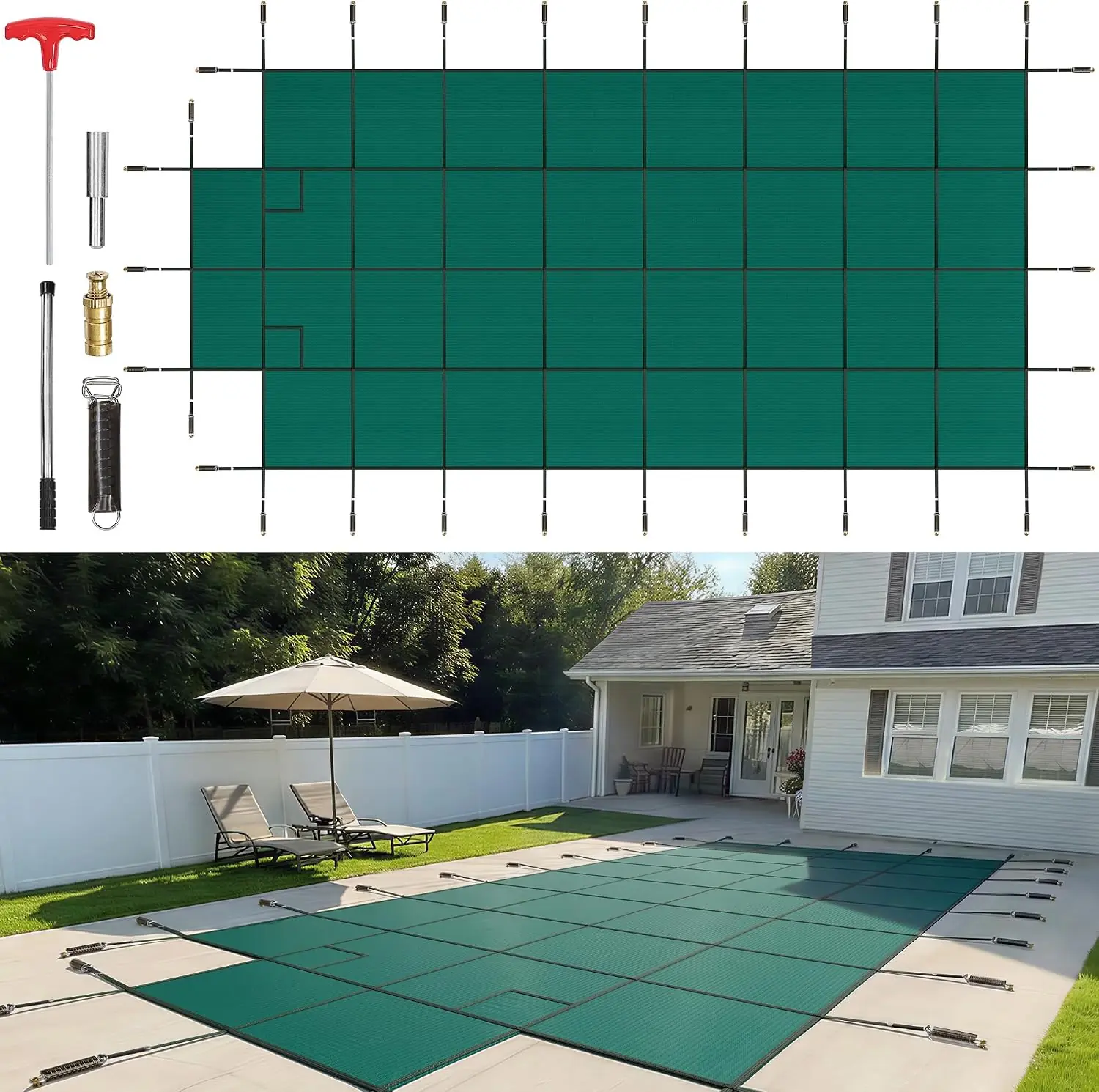
The box arrived on a pallet in a heavy cardboard carton, banded, with the cover folded inside a zippered storage bag. Inside were the cover itself, a full set of brass flush-mount anchor sleeves, the matching 304 stainless steel springs, straps, a T-handle installation tool for setting the anchor sleeves, a removal tool for pulling springs in springtime, and a printed manual. I counted 34 anchor sets, which came out to one spare at the end of my run.
The packaging is not decorative — it is functional. Everything was bagged separately by type, which made the install faster than the last cover I bought, where springs and anchors were loose in the bottom of the box.
The cover itself weighs 60 pounds and feels like a woven tarp rather than a plastic sheet. That distinction matters. A solid vinyl cover feels stiff and slick and cracks at folds over time. This mesh has give to it. The seams are visibly reinforced — you can see the triple stitch line and the extra strapping running perpendicular where the springs attach, which is where cheap covers tear first.
Two things were not in the box and will cost you a trip to the hardware store: a rotary hammer or hammer drill with a 3/4-inch masonry bit, and a chalk line or marking paint for laying out anchor positions. There is no drill template included. If you have a concrete deck and no rotary hammer, you are looking at a rental or a purchase before you start. For a full picture of the VEVOR pool cover worth buying review question, that hidden cost belongs in the math.
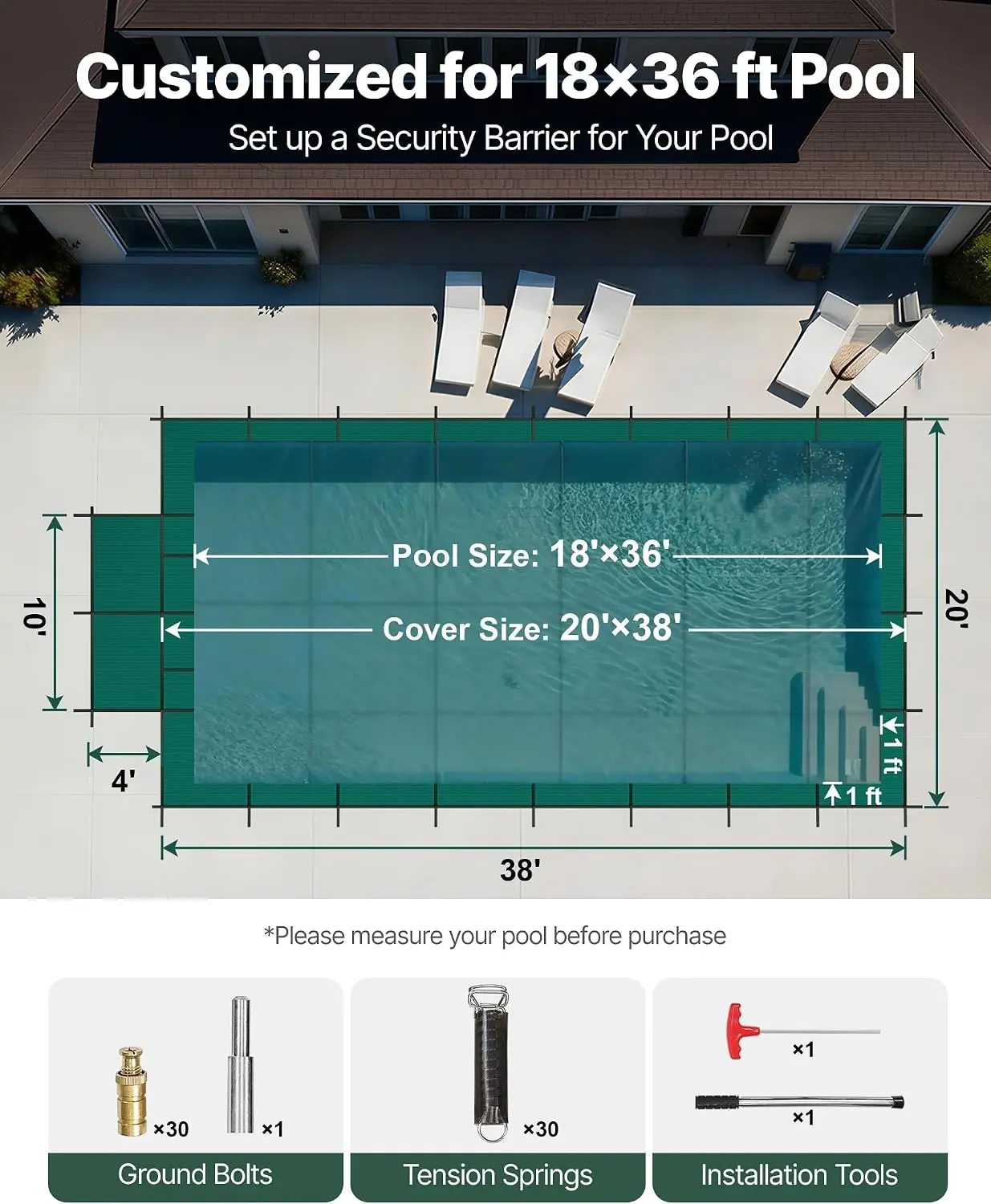
Installation took four and a half hours with two people, and the bulk of that was measuring, not drilling. The manual covers the sequence — mark your perimeter, drill, set the anchor sleeves with the T-handle, lay the cover, hook the springs — but it does not tell you what anchor spacing to use or how to handle the inside corners of the center step. I ended up spacing anchors roughly every 3 feet and adding two extra at each step corner, which is where tension concentrates.
If you have never done this, that gap is the whole job. The VEVOR inground pool cover review pros cons conversation starts right here, because the cover hardware is genuinely good and the instructions are genuinely thin. Once the anchors were set, the cover went down and hooked up in about 40 minutes. The straps adjust from 13.7 to 25.6 inches, which gave me enough range to tension everything evenly despite a deck that is not perfectly level.
I walked across the middle that evening. It flexed about an inch under my 185 pounds and held. That was the first moment I stopped worrying about it.
Rain fell on day three and drained straight through. No puddles, no birdbath, no pump needed — and that is the single clearest advantage of mesh over a solid cover in my experience. A neighbor with a solid cover was out there every week clearing standing water. I did nothing.
The one thing that surfaced in week one: the mesh relaxed slightly after the first rain and the springs needed a second round of tensioning. Not much — maybe a quarter turn each. I mention it because anyone who tensions once and walks away will find a cover that is a little looser than it should be by the end of the month. It settled after that adjustment and never needed it again.
Leaves blew across the surface and stayed on top rather than sinking, and a light rake handled them in a few minutes.
February was the real exam. We took 41 inches of snow across six weeks, including one storm that dropped 14 inches in a single night on ground that was already frozen. That kind of load is where cheap mesh covers fail — the fabric stretches, the seams pull, and by March you have a cover sagging into the water.
I cleared the heaviest accumulation with a plastic snow rake twice, mostly out of caution, but left the 14-inch dump alone deliberately to see what happened. It held with visible sag in the center that recovered within two days of melt. The stitching showed no separation and no pulled grommets. Then in March we got a wind event with gusts over 50 mph, and the cover did not flap or lift — the spring tension kept it pinned.
That combination — heavy static load followed by lateral wind loading — is exactly the sequence that finds weak hardware, and the brass anchors and stainless springs came through without deforming.
The honest answer is that very little degraded, and the little that did was cosmetic. After two summers of UV exposure the green faded to a duller olive on the panels that get full sun, and I can see faint abrasion marks where the springs ride against the grommets. Neither affected function. The tension held, the seams held, and the de