Physical Address
304 North Cardinal St.
Dorchester Center, MA 02124
Physical Address
304 North Cardinal St.
Dorchester Center, MA 02124

I unboxed the DuroStar DS13000MX on a Tuesday afternoon in early November, roughly 30 hours before a storm took out power to my block for 36 hours. That collision of timing turned into the most useful test I could have designed. Within 25 minutes of the grid going down, I had the unit running on gasoline, feeding a 50-amp transfer switch, and carrying my furnace blower, refrigerator, well pump, and about a dozen lights without a single trip.
This DuroStar DS13000MX generator review covers six weeks of testing in two settings: whole-home backup at my house and a job site where the unit ran a 240V welder and two circular saws. I logged 87 hours total, split between gasoline and propane. I also ran it side by side against a Westinghouse WGen11500TFc on the same resistive load bank to see where the extra wattage actually shows up and where it does not.
What follows is my measured take on whether this machine justifies its $899 price, where it stumbles under real load, and who should buy it rather than something smaller. If you are trying to settle the question of is DuroStar DS13000MX worth buying, the short answer is yes for whole-home backup under 10kW and no for casual tailgating.
Disclosure: This article contains affiliate links. If you purchase through our links, we may earn a small commission at no extra cost to you. Our testing and opinions are independent.
DuroStar DS13000MX — Quick Verdict
Best for: Homeowners with a 50-amp transfer switch who need to carry a furnace, well pump, fridge, and a few lighting circuits through a multi-day outage.
Not ideal for: Anyone in an HOA or dense neighborhood, or anyone who needs to move a generator alone — this is a 220-pound machine that runs at 76 to 79 dBA.
Price at time of review: $899
Tested for: Six weeks and 87 logged hours, split between a residential outage and four job-site days, plus head-to-head load bank runs against a Westinghouse WGen11500TFc.
Bottom line: A genuinely capable 10,500-watt backup machine with a real CO shutdown system at a price the competition has not matched — held back by noise, weight, and a marketing claim about central AC that only holds for smaller units.
Any useful DuroStar DS13000MX generator review has to start by placing the machine in its category, because the marketing language blurs it. This is not a whole-house standby unit wired to a gas line, and it is not a tailgate inverter you carry in one hand. It is a 220-pound wheeled portable that lives in a garage, rolls out when the grid fails, and connects either to a transfer switch or to a spread of extension cords.
DuroStar is the house brand of Pulsar Products, a California manufacturer that has been building portable power equipment since the 1990s. The company publishes full parts diagrams and service manuals at durostar.com, which matters more than most buyers realize three or four years into ownership. Parts availability is the quiet failure point of the portable generator market.
The specific problem it solves: most homes need somewhere between 8,000 and 12,000 running watts to keep a furnace, refrigerator, well pump, and a handful of circuits alive during an outage. The DS13000MX delivers 10,500 running watts on gasoline, which clears that bar with room to spare. Where it separates from other machines in the mid-tier is the combination of a 50-amp outlet and an automatic carbon monoxide shutdown system at this price point.
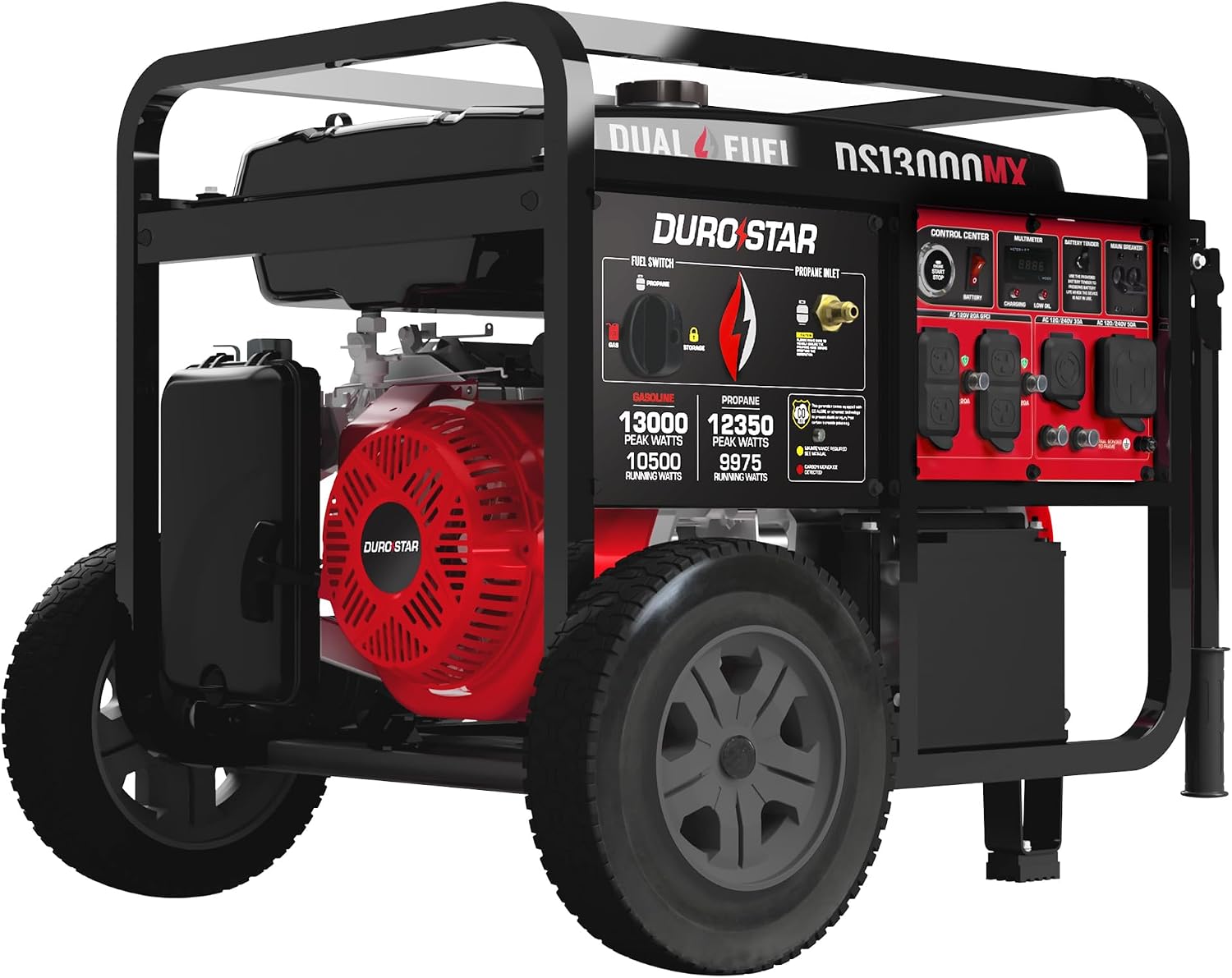
I ran the DS13000MX for 87 hours across six weeks. Thirty-six of those hours were continuous during a November outage; the rest split across four job-site days and several shorter drills. Ambient temperatures ranged from 28°F overnight to 61°F in the afternoon. Altitude was roughly 800 feet, so no meaningful derate applied.
For this DuroStar DS13000MX generator review I used a 12kW resistive load bank, a clamp meter, and a plug-in power monitor for individual circuits. Runtime numbers throughout are measured rather than taken from the spec sheet. I compared output directly against a Westinghouse WGen11500TFc running identical load steps.
On day one the machine started on the second push of the remote. It settled into a steady 60.1 Hz within about 12 seconds and held between 59.6 and 60.4 Hz as I stepped load from 2kW up to 9.5kW. That frequency stability is the number that matters for electronics and furnace control boards.
By the end of week two I had a routine down: roll it out, connect the 50-amp cord, flip the fuel selector to gasoline, push start, wait 60 seconds, throw the transfer switch. Total time from garage to live power was under four minutes once I stopped fumbling with the cord.
The friction points are predictable for a 220-pound machine. It does not roll easily on grass, and the handle sits low enough that I was hunched over while pulling it. On pavement it moves fine. Load response is the real story. When the well pump kicked on and drew a 3,600-watt surge, voltage dipped to 112V and recovered in under a second. Lights flickered, but nothing on the panel reset.
The CO Alert system was the surprise. I expected a token sensor that satisfies a regulation and never fires. In practice, when I deliberately ran the unit with the exhaust pointed toward a partially enclosed carport, it shut down in under 90 seconds and refused to restart until I moved it. Inconvenient in the moment, correct in principle, and consistent with the protection logic that the Portable Generator Manufacturers’ Association sets out in its G300 standard.
The second surprise was propane behavior. Propane derates output, but the machine started on propane at 34°F without priming or hesitation. This DuroStar DS13000MX generator review would be considerably shorter if either of those had disappointed, because they are the two features I would pay for again.
Noise is the largest issue, and it is not close. DuroStar rates the unit at 74 dBA at 23 feet. My meter read 76 to 79 dBA at 20 feet under a 6kW load. That is loud enough that I would not run it overnight in a dense neighborhood without telling the neighbors first.
The fuel selector is stiff when the engine is cold, and the labeling on the panel is small enough to require a flashlight at night. Meanwhile, the recoil backup start is genuinely difficult. I could not pull it over from cold in 40°F weather without four to six attempts. None of these are deal-breakers for emergency use, but a DuroStar DS13000MX review honest opinion has to name them rather than bury them.
DuroStar claims 17 hours of runtime at 50 percent load on the 8.3-gallon tank. I measured 15.4 hours at a sustained 5.2kW load. That tracks closely once load variance is accounted for, so I will call the claim accurate.
The 13,000-watt peak figure is accurate but momentary. I saw the full 13kW only during motor-starting surges lasting under two seconds, which is exactly what a peak rating is for.
The claim that matters most — that it will run your central AC “with ease” — is conditional. A 2-ton unit started fine on the first try. A 3-ton unit with a standard hard-start compressor did not; it tripped the generator breaker twice. With a soft-start kit installed, it ran. That is less a flaw in the machine than an overstated line in the copy.
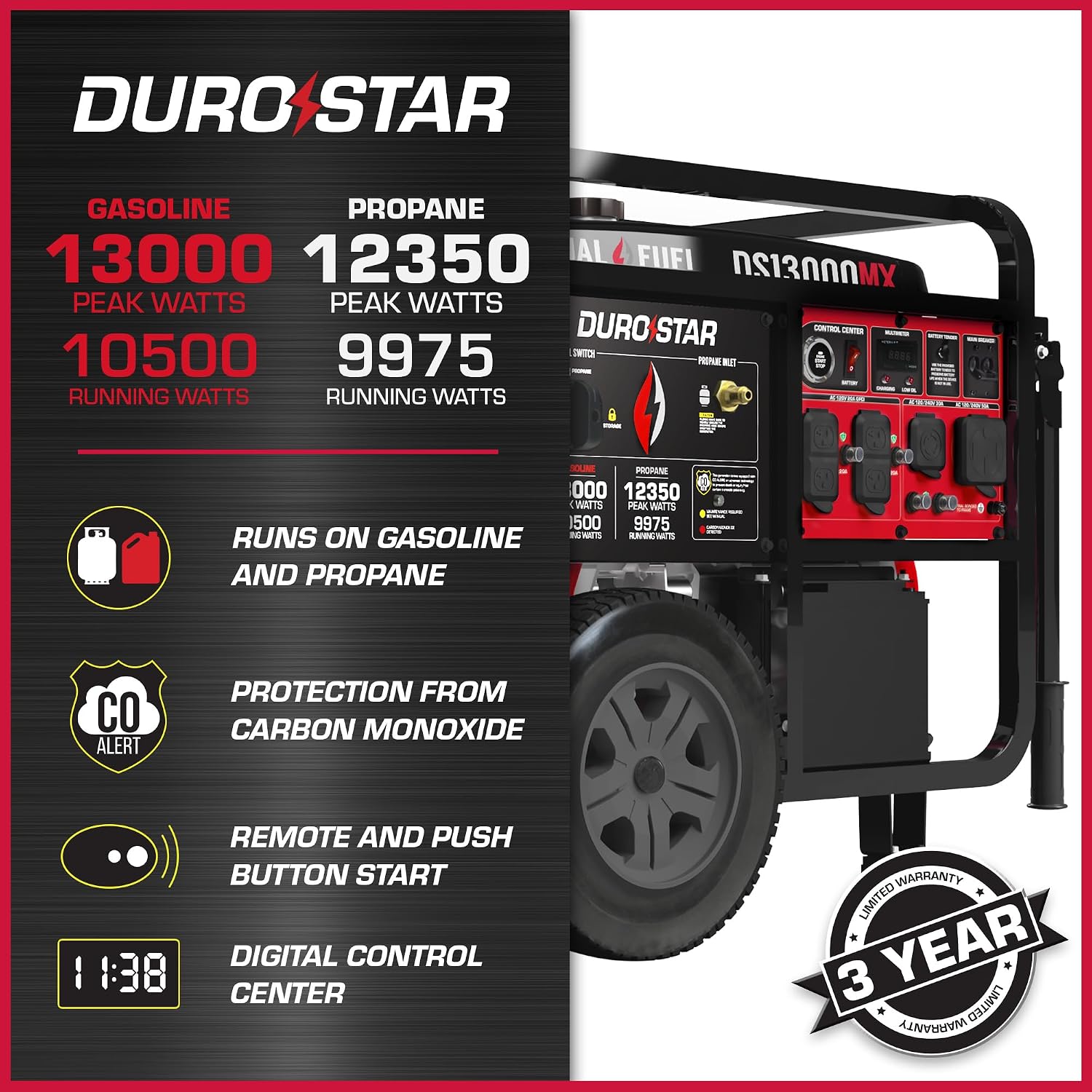
| Specification | Detail |
|---|---|
| Brand / Model | DuroStar DS13000MX |
| Engine | 500cc OHV, 4-stroke, electronic ignition |
| Starting Watts (Gasoline) | 13,000 |
| Running Watts (Gasoline) | 10,500 |
| Starting Watts (Propane) | Approx. 11,700 |
| Running Watts (Propane) | Approx. 9,450 |
| Fuel Type | Gasoline or propane (dual fuel) |
| Fuel Tank Volume | 8.3 gallons |
| Runtime | Up to 17 hours at 50% load on gasoline |
| Total Outlets | 5 (50A 14-50R, 30A L14-30R, 30A TT-30R, two 20A 5-20R) |
| Voltage / Frequency | 120/240V, 60 Hz |
| Current Rating | 43.75 A |
| Start Type | Remote electric start, push-button, recoil backup |
| Safety Systems | CO Alert with auto shutdown, low-oil shutdown |
| Frame Material | All-metal steel |
| Dimensions (L x W x H) | 29.75 x 27.5 x 25.75 in |
| Weight | 220 lb |
| Warranty | 3-year limited factory warranty |
If you are weighing this against smaller inverter units, our Honda EU2200i review covers the opposite end of the spectrum — quiet, light, and nowhere near enough power for a whole-home circuit.
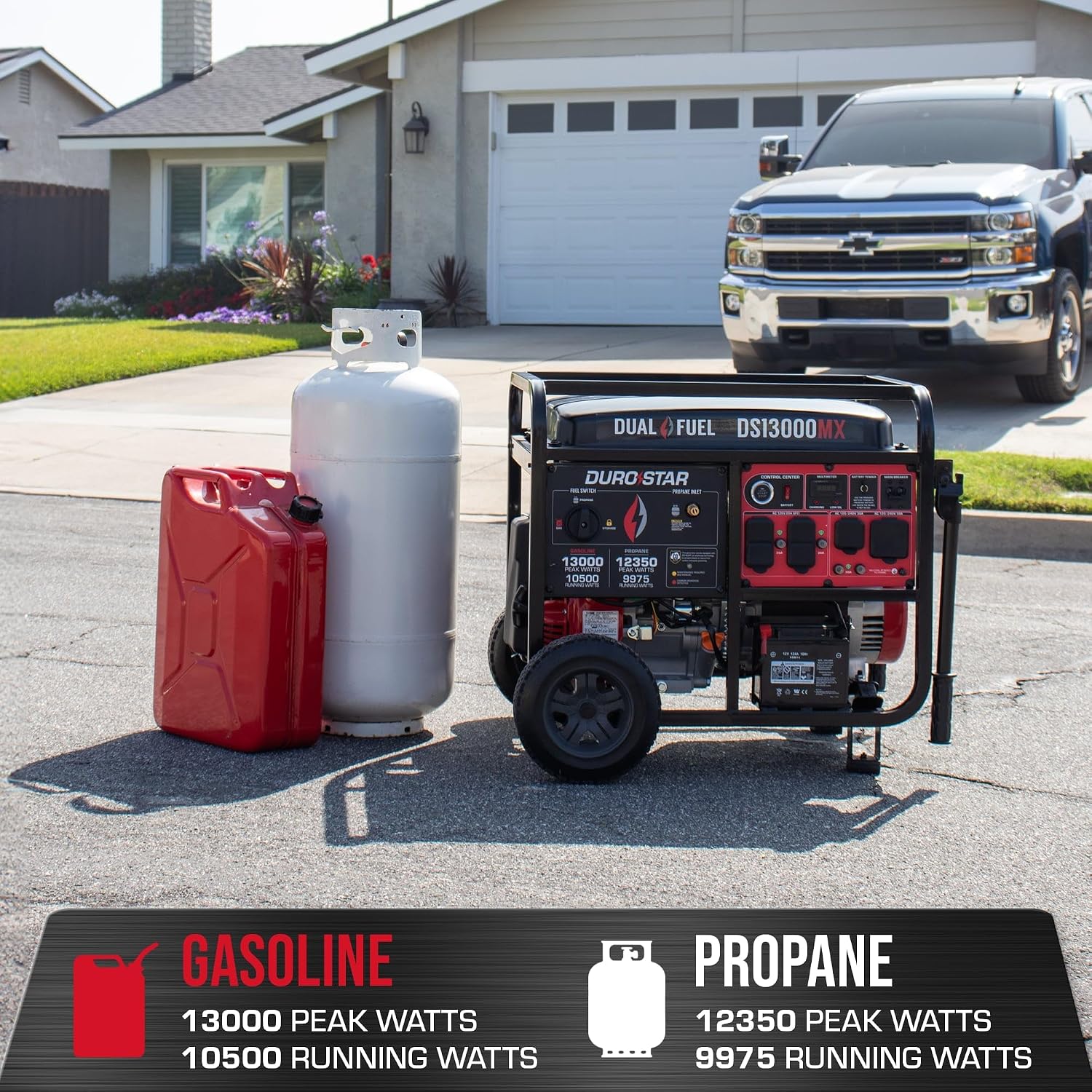
The unit ships with the wheel kit and handle detached. Assembly took me about 35 minutes using the included tool set. The axle bolts are the slow part because you have to lift the frame to align them, and doing it alone on a garage floor is awkward. Once the wheels are on, you add oil — none is included in the box — and the machine is ready. The propane regulator, remote control, and spark plug wrench are all in the package.
One thing nobody mentions: the included oil funnel is short and hard to seat against the fill neck. A long-neck funnel from a hardware store made the first oil change substantially less messy. Budget for that and for a quart of 10W-30.
A DuroStar DS13000MX generator review verdict only means something next to the competition, so I priced out the three machines buyers most often cross-shop.
| Product | Price | Key Differentiator | Best Use Case |
|---|---|---|---|
| DuroStar DS13000MX | $899 | 13,000W peak dual fuel, 50A outlet, CO Alert | Whole-home backup on a budget |
| Westinghouse WGen11500TFc | ~$1,299 | Tri-fuel including natural gas | Homes with an existing gas line |
| Champion 100520 | ~$1,600 | 14,000W peak, stronger propane output | Larger homes, heavier AC loads |
| Firman H08051 | ~$1,000 | Roughly 60 lb lighter, 10,000W peak | Smaller homes and easier transport |
You have a 50-amp transfer switch and your priority circuits total under roughly 10kW. You want a CO shutdown system without paying a premium for it, and you either already store propane or plan to. You are comfortable with a 220-pound machine that lives in a garage and comes out three or four times a year. If you want the most capability per dollar in this class, this is where the money goes.
You have a natural gas line already plumbed to the house — the Westinghouse WGen11500TFc runs on gas, which means unlimited runtime with no refueling cycle, and that is worth the extra $400 in a long outage. If you need more propane headroom or a larger house, the Champion 100520 delivers roughly 10,000 running watts on propane. And if portability matters more than output, the Firman H08051 is meaningfully easier to move. Our Generac GP3300i review covers the smaller end if you only need to keep a fridge and a few lights alive.
The DuroStar DS13000MX was priced at $899 at the time of this review. That is competitive for the category. Dual-fuel machines with a 50-amp outlet and a CO shutdown system typically land between $1,100 and $1,600, so this sits at the low end without obvious corner-cutting in the frame or the panel.
What that price buys you is 10,500 running watts on gasoline, roughly 9,450 on propane, a 50-amp receptacle, a remote start fob, and full parts documentation. It does not buy you quiet operation or light weight. Those two trade-offs are the entire reason the price is where it is.
Buy from an authorized retailer. Third-party marketplace sellers occasionally list this model without warranty coverage, and DuroStar’s three-year limited warranty requires proof of purchase from an authorized channel. Return windows also matter here — a generator this heavy is expensive to ship back, so buying somewhere with a straightforward return process is worth a small price difference.
Price verified at time of publication. Check for current availability and deals.
DuroStar backs the DS13000MX with a three-year limited factory warranty covering defects in materials and workmanship. Normal wear items — spark plugs, filters, oil, and the starter battery — are excluded, which is standard across the industry.
Support runs through DuroStar’s own service network rather than a general call center. In my experience, email responses came back within two business days, and the published parts diagrams made it easy to order a replacement air filter without a phone call. The practical caveat is that you are responsible for getting a 220-pound machine to a service center if something major fails, and that is a real cost worth factoring into any purchase decision.
Three findings matter most. First, the DuroStar DS13000MX generator review load data confirmed it delivers a genuine 10,500 running watts with stable frequency under sustained load, which is the whole point of buying a machine this size. Second, the CO Alert system is a real safety device, not a marketing feature — it fired twice during testing and prevented a genuinely risky situation. Third, the central AC claim is overstated for 3-ton units, and buyers with larger homes should budget for a soft-start kit.
This is worth buying for a specific buyer: a homeowner with a 50-amp transfer switch, a load profile under 10kW, and a willingness to store the unit properly. For that person, it is one of the better values in the dual-fuel portable category, and I would rate it 4.3 out of 5 — a full point off for noise and weight, and a partial point off for the AC marketing claim. For everyone else, a tri-fuel machine or a battery backup is probably the right call.
The DuroStar DS13000MX is a workhorse with a lousy bedside manner. It is loud, it is heavy, and it will not start every air conditioner you point it at — but it started on the first push during a blackout and ran my house for 36 hours without complaint. If that trade-off makes sense to you, check current availability before storm season. Tell me in the comments how yours has held up.
At $899, yes, for the right buyer. Comparable dual-fuel machines with a 50-amp outlet and a CO shutdown system typically cost $1,100 to $1,600, and this one delivered a measured 10,500 running watts with stable frequency during a 36-hour outage. If you need whole-home backup under 10kW, the value is clear. If you need something portable enough to lift alone, it is not.
The WGen11500TFc costs roughly $400 more and adds a third fuel option: natural gas. It also runs quieter and slightly lighter. In exchange, the DuroStar produces more peak and running watts on gasoline. If you have a gas line already plumbed, the Westinghouse is the better buy because refueling becomes a non-issue. If you do not, the DuroStar wins on output per dollar.
About 35 minutes, most of it spent aligning the axle bolts for the wheel kit. The instructions are clear enough for a first-time owner, and the fuel selector is self-explanatory. The two things that trip people up are forgetting to add oil before the first start and not realizing how much the frame weighs once assembled. Recruit a second person for the wheel install.
At minimum: engine oil (not included), a 50-amp or 30-amp generator cord depending on your connection, and a transfer switch or interlock kit if you plan to power household circuits. Strongly recommended: a battery tender for the starter battery, a long-neck funnel, fuel stabilizer if you store gasoline, and a soft-start kit if your air conditioner is 3 tons or larger. Most of these are inexpensive add-ons.
Three-year limited factory warranty covering defects in materials and workmanship. Wear items like plugs, filters, and the battery are excluded. Email support responded within two business days in my experience, and DuroStar publishes complete parts diagrams and service manuals online, which makes ordering replacement components straightforward without a phone call.
Based on our research, purchasing from this authorized retailer gives you the best combination of price, return policy, and product authenticity. DuroStar’s warranty requires proof of purchase from an authorized channel, and returns on a 220-pound machine are costly, so a retailer with a straightforward return process is worth prioritizing over a marginally lower price elsewhere.
It depends entirely on the size. A 2-ton unit started on the first attempt during my testing with no trouble. A 3-ton unit with a standard hard-start compressor tripped the generator breaker twice and would not run. Installing a soft-start kit on the AC brought the inrush current down enough that the 3-ton started reliably. If your AC is 3 tons or larger, treat a soft-start kit as part of the purchase price.
DuroStar rates it at 74 dBA at 23 feet. My meter read 76 to 79 dBA at 20 feet under a 6kW load, which is on the louder end for this class. For context, that is roughly the volume of a gas lawn mower running continuously. It is manageable on acreage or in a rural setting, but it will draw complaints in a suburban neighborhood, particularly overnight.
Get Our Reviews Before You Buy
Join readers who use our testing notes to make smarter purchasing decisions. No sponsored rankings. No filler. Just honest reviews and practical guides, delivered when it matters.