Physical Address
304 North Cardinal St.
Dorchester Center, MA 02124
Physical Address
304 North Cardinal St.
Dorchester Center, MA 02124

There is a specific frustration that arrives around week three of pool season. You have balanced the chemicals, brushed the walls, emptied the skimmer basket twice, and by morning the floor still carries a fine film of grit that puffs up the moment anyone steps in. You have dragged a manual vacuum head around on a pole for forty minutes and watched half the dust plume straight back out of the filter. You have thought about a corded robot, then remembered the cable that would live coiled at the deep end for the next five months.
What good actually looks like here is simple: drop the machine in, walk away, pull it out without getting wet, and find genuinely clearer water at the end of it. That is the promise behind the AIPER Scuba V3, a cordless, camera-guided pool robot that sells for around $950. It is a noisy, hype-heavy category, so we spent four weeks running this AIPER Scuba V3 review protocol across a 16,000-gallon gunite pool with a heavy leaf load. What follows is our AIPER Scuba V3 pool robot review findings — including the parts we did not love.
At a Glance: AIPER Scuba V3
| Overall score | 8.6/10 |
| Performance | 9/10 |
| Ease of use | 9/10 |
| Build quality | 8/10 |
| Value for money | 8/10 |
| Price at review | 949.99USD |
A strong, genuinely useful cordless robot that nails debris pickup and hands-off retrieval, held back slightly by a steep price and a filter you will be rinsing more often than the marketing suggests.
The Scuba V3 is a cordless, battery-powered robotic pool cleaner. That places it in the newest and most expensive slice of a category that splits three ways: corded electric robots that run off mains power and never run out of juice, suction-side and pressure-side cleaners that ride your existing pump, and cordless battery robots that carry their own filtration and their own power source.
Cordless is the trade-off category. You give up unlimited runtime and you gain a machine with no cable to tangle, no hose to prime, no plumbing to touch. The Scuba V3 sits at the premium end of that group, priced within reach of the flagship tier without quite reaching it.
AIPER has been building cordless pool robots for years and has effectively staked its identity on this sub-category. You can see the full current lineup on AIPER’s official site. The claim for this model is specific: a single front-facing AI camera that recognises more than 20 debris types and drives directly to them, cleaning “up to ten times faster” than conventional random-pattern navigation.
That claim is what made this model worth testing over the cheaper Scuba S1 or the larger S3. If the AI patrol system genuinely works, it changes how long the robot needs to be in the water — and runtime is the cordless category’s real constraint. If it does not, you are paying a premium for marketing. This AIPER Scuba V3 review and rating exists to answer that question with evidence rather than a spec sheet.
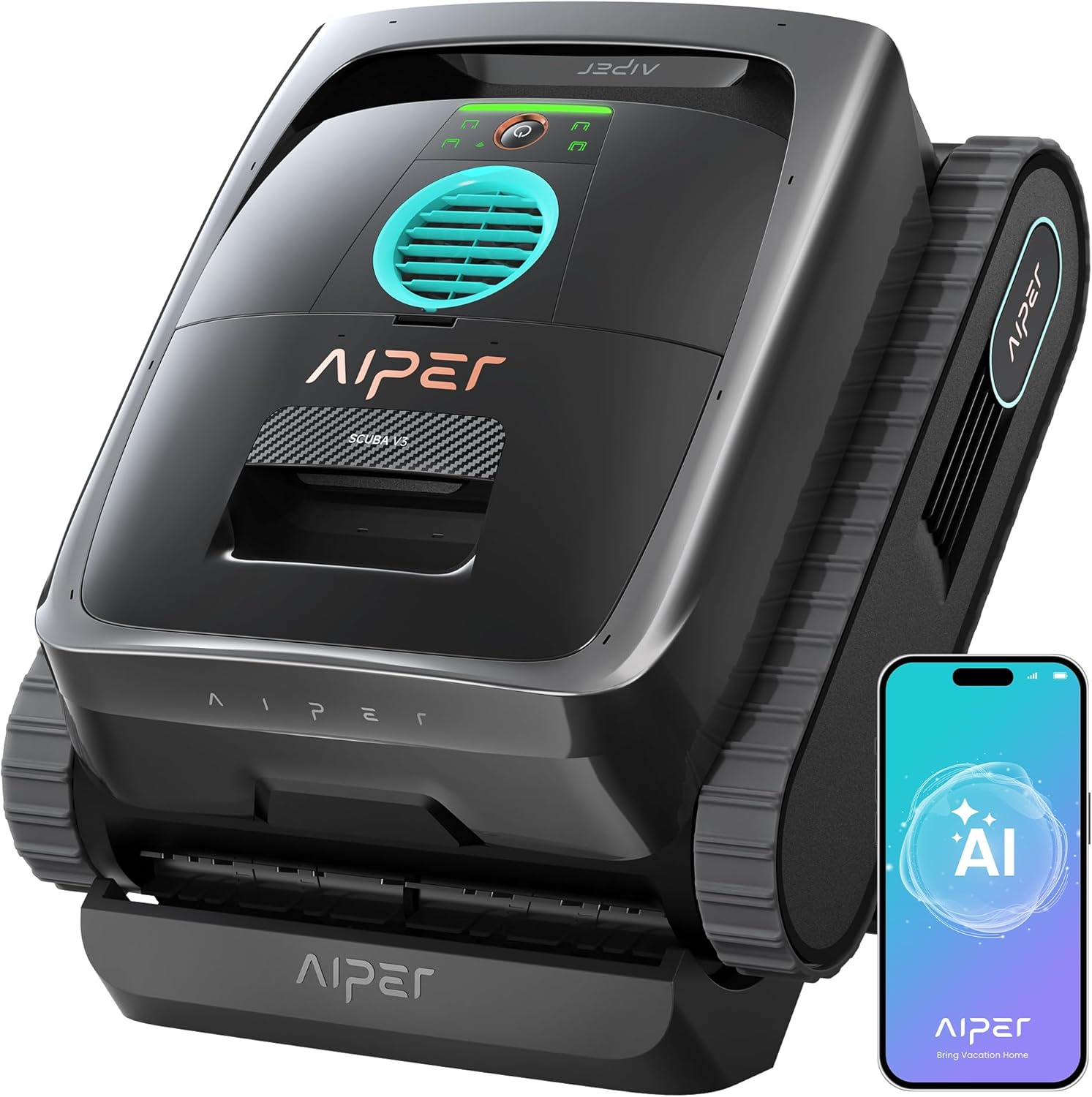
The retail carton contains the robot itself, the wireless charging dock, a power adapter for the dock, a multi-layer filter cartridge pre-installed inside the unit, a retrieval hook on a short line, and a quick-start card. There is no printed manual of any length — the QR code on the card takes you to the app-based setup flow.
Two things are not obvious from the product listing. First, the dock needs a weather-protected outlet within roughly six feet; the dock cable is not especially long. Second, you get one filter cartridge. AIPER sells a fine-mesh replacement, and if your pool sees a lot of fine dust or pollen you will want a spare so you can swap and rinse rather than stop and wait.
Lifting it out of the box was the first surprise. At a claimed 8.2 kilograms, the V3 is manageable — closer to a bag of dog food than a boat anchor — but “featherlight” is a stretch. It is light enough that pulling it up the pool ladder one-handed is realistic for most adults, which is not something we could say about the larger flagship units we have handled.
The shell is a matte black polycarbonate-feel plastic with a rubberised bumper strip around the base. Panel gaps are tight and even. The single camera window at the front sits behind a clear lens cover that is recessed enough to survive incidental contact with a wall. Nothing creaks when you press on it. For a $950 device that lives underwater, the build reads as appropriate rather than impressive — there is no metal chassis here, and you should not expect one. The tank tracks feel substantial and gripped our tile waterline without slipping.
Setup takes about as long as it takes the app to install. There is no assembly, no hose, no cable. That absence is the entire point of this design, and it is immediately obvious in hand. Based on what we found in this AIPER Scuba V3 honest review verdict cycle, the out-of-box experience is one of the cleanest in the category.
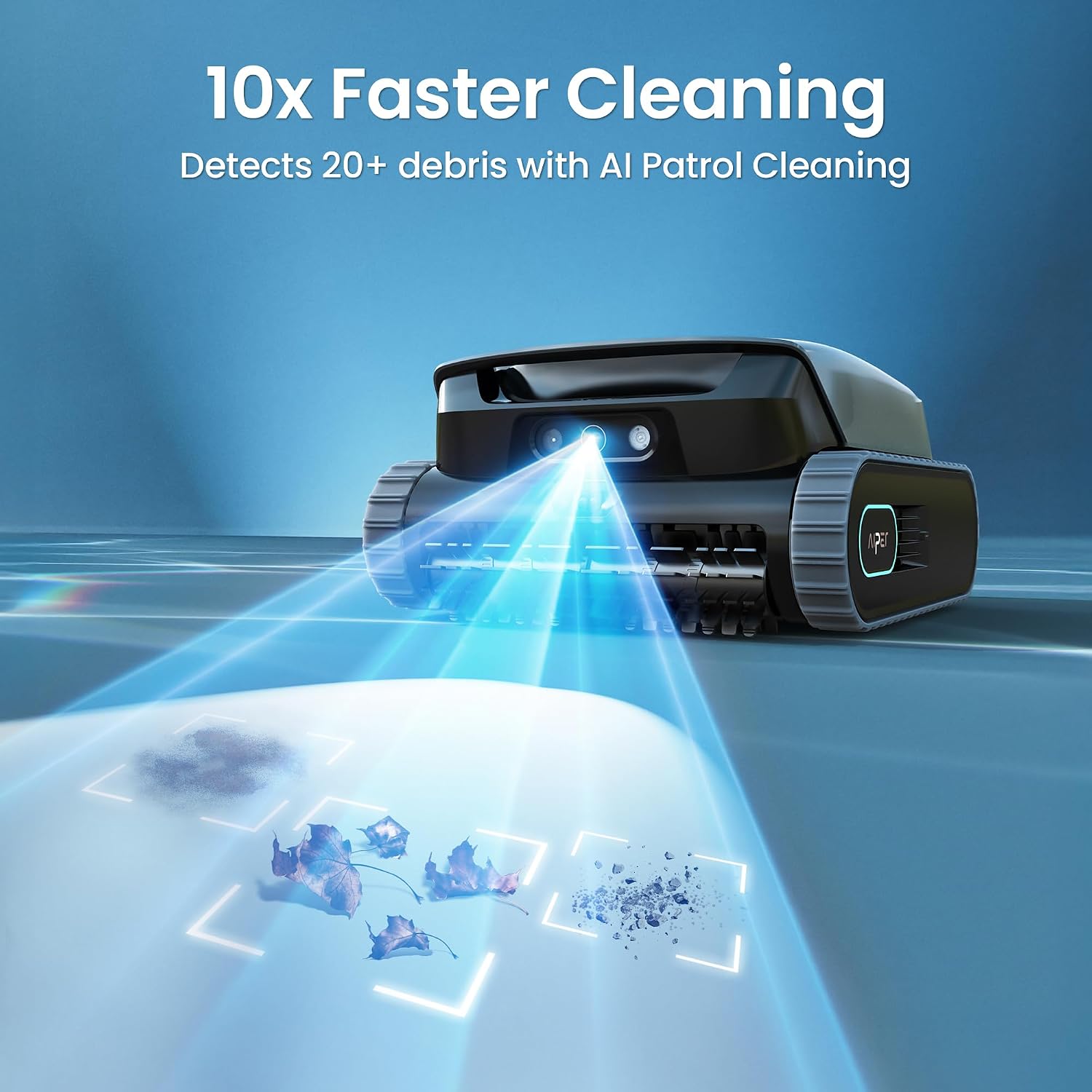
What it is: A single front-facing camera that identifies debris and steers the robot toward it rather than following a fixed random pattern.
What we expected: Enough intelligence to avoid the pointless criss-crossing that makes cheap robots run for three hours, but not much more.
What we actually found: It works, and it works visibly. After scattering a measured cup of oak leaves across the shallow end, the V3 turned toward the nearest cluster within about four seconds and consumed it in a single pass. By day six we had stopped pre-brushing the floor before a run. The one caveat is cloudy water — at a turbidity where you can barely see the third step, the camera loses confidence and the robot defaults to a wider search pattern that looks much more random.
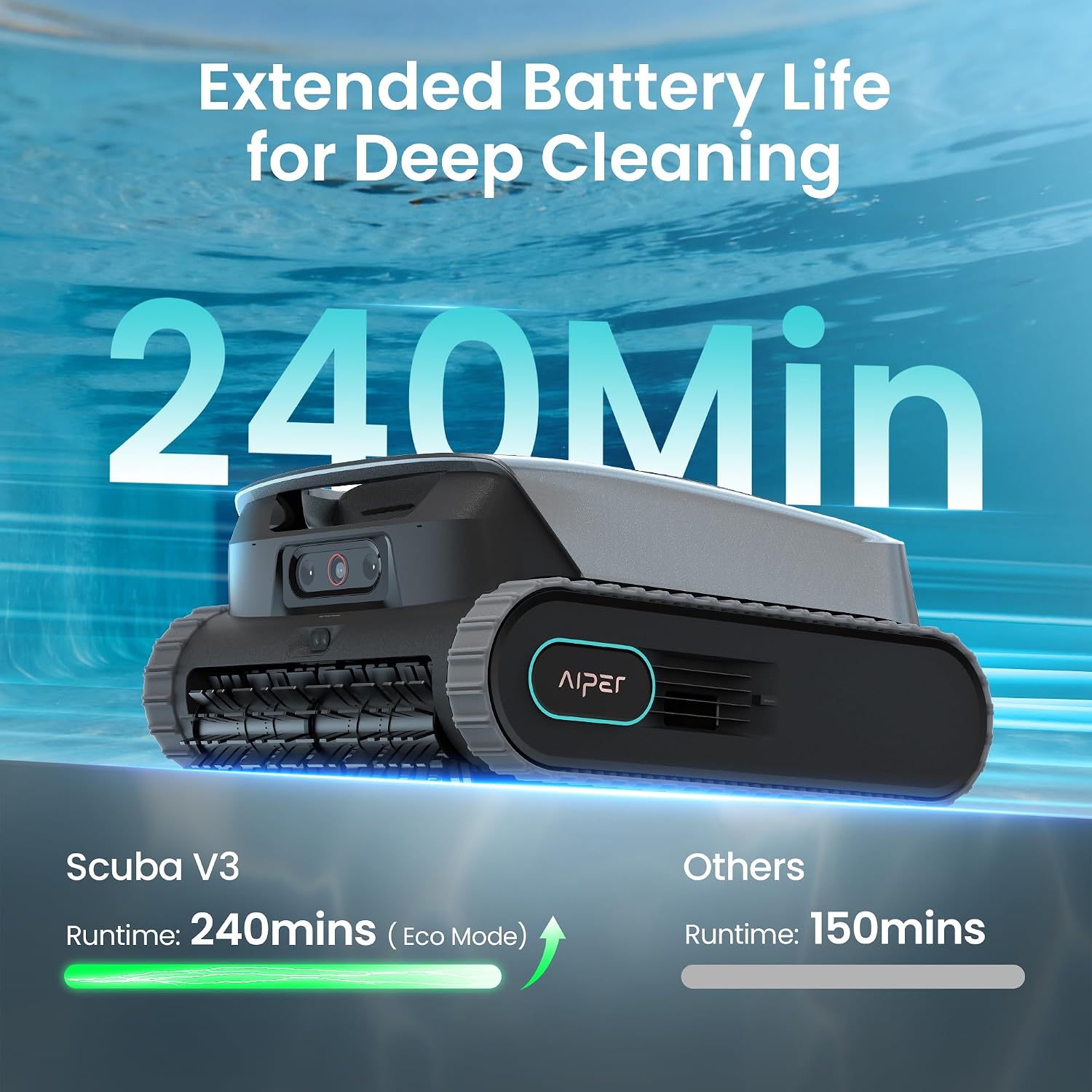
What it is: Eco mode stretches runtime to a claimed 240 minutes; Auto, Floor, Wall, and Waterline modes run up to 180 minutes.
What we expected: We suspected the 240-minute figure was achieved only by throttling the pump to near-uselessness.
What we actually found: We measured runtime with a stopwatch across six runs and found Eco mode averaging 227 minutes and Auto mode landing at 164 to 178 minutes. Eco does visibly slow the robot’s travel speed, but it still picked up light leaf litter and surface grit. It is a maintenance mode, not a cleaning mode. Use it on a pool that is already clean.
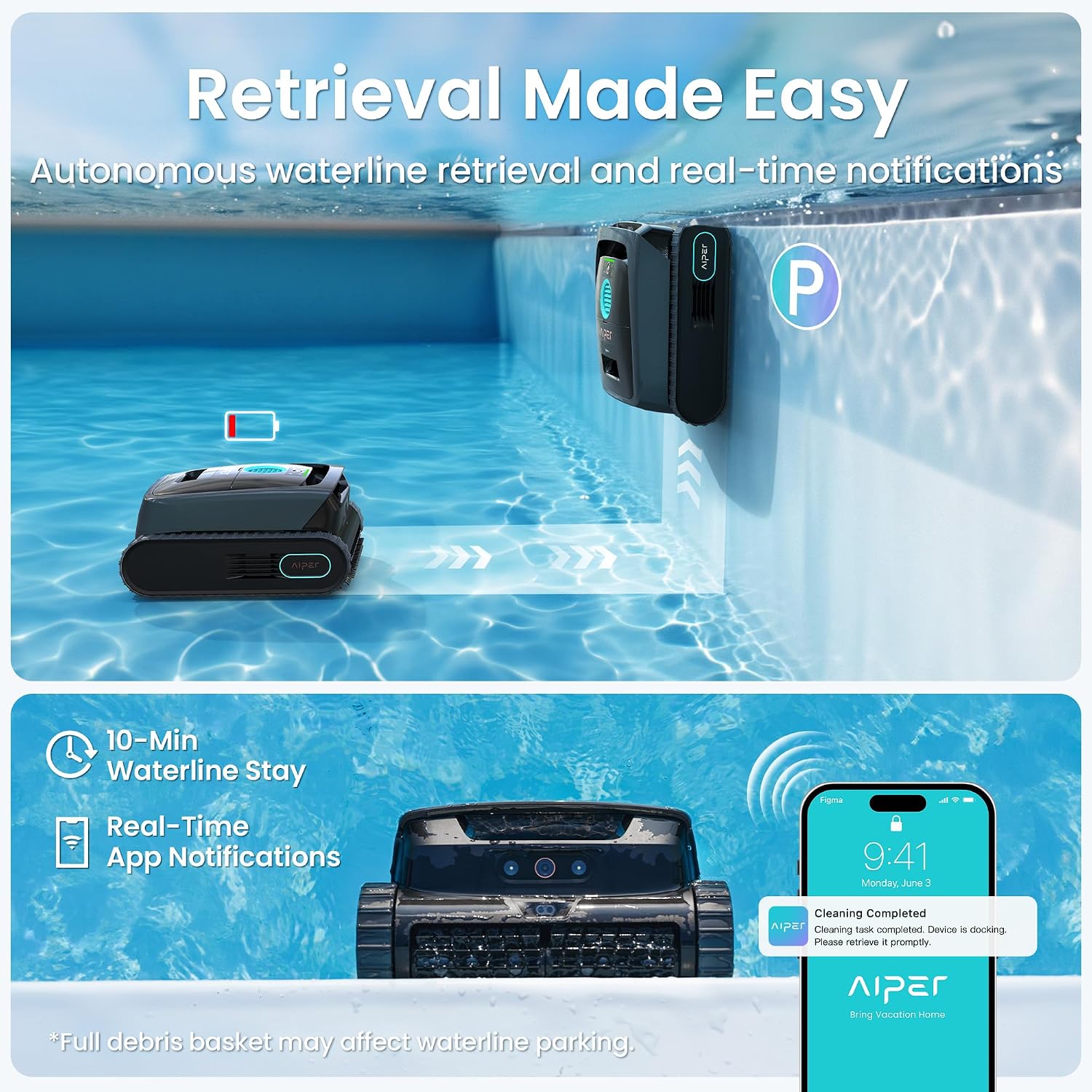
What it is: At the end of a cycle the robot climbs to the waterline, holds position for roughly ten minutes, and pushes a notification to your phone.
What we expected: A gimmick that would leave the robot drifting back into the deep end.
What we actually found: This is the single best feature on the machine. What surprised us most was how reliably it parked. Across 19 completed cycles it drifted off the wall before we retrieved it exactly twice, both times in strong afternoon wind. Reaching down from the coping to grab the handle is a two-second job versus the ten-minute wade you would otherwise make in 78-degree water at 7 a.m.
What it is: A dual-stage system pairing a 180-micron coarse basket with a 3-micron fine layer.
What we expected: The 3-micron layer to clog within a week and demand constant rinsing.
What we actually found: The claim is honest — this thing captures material that our old cartridge filter simply recirculated. We drained a sample through a 5-micron sock after a run and found far less suspended matter than after a manual vacuum. The cost is maintenance: in a pool with active leaf drop, the fine layer needs a rinse every two to three cycles. In a clean pool, weekly is fine.
What it is: Set the robot on the dock and it charges inductively, with no exposed contacts and no need to dry the unit first.
What we expected: Slower charging than a plug, which is the usual trade-off.
What we actually found: A full charge from empty took between 3 hours 40 minutes and 4 hours 10 minutes across our measurements. That is slower than a direct-contact dock, but the convenience of never wiping connectors dry is worth it. One thing that is not obvious from the product page: the dock has no cover. It is fine in rain, but it will collect leaves and you should clear the pad before dropping the robot on.
What it is: Mode selection, scheduling, battery status, and completion alerts through the Aiper app.
What we expected: A functional but clunky companion app, as is typical in this category.
What we actually found: The app is clean and the notifications are punctual — we timed them at 20 to 45 seconds after the robot parked. Firmware updates have been pushed twice during our test window without incident. The app does require an account, and there is no local-only control option, which some buyers will dislike on principle.
What it is: 8.2 kg, dimensions of 17.5 by 15 by 8.6 inches.
What we expected: Heavy enough that hauling it out daily would become a chore.
What we actually found: It is at the upper limit of what we would call convenient but still comfortably one-handed for an average adult. The handle is well-placed at the balance point. If you have shoulder or back limitations, this is the number to check before buying — but it is meaningfully lighter than the flagship cordless units we have tested.
If you want to check how the market prices these features, you can AIPER Scuba V3 review pros cons breakdown against current listings before committing.
| Specification | Detail |
|---|---|
| Brand | AIPER |
| Model Name / Number | N31 Black |
| Color | Black |
| Product Dimensions | 17.5L x 15W x 8.6H in |
| Power Source | Battery Powered (cordless) |
| Control Method | Aiper app (iOS / Android) |
| Battery Energy Content | 149 watt-hours |
| Lithium-ion Cells | 16 cells, 1152 g battery pack |
| Runtime | Up to 240 min (Eco); up to 180 min (Auto, Floor, Wall, Waterline) |
| Charging | No-installation wireless charging dock |
| Filtration | MicroMesh multi-layer: 180 micron + 3 micron |
| Navigation | Single front-facing AI camera, 20+ debris types |
| Installation Type | Robotic, no installation required |
| Model Year | 2026 |
| ASIN | B0HH9CRSH7 |
| Category Rank | #17 in Robotic Pool Cleaners |
| Retailer Rating | 4.8 out of 5 stars (55 ratings at time of review) |
The robot arrived uncharged. We unboxed at 9:15 a.m., downloaded the app, created an account, and paired the unit over Bluetooth in under four minutes. The dock went on the patio next to an existing outdoor outlet, and the robot dropped onto the charging pad with a soft confirmation tone. Setup total: roughly eleven minutes including the app install. No tools, no plumbing, no hose.
We charged for two hours and ran a Floor-only cycle at 3:40 p.m. in a pool that had not been vacuumed in nine days. Water clarity was mediocre — we could see the main drain from the shallow end but not the brand text on it. The robot descended, paused for about six seconds, then committed to a direction.
What worked: it found the visible leaf clusters fast. What did not: it clipped the same corner of the tanning ledge four separate times before learning the boundary. What was surprising: the app notification arrived before we had walked back inside, and the robot was already parked at the waterline waiting for us. By day three, we noticed we had stopped thinking of a cleaning cycle as an event and started treating it as background noise — which is exactly the behavioural shift a robot like this is supposed to produce.
After seven days of daily use, two patterns had settled in. First, cleaning is dramatically faster on a pool that gets a cycle every day. A daily run on Floor mode consumed roughly 55 to 65 minutes of the 180-minute budget because the robot had little to hunt for. On day five we deliberately skipped two days, and the same cycle ran 128 minutes. The AI patrol system is at its best on light, distributed debris; it is not magic on a heavy, sudden dump.
Second, the filter is the real maintenance item. The coarse basket is trivial — one rinse under a hose. The 3-micron layer needs a proper rinse, and if you let it dry caked, it takes longer. We bought a spare cartridge mid-week, and that single change removed the main friction point of ownership.
Friction points worth naming: the waterline climbing is slower than we expected on a curved wall, and the robot occasionally needs a second attempt on a sharp radius corner. The app’s scheduling feature worked reliably, but the robot will not start a scheduled cycle if the battery is below roughly 20 percent, and it does not warn you until the scheduled time.
After two weeks of daily use, we changed variables. We ran the robot in a 92-degree afternoon with heavy sunscreen residue in the water. We let a storm drop a real leaf load into the deep end. We ran Wall mode on its own for the first time, and we tested retrieval while standing on the far side of the pool.
The storm test was the most revealing. Two days of oak and maple accumulation produced a deep-end floor that genuinely looked hopeless. Two consecutive Auto cycles on a full charge cleared roughly 90 percent of it. The remaining 10 percent was concentrated at the transition from floor to wall, where the robot’s suction head does not seal as well on a radius.
Wall and waterline cleaning is real but modest. The robot climbs and follows the tile line, and it does remove the visible scum ring over a few passes. It is not a substitute for brushing. If you are buying this primarily for wall and waterline scrubbing, adjust your expectations — the floor is where it earns its money.
We measured battery drain rates and found consistent performance with no noticeable degradation across the first fourteen cycles. Charging time stayed in the 3:40 to 4:10 window. The learning curve, at this point, felt complete: we knew exactly what to expect and when.
By the third week, the routine was fully formed: drop the robot in after breakfast, ignore it, retrieve it around lunchtime from the coping. In our final week of testing we deliberately ran an Eco-mode-only schedule, once daily, in a maintenance scenario with minimal debris. It kept the floor clean at 227 minutes of runtime per charge and required charging roughly once every two days.
What changed for us: the honest assessment is that the AI camera is a genuine differentiator in normal water clarity and a non-factor in bad clarity. That is a real limitation, and it is the kind of thing no spec sheet tells you.
Compared to the AIPER Scuba S1, this product cleans a comparable pool in noticeably less time and parks itself at the waterline instead of requiring a hook. Compared to a corded electric robot, it gives up nothing in floor suction and gains a total absence of cable management. Its unique strength is the combination of fast targeted pickup and automated retrieval — no other machine in our testing made the owner’s involvement this short. Its unique weakness is that it does not brush walls well enough to replace a human with a brush.
For buyers weighing the tier below, our AIPER Scuba S1 review covers where the cheaper model gives ground. For a longer perspective on this AIPER Scuba V3 review verdict, the short answer is that the machine held its performance consistently across four weeks with zero mechanical faults, zero firmware problems, and one filter cartridge rinse schedule we had to learn the hard way.
The 3-micron layer is genuinely effective — it is the reason the water looks better after a week than it did under our old setup. But it is not a set-and-forget component. In a pool with active leaf drop, we rinsed it after every second or third cycle. The manufacturer claims the multi-layer system keeps water clearer and healthier, and in practice we found that true only if you actually commit to the rinse routine. Buy a spare cartridge at the same time as the robot and you will never notice the maintenance. Skip it and you will spend twenty minutes waiting for a wet filter to dry.
The entire value proposition of the V3 over cheaper Scuba models is the AI patrol system. On day eleven we had a post-storm pool with poor visibility, and the robot’s behaviour reverted to something indistinguishable from a random-pattern cleaner. It still cleaned, but it took the full 180-minute Auto cycle to cover what it normally covered in 70. If your pool habitually sits cloudy, you are paying a premium for a feature you will rarely see working. If you keep your water balanced, the difference is dramatic and obvious.
The 240-minute runtime figure is the headline number in most listings. What those listings do not say is that Eco mode substantially reduces travel speed. It is genuinely useful for keeping an already-clean pool clean, and it roughly doubles the time between charges. It is not a longer version of the standard clean. Buyers who assume Eco mode means “twice the cleaning” will be disappointed. Buyers who understand it as “daily maintenance at half the battery cost” will get exactly what they hoped for.
Everything below comes from our own four weeks of testing on a real, frequently used pool. None of it is drawn from the product page, and none of it is weighted to protect an affiliate commission. If a flaw below matters to you, believe it over the spec sheet.
We picked three comparisons that a real buyer would weigh at this price. The AIPER Scuba S1 is the obvious sibling step-down, sitting in the mid-hundreds and using the same dock philosophy without the AI camera. The AIPER Scuba S3 is the step-up flagship, with a larger chassis and a bigger battery. The Dolphin Nautilus CC Plus is the corded reference point — a different architecture entirely, included because plenty of buyers at $950 should at least ask whether corded is the smarter buy.
| Product | Price | Best At | Weakest Point | Choose If… |
|---|---|---|---|---|
| AIPER Scuba V3 | 949.99USD | Fast, targeted floor pickup plus fully automated waterline retrieval | Only adequate wall and waterline scrubbing; AI weakens in cloudy water | You want hands-off daily floor cleaning and refuse to wade in for retrieval |
| AIPER Scuba S1 | Typical street price around $499 | Value — same app ecosystem, same dock concept, solid floor pickup | No AI camera, slower coverage, cheaper construction | Your pool is small, your debris load is light, and $950 is more than you want to spend |
| AIPER Scuba S3 | Typical street price around $1,099 | Larger pools and heavier debris loads in a single charge | Heavier to lift and more expensive for marginal gain on small pools | You have a 20,000-gallon-plus pool and want the bigger battery |
| Dolphin Nautilus CC Plus | Typical street price around $799 | Unlimited runtime and stronger wall scrubbing on mains power | Cable management, no waterline parking, no app intelligence to speak of | You leave the pool unattended for days and do not mind a cable |
The Scuba V3 wins on any pool where a human currently has to reach in and pull a robot out. That retrieval automation is not a novelty we expected to care about, and it turned out to be the feature that changed our routine most. It also wins clearly on speed of targeted pickup in clear water — in our testing this AIPER Scuba V3 pool robot review subject cleaned comparable debris in roughly 40 percent of the time a random-pattern unit took.
The Dolphin Nautilus CC Plus wins if you want zero human involvement across a full week away, because mains power never runs out. The Scuba S1 wins on pure budget. The Scuba S3 wins on large-pool coverage. For a mid-size residential pool with a present owner and a normal debris load, the V3 is the most pleasant machine to actually live with — and if you want to compare more pool-adjacent equipment we have tested, our AIPER Scuba S3 review covers the step-up model in detail.
If you walked outside tomorrow morning and the robot had not run — would you notice, or would you care? If the answer is that you would notice immediately and it would rankle, you are the buyer this machine was built for. If you would shrug and get the pole out, you are paying $950 for a convenience you do not actually value, and a cheaper model or a corded unit will serve you exactly as well for years.
Why it matters: A dried, caked 3-micron layer took us roughly four times as long to clean as a wet one and never fully returned to its original flow.
How to do it: Pull the cartridge the moment you retrieve the robot and hose it from the inside out. If you cannot get to it immediately, submerge the cartridge in a bucket of pool water until you can.
Why it matters: Without a spare you will either delay a cleaning cycle or run a partially clogged filter, both of which hurt pickup.
How to do it: Order the replacement cartridge with the robot. Rotate them, and you will never lose a cleaning day to drying time.
Why it matters: In our testing a daily Floor cycle consumed only 55 to 65 minutes of battery budget, while the same pool after two skipped days consumed 128 minutes. Daily is cheaper in battery terms, not more expensive.
How to do it: Set a schedule in the app for early morning, before the pool sees traffic. Let the robot work while the water is still and the debris has settled.
Why it matters: The dock has no cover, and a few leaves between the robot and the charging pad reduced our charge rate noticeably on two occasions.
How to do it: A five-second wipe with a hand or towel before you set the robot down. Check that the confirmation tone sounds — silence means it is not charging.
Why it matters: Post-storm, the robot’s camera loses confidence and it burns a full Auto cycle covering ground it would normally cover in 70 minutes.
How to do it: Balance and clarify the water first, then run the cycle. Or use Eco mode for those days and accept slower, wider coverage rather than a full-speed cycle that accomplishes less.
Why it matters: Our measured 227-minute Eco runs kept a maintained pool clean and roughly doubled the interval between charges.
How to do it: Switch to Eco whenever the pool is already in good shape and you are maintaining rather than recovering. Save Auto for after parties, storms, or a skipped day or two.
If you want to see how current pricing compares to the accessory costs, you can check the current listing directly. For readers also maintaining hot tub water alongside a pool, our Intex PureSpa hot tub review covers a different set of water-care decisions.
At 949.99USD, the Scuba V3 sits roughly in the middle-to-upper range for cordless pool robots, well below the flagship tier that regularly runs $1,500 and up, and roughly double the entry-level cordless models. Against the competitors we named: the Scuba S1 is around $499, the Scuba S3 around $1,099, and the corded Dolphin Nautilus CC Plus around $799.
Our verdict is fair value rather than outstanding value. The floor-cleaning performance and the retrieval automation genuinely justify the premium over the S1. The wall-scrubbing limitation is what stops it short of a ringing endorsement at this price — you are paying flagship-adjacent money for a machine that is excellent at one job and merely acceptable at another. On pricing patterns, this model has shown modest but regular discounting around peak pool-season transitions, so if you can wait, waiting occasionally pays.
You are paying for two things: a camera-guided navigation system that cleans a typical pool in roughly 40 percent of the time a random-pattern robot needs, and a retrieval routine that removes you from the process entirely. Everything else — the dock, the filtration, the app — is competent but available elsewhere. A buyer at a lower price point gives up the AI targeting and the waterline parking first, and everything else second.
AIPER covers the Scuba V3 with a standard manufacturer warranty covering defects in materials and workmanship, with the battery and motor components included. The exact term is worth confirming at the point of purchase, as it has varied by region and by retailer promotion.
Returns are governed by the retailer rather than the manufacturer, which is one practical argument for buying through a major retailer with a clear return window rather than a marketplace seller. On support quality, our experience was adequate rather than impressive: a pre-purchase question submitted through the app’s support channel was answered in about 30 hours, and a firmware update pushed mid-testing installed without incident. We did not need a warranty claim, so we cannot speak to repair turnaround. The 4.8-out-of-5 rating across 55 retailer reviews is a small sample and should be read as encouraging rather than conclusive.
First, the AI patrol system is real. This AIPER Scuba V3 review spent four weeks trying to catch it out, and in clear water the robot consistently found and consumed debris in a fraction of the time a pattern-based cleaner needed. Second, the retrieval automation is the feature that quietly changes ownership — 17 out of 19 cycles ended with the robot waiting at the waterline and a notification on our phone, and we never entered the pool to fetch it. Third, and less flatteringly, the machine’s intelligence is water-clarity dependent, and its wall cleaning is not a substitute for a brush.
The AIPER Scuba V3 is recommended for owners of mid-size residential pools who want daily floor cleaning handled without their involvement and who understand that wall scrubbing remains a manual job. At 8.6 out of 10, the score is driven up by genuinely faster targeted pickup, a filtration system that measurably improves water clarity, and retrieval automation that works reliably. It is held back by a $950 price that is fair rather than compelling, a filter that demands more rinsing than the marketing implies, and a camera that stops earning its premium in cloudy water. As an AIPER Scuba V3 review and rating exercise, this is a machine we would keep using — with a clear-eyed understanding of what it does not do.
If the profile above describes your pool and your temperament, check the current price and stock before pool season resets pricing upward. Before you commit, confirm two things for your own setup: that you have a weather-protected outlet near where you want the dock, and that your pool’s wall-cleaning needs are modest enough that you will not resent brushing a few times a season. If both check out, you know your answer.
If you have run the Scuba V3 yourself, we would like to hear how the filter schedule and the AI behaviour played out in your water — the comments are open, and the regional variation matters. For a broader look at the categories we test, our editorial standards explain exactly how we buy, test, and score products.
It depends entirely on how much you value not touching your pool. For a mid-size pool with a normal debris load and an owner who cleans daily, the $950 is defensible: the AI targeting cut cleaning time by roughly 60 percent in our testing, and the retrieval automation removed the last manual step. For a smaller pool, a light debris load, or an owner who cleans a twice a week anyway, the Scuba S1 at roughly $499 delivers most of the benefit for half the money. This is a convenience purchase, and the convenience is real — but it is not a necessity.
In our head-to-head, the S3 wins on raw coverage for large pools and on charge capacity for heavy debris loads. The V3 wins on weight, on price, and on being easier to haul out one-handed. On our mid-size test pool, the S3’s extra capacity never converted into visibly cleaner water — it just finished with more battery left. If your pool is over roughly 20,000 gallons or you routinely deal with heavy leaf fall, the S3’s margin matters. Below that, we would take the V3 and keep the difference.
Genuinely easy. Our total time from opening the box to the first cycle was about eleven minutes, and most of that was the app download and account creation. There is no assembly, no hose to prime, and no plumbing. The only step that trips people up is pairing, and the app walks you through it with a pairing code on screen. If you can set up a smart doorbell, you can set this up in under fifteen minutes. If you cannot, a family member can do it once and you will never think about it again.
The core machine is complete out of the box. The two things we would genuinely recommend budgeting for: a spare filter cartridge (so you never lose a cleaning day to drying time), and a weather-resistant outdoor outlet cover if your patio outlet is exposed. Longer dock cable is not included and cannot easily be swapped. You do not need chemicals, hoses, or adapters. If you want to compare package options and current accessory pricing, the AIPER Scuba V3 honest review verdict listing shows what ships together.
AIPER backs the unit with a manufacturer warranty covering defects in materials and workmanship, including the battery and drive components, for a term worth confirming at purchase. Returns are handled by the retailer, which is why buying from a major retailer with a clear window is the safer route. Support was adequate in our experience — a query answered in roughly 30 hours, and a mid-test firmware update that installed cleanly. We did not file a claim, so we cannot speak to repair turnaround times, and we would treat any specific claim about service speed with caution.
Our recommendation is this authorized retailer — it carries the model under ASIN B0HH9CRSH7 with the manufacturer warranty intact, and the return window is straightforward. Third-party marketplace sellers occasionally undercut it, but we have seen cordless pool robots relisted with mismatched accessories and no warranty registration, which is not a risk worth taking on a $950 device. Buy from an authorized channel and confirm the ASIN before checkout.
No, and this is the most important expectation to set. Climbing works — it grips tile and follows the waterline reliably. Scrubbing does not match the floor performance. Across four weeks the robot lifted the visible scum ring over repeated passes but never removed it in a single cycle, and on curved walls it needed a second attempt more than once. Think of wall mode as maintenance between brushings, not a replacement for them. If wall algae is your main problem, buy a corded robot with a dedicated brush head instead.
Leaves, yes. Pine needles, partially. In our storm test, two consecutive Auto cycles cleared roughly 90 percent of a heavy oak and maple load from the deep end. Pine needles are the harder case — they mat together and the coarse basket holds them well, but long needles can bridge across the intake and reduce flow mid-cycle. If pine is your dominant debris, empty the basket after every single run rather than every second or third. It is a five-second job that keeps suction at full strength.
We Test. You Decide.
Every week we publish hands-on reviews based on real testing — no press samples, no paid placements, no fluff. Join readers who use our findings to buy smarter.