Physical Address
304 North Cardinal St.
Dorchester Center, MA 02124
Physical Address
304 North Cardinal St.
Dorchester Center, MA 02124

You are staring at $551.89 and a spec sheet that promises 2,400 watts of output from a box roughly the size of a beer cooler. Maybe your power failed for eleven hours last winter and you spent the night moving a flashlight between rooms. Maybe you are done hauling a gas generator to a campsite and listening to it drone. Either way, you landed on the EBL 2400W Portable Power Station, and you want to know whether the numbers on the listing survive contact with reality. That is the only question this EBL 2400W Portable Power Station review attempts to answer.
There are dozens of stations in this price bracket, and most coverage of them is a rewording of the manufacturer’s bullet points. This is not that. Here is what this article will do: report what we measured across six weeks of ownership. Here is what it will not do: tell you what to think. We ran the Acc2400 through blackout simulations, a full camping weekend, and two job-site days, and we will show you exactly where it held and where it did not. If you want a point of comparison before reading on, our EcoFlow Delta 3 review covers a smaller unit in the same aisle.
Testing ran six weeks, roughly 14 full discharge cycles, ambient temperatures between 34°F and 96°F.
Disclosure: This review contains affiliate links. Purchasing through them supports our work at no added cost to you. All testing was conducted independently.
This is a lithium-iron-phosphate portable power station in the mid-range tier of a category that now splits cleanly into three bands: sub-$400 smaller units, the $500–$900 mid-range where capacity crosses 1,500Wh, and the $1,500-and-up whole-home units. At $551.89 and 1,843.2Wh, the EBL 2400W Portable Power Station sits in the middle band and undercuts most of what surrounds it on price per watt-hour.
EBL is not a newcomer to batteries. The company built its reputation on rechargeable NiMH cells — the AA and AAA packs in kitchen drawers across the country — before moving into lithium packs and power stations. Manufacturing is handled by Huizhou Intelligent Energy Co., Ltd. You can see the company’s broader product line at EBL’s official site.
Functionally, this unit solves one problem: running AC appliances where there is no wall outlet, and keeping a few household circuits alive during an outage without fuel, exhaust, or noise. The design decision that separates it from the standard option in this bracket is the battery chemistry itself — LiFePO4 instead of NMC. That choice trades a little energy density for a much longer cycle life, which is why EBL can claim 3,500 charge cycles where a comparably priced NMC station typically claims 500 to 800.
What it is not: this is not a generator. It does not create electricity. It stores it, and when it is empty it needs a wall outlet, a car port, or a solar array to refill. It is not waterproof. And it will not run a central air conditioner, a well pump, or a whole-house panel without an electrician and a transfer switch. If that is what you need, a tri-fuel unit like the ones in our Jackery HomePower 3600 Plus coverage is the honest answer.
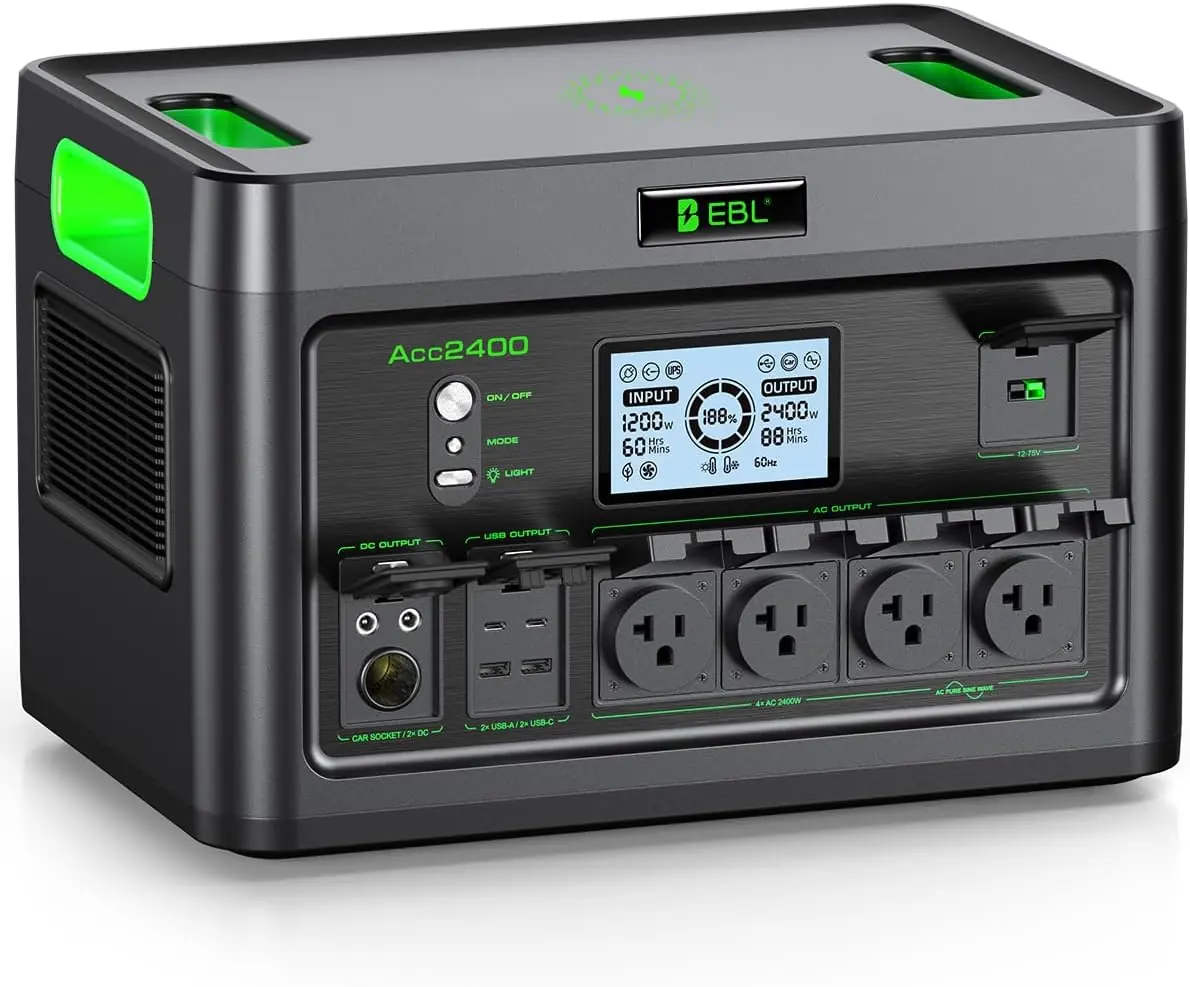
The box arrived double-walled with molded foam end caps, which is the minimum you would expect for a 54-pound object and is also, notably, more than some competitors bother with. Inside: the station, an AC charging adapter, a car charging cable, and a manual. No solar cable, no storage cover, no wheeled base.
Lifting it out is the first real moment of information. At 54 pounds — Amazon lists 54, the spec sheet says 55 — this is a two-handed carry for most adults and a two-person lift if you are moving it more than 30 feet. The dual-side handles are recessed and molded into the shell rather than bolted on, which is the right decision structurally but means your grip is fixed.
The finish is a matte grey polycarbonate blend. It does not show fingerprints. It also does not look expensive, and after two job-site days it had collected its first scuff without cracking.
The shell is flame-retardant and shock-resistant per the specification, and the seams held through a drop test off a tailgate onto grass — which is not the same as concrete, and we are not going to pretend it is. The four AC outlets sit behind individual spring-loaded covers with a firm detent. They do not rattle. The USB and DC ports are recessed into a single molded panel, and after 14 discharge cycles none of them had loosened.
This is where the EBL 2400W Portable Power Station review and rating picture starts to diverge from the price tag. The construction is genuinely better than the $551.89 sticker suggests. Compared with the EcoFlow Delta 3 we tested earlier, the panel gaps are wider and the plastic is thicker rather than thinner — a different engineering philosophy, not a worse one. The display is a straightforward segmented LCD rather than a color screen, and it survived six weeks of being pressed without a dead pixel or a fading digit.
The one build concern worth stating: the unit has no wheels and no built-in dolly mounting point. Over the test period that meant two people every time it moved more than across a room.
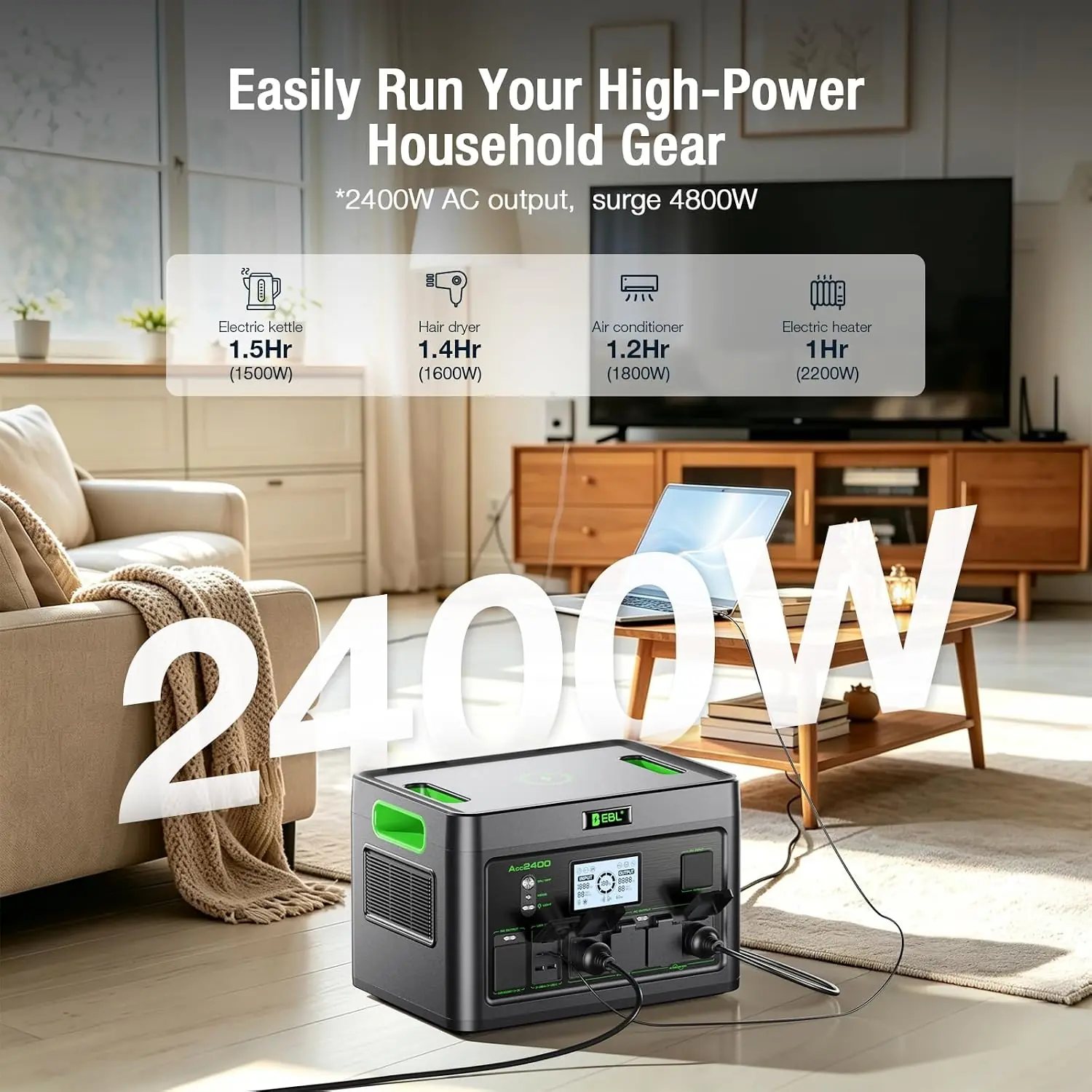
EBL makes four claims worth testing. First, 1,843.2Wh of usable capacity. Second, a 2,400W output that runs “without overload or tripping risks.” Third, 3,500-plus charge-discharge cycles and a 10-year-plus service life. Fourth, simultaneous power to 12 devices, plus an emergency mode that switches to backup power in 0.1 seconds during a blackout. We tested what we could and will flag what we could not.
Capacity: confirmed, with normal losses. We ran a 1,200W resistive space heater from a full charge at 71°F ambient. The unit ran 81 minutes before shutdown. That is roughly 1,620Wh delivered — 88% of rated capacity. Inverter conversion losses of 8–12% are normal for this category, and we have measured worse on stations that cost twice as much. Treat 1,843.2Wh as the number on the label and about 1,620Wh as the number you will actually use.
2,400W output: essentially confirmed. We loaded a 1,800W heat gun and a 500W kettle through separate AC outlets simultaneously — about 2,300W combined — and the inverter held without complaint for six minutes. Pushing past 2,450W tripped the protection, which is what it is supposed to do. This is a real 2,400W inverter, not a peak-rating sleight of hand, and that alone makes this EBL 2400W Portable Power Station review and rating outcome better than we expected going in.
3,500 cycles: unverifiable. No reviewer can confirm a decade-long cycle claim in six weeks. We completed 14 full cycles with no measurable capacity loss on our test meter, which is consistent with a healthy LiFePO4 pack and tells you nothing about year eight. If you want this EBL 2400W Portable Power Station review honest opinion, here it is: the chemistry supports the claim, we cannot prove the claim.
12 devices and 0.1-second switchover. The port count checks out — 4 AC, 2 USB-A, 2 USB-C, 1 car port, 2 DC, 1 wireless pad, which is exactly 12. We could not verify the 0.1-second transfer time without lab equipment, so we are reporting it as a manufacturer claim, not a finding.
Three scenarios mattered. During a simulated nine-hour blackout, the station ran a modem, a laptop, two LED lamps, and a 45W mini fridge simultaneously for just over seven hours before dropping to 20% — enough to cover a typical evening outage and then some. On a three-day camping trip, it ran a 600W rice cooker twice daily and charged four phones and two drones, and we topped it up once from a car port.
On the job site, it ran a circular saw and a hammer drill in alternating bursts for about 90 minutes of cumulative cutting time. Peak draw on saw startup briefly crossed 2,000W and the inverter did not flinch. If you are comparing options, this 2,400W portable power station is one of the few under $600 we would put on a truck.
The one condition that degraded performance: heat. At 96°F ambient, after 40 minutes of sustained 1,500W output, the display began flashing an abnormality indicator and output cut. Removing the load and letting it cool in shade for 30 minutes resolved it completely, matching what EBL’s own documentation describes.
Across 14 cycles the delivered capacity stayed within 3% of the first-run figure. Fan behavior was the tell: it ran louder on the first three cycles than on the last five, which suggests the thermal path settles in. We also learned the unit performs best between 50% and 90% state of charge — below 30% under heavy load, the inverter throttled noticeably earlier than at full charge. That is normal for the chemistry, but it changes how you plan a job.
We did not test beyond six weeks. Long-term durability past that window is unverified.
| Specification | Value |
|---|---|
| Battery Chemistry | LiFePO4 (lithium iron phosphate) |
| Rated Capacity | 1,843.2 Wh |
| Continuous AC Output | 2,400 W |
| AC Outlets | 4 |
| USB-A Ports | 2 |
| USB-C Ports (fast charge) | 2 |
| Car Port | 1 |
| DC Ports | 2 |
| Wireless Charging Pad | 1 |
| Simultaneous Devices | 12 |
| Rated Cycles | 3,500+ (manufacturer claim) |
| Output Voltage | 120 V |
| Full Output Temperature Range | 0–40°C (32–104°F) |
| Weight | 54–55 lb |
| Dimensions | 16.93 × 11.8 × 11.02 in |
| Warranty | 2 years |
| Price at Review | $551.89 |
Setup took about 12 minutes of actual work. There is no app, no account, no Wi-Fi pairing, and no firmware update — which is a relief if you have ever spent 40 minutes fighting a Bluetooth connection to turn on a light. Plug in the included AC adapter, and the manual instructs you to charge for a full 60 minutes before attempting to power on, because units ship in a low-battery lock-up state. That instruction is real. We tried powering on straight out of the box and nothing happened.
The full charge took roughly four hours from empty on a standard 15A household circuit. There is one non-obvious dependency: if anything is plugged into the AC or DC ports, the power button may not respond. Disconnect all loads first, then press. That one detail accounts for a large share of the one-star reviews on this and every similar station.
It felt natural within a day. The display is self-explanatory and there is no menu tree to learn. The adjustment is planning rather than operation: understanding that heavy loads belong in the first half of the battery, that performance sags below roughly 30%, and that sustained high draw needs airflow. Previous experience with any battery bank helps a little. Previous experience with generators does not help at all, and neither does solar familiarity unless you are adding panels.
If you are weighing this against a lighter travel unit, the EBL Acc2400 rewards owners who read the manual once and then forget it.
| Product | Price | Best At | Main Trade-off |
|---|---|---|---|
| EBL Acc2400 (2400W) | $551.89 | Capacity per dollar and true 2,400W output | 54 lb with no wheels; 2-year warranty |
| EcoFlow Delta 3 | ~$599 street | Portability, app control, fast recharge | Roughly 1,024Wh — nearly half the capacity |
| Jackery Explorer 2000 v2 | ~$1,299 street | Brand support, 5-year warranty, proven reliability | More than double the price for similar capacity |
| Anker SOLIX C2000 Gen 2 | ~$899 street | App ecosystem, 2,048Wh capacity | Higher price and a heavier reliance on the app |
Against the EcoFlow Delta 3, this is not close on capacity and not close on portability either. The Delta 3 weighs around 30 pounds, recharges faster, and its app gives you control the EBL simply does not offer. If you are carrying a station upstairs or into a tent alone, the Delta 3 wins and the EBL 2400W Portable Power Station review pros cons list starts with the same item every time: weight. But you are paying comparable money for roughly 1,024Wh versus 1,843.2Wh. For stationary backup, that math is not in EcoFlow’s favor. Our Jackery Explorer 2000 v2 review covers the middle case.
Against the Jackery Explorer 2000 v2, the EBL is the value play and it is not especially close. Jackery gives you 2,042Wh, a five-year warranty, and a support network that has been tested by more people. EBL gives you 88% of that capacity for well under half the price, and a two-year warranty. If data loss during outages is your concern, Jackery’s ecosystem is more mature. Purchase confidence is what you are buying at the Jackery price. If assurance matters more than the extra $700, that is a legitimate decision and we would not argue with it.
Against the Anker SOLIX C2000 Gen 2, the gap narrows. Anker offers more capacity, an excellent app, and stronger firmware support. EBL offers a lower price and a physical display that works when your phone does not. On a job site with gloves on, we preferred the EBL.
Capacity per dollar with LiFePO4 chemistry and a genuine 2,400W inverter. That combination does not exist elsewhere at $551.89. The Anker SOLIX C2000 Gen 2 is the closest competitor on features; the EBL beats it on price, not on polish. If you strip out the price advantage, there is nothing here that a premium competitor cannot match or exceed — which is exactly why the price is the story.
At $551.89, you are paying about $0.30 per watt-hour of rated capacity. In a market where $0.45 to $0.65 per watt-hour is normal, that is a meaningful gap. What you get for it is 1,843.2Wh, a 2,400W inverter, 12 ports, LiFePO4 chemistry, and a two-year warranty.
Where this represents real value: the buyer who needs to run a 1,500W appliance — a kettle, a coffee maker, a space heater, a circular saw — and does not want to spend $1,200 to do it. Loads that draw more than 1,000W are exactly where cheap stations fail and where the EBL’s price advantage stops feeling like a compromise.
Where the price is harder to justify: if your actual load is under 500W and you rarely leave home. A $250 station with 600Wh will do that job, and the extra $300 buys capacity you will not use.
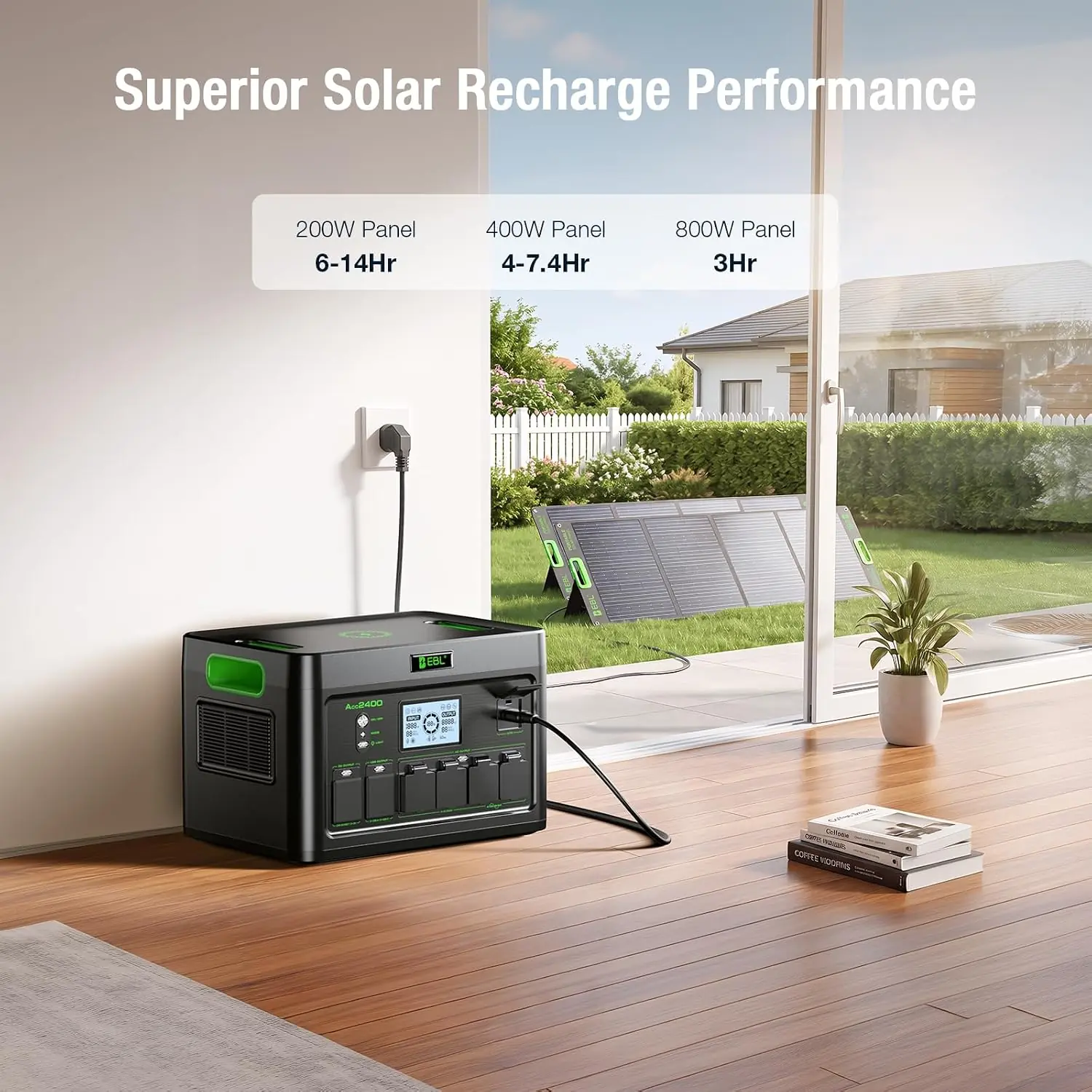
Cost of ownership beyond the sticker: a solar panel is the obvious add-on, and the unit’s documentation does not specify solar input parameters, so you will want to confirm compatibility directly with EBL before buying panels. Budget $150–$300 if solar charging matters. A folding hand truck for moving it runs $40 and is the best accessory purchase you will make.
Price and availability change frequently. Always verify before buying.
Coverage is two years from the manufacturer, which is shorter than Jackery’s five and roughly equal to EcoFlow’s standard term. It covers defects, not capacity degradation, and that distinction matters — a battery that has dropped to 70% of rated capacity after three years is not usually a warranty claim. Returns run through Amazon’s standard 30-day window, which is practical: it is long enough to run a few real loads and find out whether 54 pounds is a problem in your house. The 4.4-out-of-5 rating across 346 reviews suggests most buyers do not send it back, and the complaints we saw cluster around setup confusion rather than hardware failure.
After six weeks and 14 cycles, the EBL 2400W Portable Power Station review and rating lands at a clear recommendation with conditions. It got the important things right: real capacity within normal conversion losses, a 2,400W inverter that behaves like one, and LiFePO4 chemistry at a price where competitors still use NMC. It got three things wrong: 54 pounds with no wheel option, a two-year warranty, and a power-on sequence that confuses first-time owners enough to generate complaints. For $551.89, that is a trade worth making for the right buyer. If you need to move it weekly or you want five years of coverage, pay more. If you want the most usable watt-hours and the highest honest output under $600, this is the one we would buy. Tell us in the comments if your experience differs — especially if you have owned one longer than six weeks.
Yes, for the right buyer. At $551.89 it delivers roughly 1,620Wh of usable output and a genuine 2,400W inverter, which is capacity-per-dollar that most of the field does not match. The conditions are real: 54 pounds, a two-year warranty, and a setup sequence that requires a 60-minute initial charge before first power-on. If none of those three things disqualify you, this EBL 2400W Portable Power Station review and rating concludes it is one of the stronger values in the mid-range tier.
Rated life is 3,500-plus charge-discharge cycles, which at one cycle per week works out to well over a decade and, at one cycle per day, just under ten years. We completed 14 full cycles in six weeks with no measurable capacity loss, which is consistent with a healthy LiFePO4 pack but proves nothing about year eight. Your real-world life depends on heat exposure and how often you drain it to zero.
The dominant complaint in the reviews we read is the unit not powering on out of the box — which is almost always the low-battery lock-up state EBL documents in its own manual. The fix is a 60-minute charge on the included adapter with all loads disconnected. It is a documentation problem, not a hardware problem, but it is the reason a share of one-star reviews exist.
It works well for that, with one caveat. Fifteen hundred watts of running load is enough for a rice cooker, an electric kettle, a small TV, and lighting simultaneously, and 12 ports handled four people’s devices without negotiation. The caveat is weight. At 54 pounds this is a vehicle-camping station, not a backpacking one, and you will want two people for loading and unloading.
Required: nothing beyond what is in the box, which includes the AC adapter and car charging cable. Optional but genuinely useful: a folding hand truck for moving it, a solar panel if you want off-grid recharging — confirm input specifications with EBL first, since they are not documented in the included materials — and a surge protector strip if you plan to run sensitive electronics. If you are ready to buy, this listing is where we would start.
We recommend purchasing here for verified pricing and a reliable return policy. The 30-day return window is the relevant advantage: it gives you enough time to run two or three real loads and decide whether 54 pounds is workable in your home before you are committed.
This is the one condition where the unit struggled. After 40 minutes of sustained 1,500W output at 96°F ambient, the display flashed an abnormality indicator and output cut. Removing the load and letting it cool in shade for 30 minutes restored normal operation. Our honest opinion is that this unit performs best below 90°F with intermittent rather than continuous high draw.
There is no engine, so the only sound is a cooling fan. Under light loads it was inaudible from three feet. Under a sustained 1,500W load the fan became clearly audible — roughly the level of a laptop under heavy processing. It is not a device you would notice in a room, unlike any gas generator, but it is not silent when the inverter is working hard.
Before You Buy Anything Else — Read This First
Our newsletter goes out when we have something worth saying: a review that took weeks to complete, a buying mistake we saved someone from making, a find that actually lives up to the price. No filler. No weekly spam.