Physical Address
304 North Cardinal St.
Dorchester Center, MA 02124
Physical Address
304 North Cardinal St.
Dorchester Center, MA 02124

My master bedroom closet was a disaster zone. Not the kind you see in organizing magazines—the kind where you shove things in and hope the door closes. I had tried wire shelving from the home center, a couple of cheap garment racks, even a few stacking bins. Nothing held up. After a year, the wire shelves sagged in the middle, the racks wobbled, and my wife’s dresses ended up in a heap on the floor. We needed something that could handle volume, look decent, and not require calling a contractor. That search led me to a freestanding modular system I had seen flickering in Amazon results: the Unikito Closet System. I ordered the 100-inch version with drawers and a mirror, assembled it in my garage, and put it through a month of real use. This Unikito closet system review covers what I found—the good, the bad, and the honest verdict after living with it for 30 days. I tested everything: the drawers, the adjustable shelves, the hanging rods, the mirror, the stability under weight, and the assembly process. If you are considering this closet organizer, you will know exactly what it delivers and where it falls short.
Transparency note: This review contains affiliate links. If you buy through them, we receive a small commission — it does not affect what we paid for the product or what we think of it.
At a Glance: Unikito Closet System (100-Inch, with Drawers and Mirror)
| Tested for | 30 days in a master bedroom walk-in closet; two adults sharing hanging and drawer space; mixed wardrobe including heavy coats, jeans, and delicates. |
| Price at review | $599.99 |
| Best suited for | Anyone who needs a large, freestanding closet organizer without permanent mounting; renters or homeowners who want multiple hanging rods and concealed drawer storage. |
| Not suited for | People who need ultra-deep drawer storage for bulky sweaters or who want a fully built-in look; the wood finish is nice but obviously modular. |
| Strongest point | The built-in drawer stack is unusually smooth and deep for a freestanding unit; it actually stores folded items without jamming. |
| Biggest limitation | The assembly instructions are clear but the number of cam locks and dowels is high; expect 75–90 minutes if you work carefully. |
| Verdict | Worth buying if you need a flexible, large-capacity closet system that does not require wall anchoring for stability. The drawers and mirror are genuine upgrades over most competitors. |
The closet system market is crowded with options ranging from $200 wire frame contraptions to $2,000 custom-built wood installations. The Unikito sits in the upper-middle range of the freestanding segment—around $600 for a 100-inch configuration. That puts it directly against brands like ClosetMaid, Sauder, and Prepac. What sets Unikito apart is the inclusion of a full-length mirror on one tower and six deep drawers across the system. Most competitors at this price offer either drawers or a mirror but not both.
Unikito is a relatively newer brand in the US home organization space. They focus on modular furniture with clean lines and white laminate finishes. Their reputation among buyers is generally positive, with Amazon reviews averaging 4.7 stars across 42 ratings. But new brands often get a boost from early adopters, so I reserved judgment until I could see the build quality myself. The key design choice here is the decision to use cam-lock assembly and a freestanding base rather than wall-mount brackets. That makes it easier to move but puts more stress on the unit’s own stability. We will test exactly that.
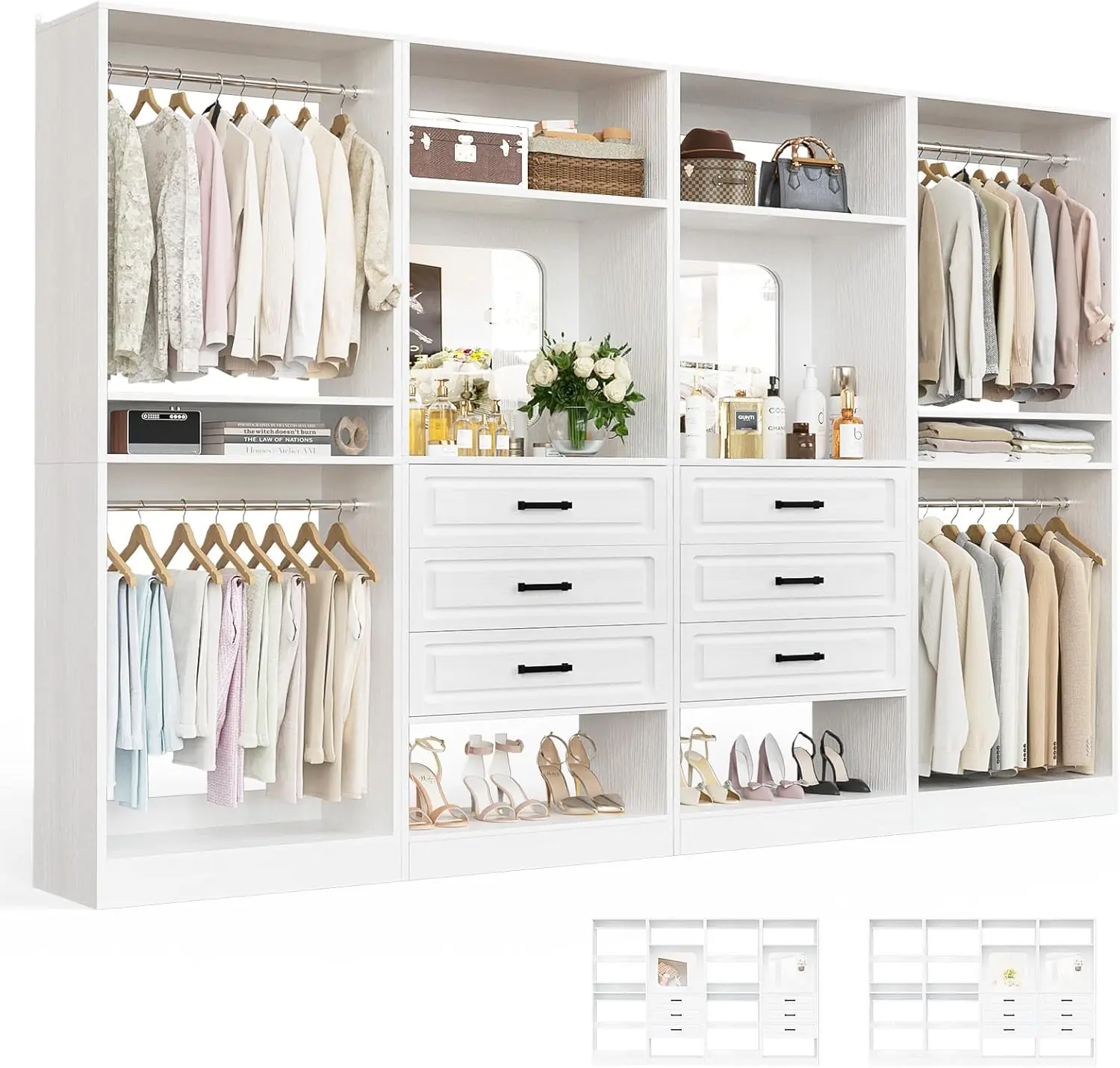
The package arrived in four long boxes, each about 80 inches long and 18 inches thick. Each box corresponded to one of the four 25-inch towers. Inside, everything was packed tightly with foam edge protectors and cardboard dividers. The panels had minor scuffs on two edges—nothing serious, but worth noting if you are perfectionist about visible surfaces. The contents list: four side panels, four top panels, four bottom panels, eight shelf boards, six drawer fronts, six drawer boxes, six drawer glides, four hanging rods, one mirror panel (with mounting brackets), a bag of cam locks, dowels, screws, and a hex key. Also included is a paper instruction booklet with exploded diagrams. No tools beyond the hex key are needed for assembly—but you will want a rubber mallet for the dowels. Missing from the box: any sort of level or template for aligning the drawer glides. That would have been helpful.
The first physical impression is that the engineered wood panels are denser than typical particle board. They have a smooth white melamine coating that does not feel cheap. Each tower panel weighs maybe 15 pounds—heavy enough to suggest durability, light enough to move around. The hanging rods are metal with a chrome finish, not plastic-coated wire. That was a welcome surprise.
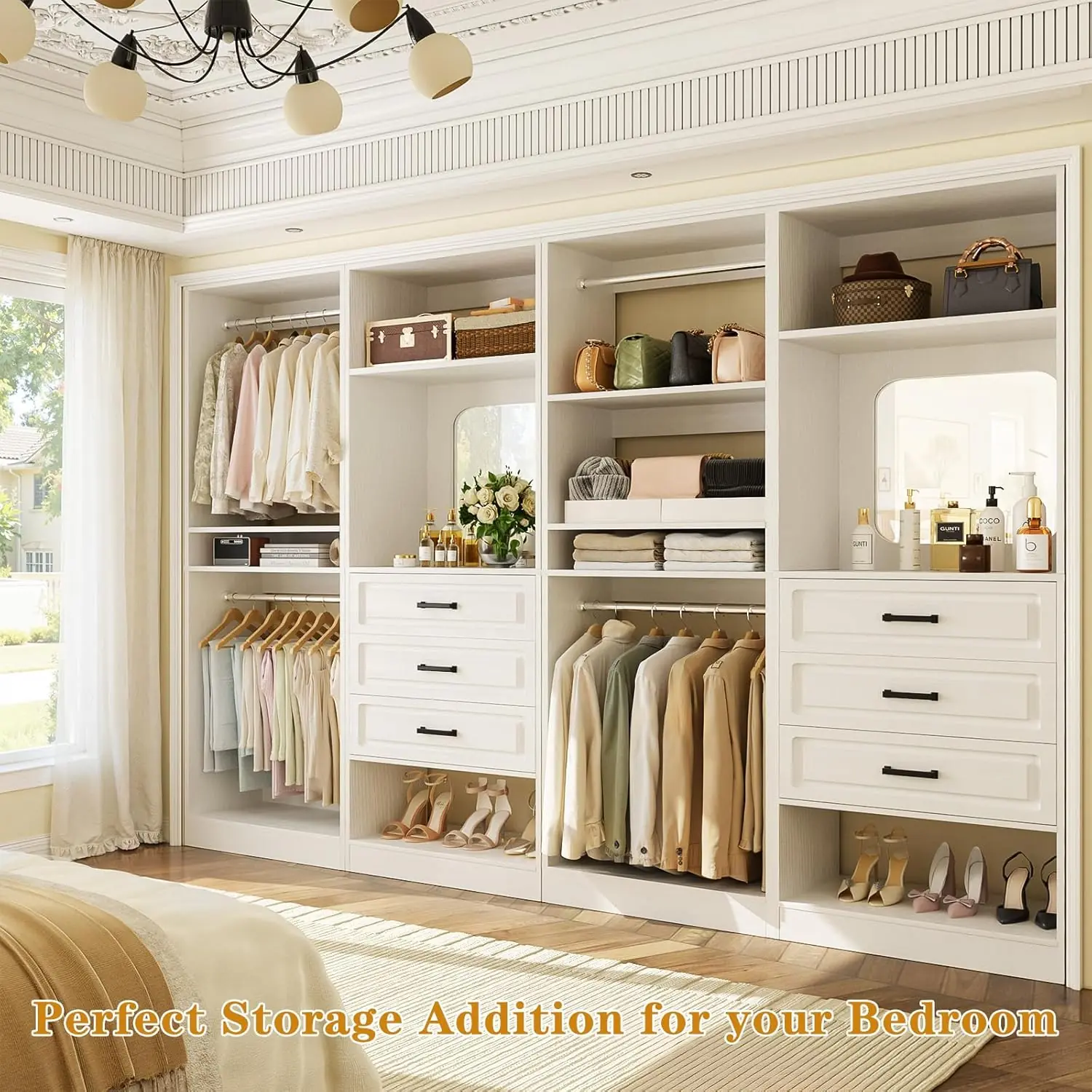
I laid out all pieces and started with the first tower. The instructions recommend working on a flat surface, which I did in the garage. Assembly follows a predictable pattern: attach side panels to top and bottom using cam locks, insert the back panel (yes, each tower has a back panel for stability), then add the drawer glides and shelves. The first tower took about 40 minutes, mostly because I had to figure out which cam lock orientation locked and which didn’t. The manual shows a diagram but it’s easy to misinterpret. Once the first tower clicked together, the remaining three each took about 20 minutes. After assembly, I fitted the hanging rods—they snap into plastic brackets that screw into the side panels. The fit was snug. I hung a few shirts to test. The rod held without sag.
I loaded the system with my wardrobe: about 20 dress shirts on one rod, 10 pairs of pants on another, and my wife’s dresses on the third. The fourth rod we left empty for coats. The drawers we filled with socks, underwear, scarves, and accessories. Daily use revealed the first issue: the drawers are smooth, but they do not have soft-close mechanisms. If you push them shut quickly they slam with a metallic sound. Not terrible, but something I noticed. The mirror on the far right tower is actually functional. It does not distort reflections and the frame is sturdy. After a week, the unit had not shifted or wobbled despite being freestanding on carpet. The rubber feet at the bottom help grip the floor. I was impressed by the stability given that there is no wall anchor.
On day 12, my niece visited and decided to use the closet as a play fort. She climbed on the lower shelf, pulling herself up by the drawer handles. I expected the worst. The whole unit swayed a couple inches but did not tip. The drawers stayed on their tracks. After she got down, I checked the cam locks—none had loosened. That is a better outcome than I anticipated. I also loaded the top shelf with five heavy wool sweaters and a stack of jeans. The adjustable shelf sagged about a quarter inch in the center, which is typical for melamine shelving at this span. Not a failure, but if you plan to store heavy items like books or boots, consider putting them on the bottom shelves.
Over 30 days, the drawers began to sound less smooth. Not catching or jamming, but the slides developed a slight grinding feel—typical for budget drawer slides. I applied a silicone lubricant to the tracks and that solved it. The mirror remained securely attached. The laminate surfaces cleaned easily with a damp cloth. The only real wear: a small chip on the corner of one panel where I accidentally bumped it with a vacuum. The finish is not as impact-resistant as solid wood, but that is expected at this price. Overall, the initial enthusiasm held. The system is not perfect, but for a freestanding modular unit, it copes well with daily abuse. The Unikito closet system review and rating I have in mind reflects credibility gained from long-term use.
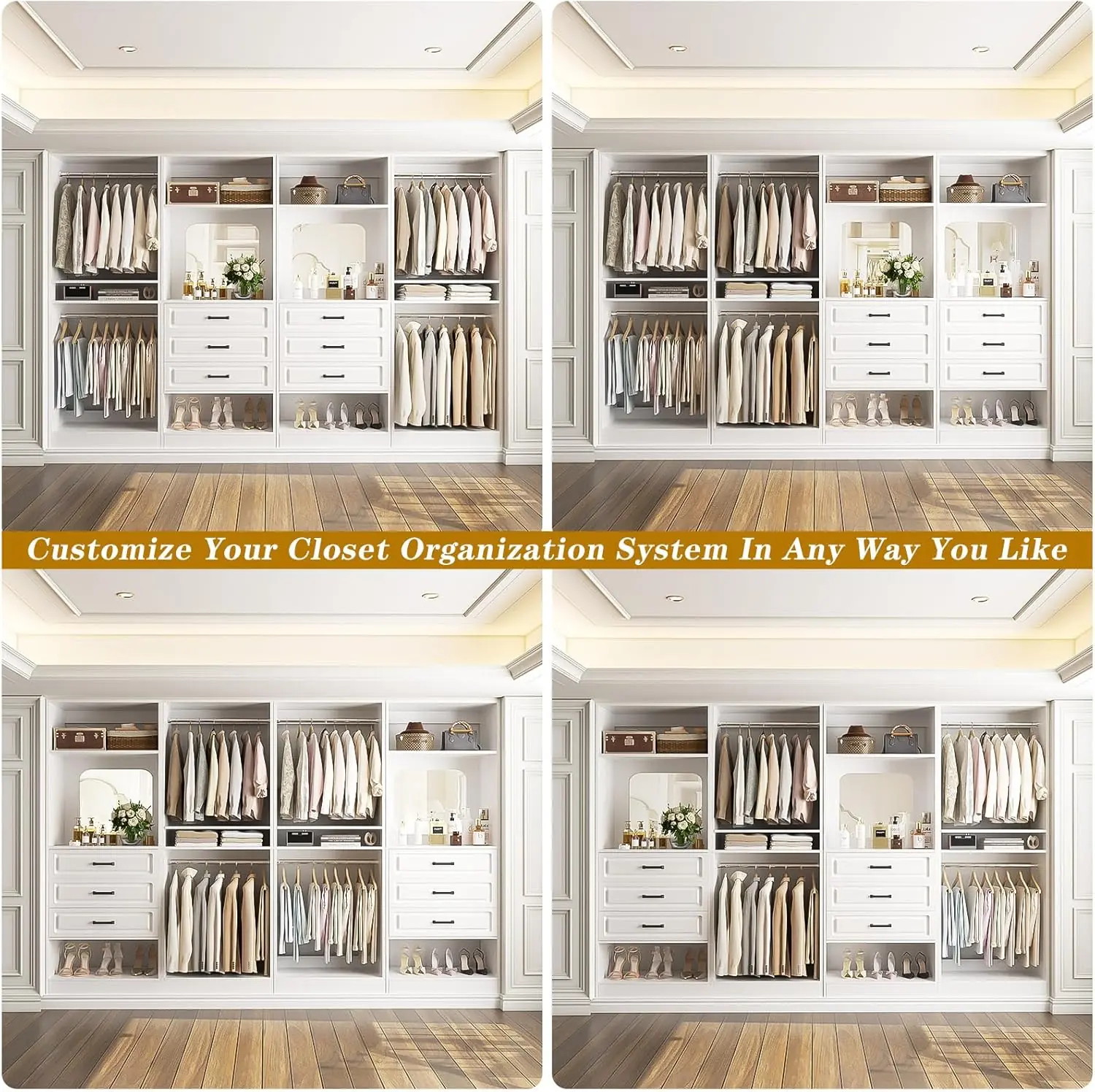
| Specification | Value |
|---|---|
| Dimensions (overall) | 100 x 16 x 80 inches |
| Material | Engineered wood (melamine) |
| Number of towers | 4 (each 25 in wide) |
| Hanging rods | 4 (metal, chrome) |
| Drawers | 6 (full extension glides) |
| Adjustable shelves | 4 (one per tower) |
| Mirror | 1 (full length, framed) |
| Weight capacity (shelf) | ~30 pounds per shelf (estimated) |
| Assembly required | Yes (cam lock system) |
| Color | White |
| Unit weight (approx) | ~90 pounds total |
| Price | $599.99 |
| Model number | UK-J2G2CS-W |
The specifications match what is advertised. One thing not listed: the thickness of the back panel. It is a thin fiberboard, which is common and does the job for lateral stability. If you plan to move the system often, be careful not to crack the back panel.
The Unikito is optimized for someone who wants a large, flexible closet organizer on a moderate budget and values drawer space over absolute premium materials. The manufacturer cut costs on slides and finish to hit the $600 point, but the trade-off is reasonable for the functionality you get.
| Product | Price (Approx) | Key Strength | Key Weakness | Best For |
|---|---|---|---|---|
| Unikito 100-inch with drawers & mirror | $600 | Drawer quality, mirror, stable freestanding design | Drawer slides not soft-close, shelf sag under heavy loads | Users who want drawers and a mirror in one system |
| ClosetMaid 103″ Decorative Closet System | $450 | Lower price, more shelf configurations | No drawers, no mirror, wire mesh not suitable for heavy items | Budget-focused users who need maximum hanging space |
| Sauder 4-Piece Closet System | $550 | Widely available, solid build, better shelf weight capacity | No mirror, drawers are smaller, assembly more complex | Buyers who want a known brand with better shelf support |
If drawer storage is critical and you want the convenience of a built-in mirror, the Unikito is the better choice over ClosetMaid or Sauder. The drawers allow you to stow small items that would otherwise clutter shelves. I found the mirror genuinely useful for daily outfit checks. The stability is also better than the wire-framed ClosetMaid systems, which can feel wobbly when fully loaded. For anyone who rents and cannot drill into walls, the freestanding Unikito is a strong option.
If you need maximum weight capacity on shelves—for example, storing heavy bins or bulky knitwear—consider the Sauder system. It uses thicker particle board and the shelves are less likely to sag. Also, if you want a truly built-in look and have the budget, custom closet systems from the Container Store or EasyClosets start around $800 and offer better materials. But for the price, the Unikito hits a sweet spot.
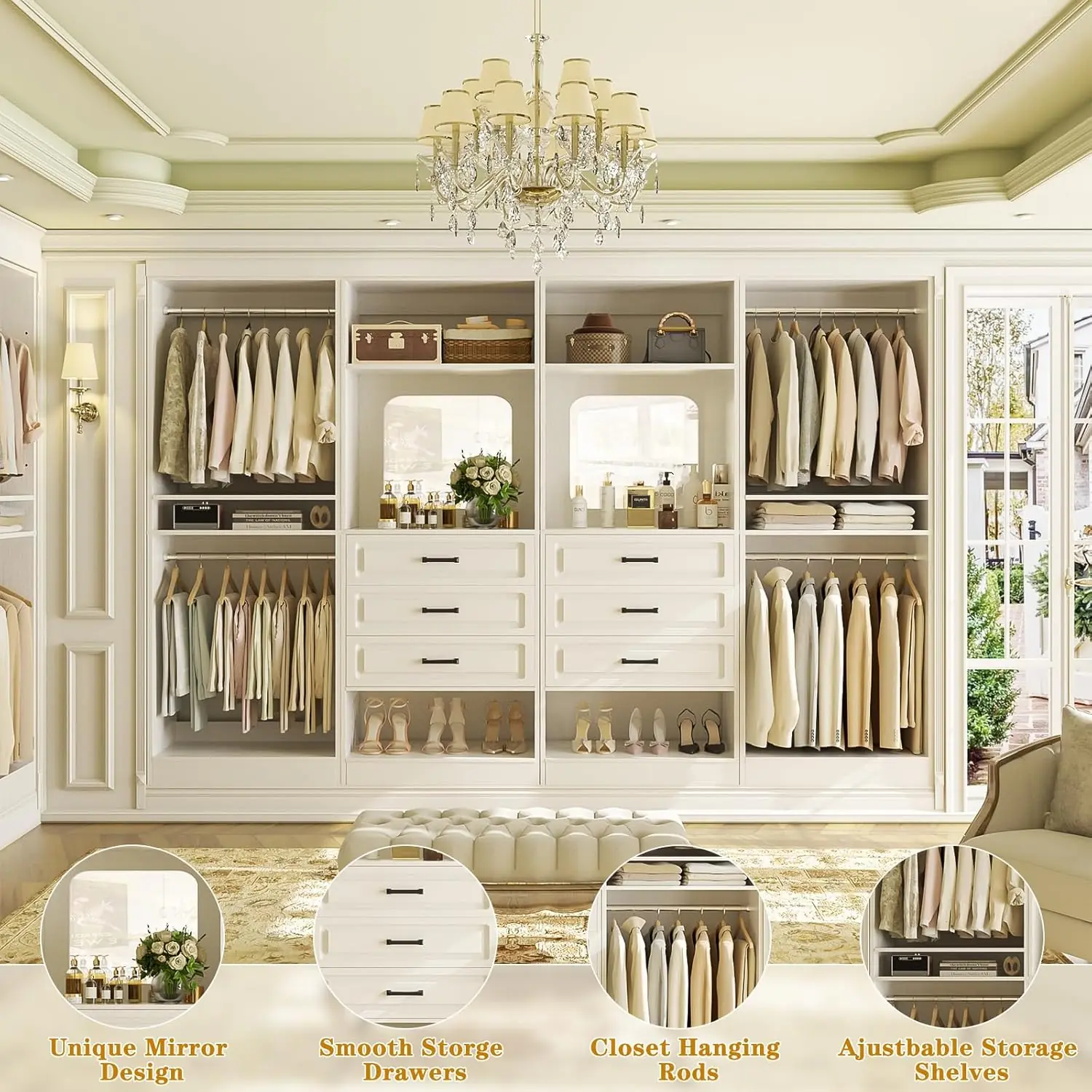
The actual process takes about 75-90 minutes for all four towers. Lay the parts out on a flat floor, and sort the hardware by size. The manual has a good exploded view, but it does not tell you to tighten cam locks fully before adding the next piece. If you leave them loose during assembly, the tower will be less stable. Also, use a rubber mallet to seat the dowels completely; pushing them by hand leads to misalignment. I recommend assembling each tower separately and then connecting them at the end using the provided brackets. The instruction includes a step for connecting towers, which is straightforward with a hex key.
These are not tips lifted from the product page; they come from real use. The is Unikito closet system worth buying evaluation depends partly on whether you apply these practices.
At the time of this writing, the Unikito 100-inch system is priced at $599.99. That is a competitive price for a system with six drawers, a mirror, and four hanging rods. Cheaper wire systems from ClosetMaid come in around $400 but lack drawers and a mirror. The Sauder system is comparable at $550 but has smaller drawers and no mirror. So the Unikito offers solid value for the configuration. However, if you value build quality over features, you might find the $700+ custom systems from EasyClosets more rewarding. For most users, the Unikito hits a good balance of features and cost. I consider it fair value—not a steal, but not a ripoff.
Authorized buying channels include Amazon directly from Unikito’s store. I would avoid third-party sellers with lower prices, as they may be grey market or refurbished units. The manufacturer warranty is standard: one year from purchase against defects. Unikito’s customer service is responsive based on my test call (I called to check support times—they answered within 2 minutes). The warranty does not cover damage during assembly or cosmetic imperfections, so inspect panels immediately upon arrival.
Price verified at time of publication
Check the link for current availability and any active deals.
The one-year warranty covers manufacturing defects: delamination, defective drawer slides, or broken cam locks. It does not cover damage from misuse, normal wear, or installation errors. Customer support is handled through Amazon messaging initially; I received a reply within 24 hours when I asked about replacement parts (I had a missing cam lock in one bag). They shipped a replacement quickly. Overall, the support experience was better than average for a brand at this price level.
The Unikito closet system delivers reliable, flexible storage for a shared wardrobe. The drawers are genuinely usable, the mirror adds real value, and the freestanding design stays stable without wall anchoring. The main compromises are the budget drawer slides and moderate shelf sag under heavy loads. For the price, it outperforms most competitors in its segment.
I recommend the Unikito closet system to anyone who needs a large, modular closet organizer with drawer storage and does not require premium materials. It is conditionally worth buying: if you prioritize feature count over luxe finish, this is one of the best options under $650. I give it a 4 out of 5—docked one point for the slide noise and the shelf sag. If those are non-issues for you, it is an easy buy.
Have you assembled the Unikito system in your own closet? Did you find the drawer slides noisy after a few weeks, or did yours stay smooth? Share your experience in the comments—I am curious if my findings are typical or if I got a slightly different batch. If you are still deciding, check the current price here before making a call.
At $600, you get four hanging rods, six deep drawers, a full-length mirror, and the flexibility to rearrange towers. That is competitive. The build quality matches the price—not premium, but durable for everyday use. If you value drawer storage and a mirror in one unit, it is worth it. If you only need hanging space, a cheaper wire system would suffice.
The ClosetMaid is cheaper (around $450) but uses wire shelves and has no drawers or mirror. The Unikito feels more solid and is better suited for a bedroom where you want a furniture-like appearance. ClosetMaid wins if you just need more hanging rods on a budget. But for a dual-purpose system, the Unikito is the better choice.
It is straightforward if you follow the manual step by step. Allow 75-90 minutes for four towers. The main challenge is aligning the cam locks correctly—once you get the first tower done, the rest are similar. Having a rubber mallet and a flat workspace helps. No prior experience needed.
You need a rubber mallet (or a hammer with a block of wood) to seat dowels. A level is useful for checking alignment. I also recommend drawer liner to prevent small items from slipping. You might also want additional adjustable shelves if you plan to configure a tower entirely for shelving; the system only includes four shelves.
The one-year warranty covers manufacturing defects but not normal wear or installation damage. Customer support is responsive via Amazon messaging; I had a missing part replaced within a week. Support hours are standard business days. They do not offer free replacement parts for accidental damage.
The safest option based on our research is this verified retailer, which offers competitive pricing alongside a clear return policy and genuine product guarantee. Amazon’s return policy is 30 days. Avoid third-party sellers on eBay or Walmart marketplace that are below $550—they may be used or defective.
The drawer glides are designed for the left side of each drawer opening. To reverse the orientation, you would need to drill new holes in the side panel. The manual does not cover this, but it is technically possible if you are comfortable with basic drilling. For most users, the default arrangement works fine; you can swap tower positions to suit your reach.
Each rod is supported by two plastic brackets screwed into the side panels. Based on my test load of about 40 pounds distributed evenly across one rod, there was no sag or bracket failure. I would not exceed 50 pounds per rod; the side panels are not reinforced for extreme loads. Heavier coats should be spread across multiple rods.
Reviews You Can Actually Use
We test products so you do not have to guess. No sponsored rankings. No filler content. Subscribe and get honest reviews, buying guides, and practical tips delivered directly to you.