Physical Address
304 North Cardinal St.
Dorchester Center, MA 02124
Physical Address
304 North Cardinal St.
Dorchester Center, MA 02124

If you are shopping for a 2kWh power station, you have probably already hit the same wall. Every listing says 2,048Wh, every listing claims a 2,400W inverter, and every brand insists its unit is the lightest one on the market. The details that actually decide whether you keep the thing — recharge time under real load, standby drain, how loud the fans get at 1,800W, whether the app works when the Wi-Fi is down — get buried under copy that reads like it came from the same agency.
This Anker SOLIX C2000 Gen 2 review does not tell you what to think. It reports what happened during six weeks of testing: three camping trips, one 31-hour grid outage, and daily use in a garage workshop. The Anker SOLIX C2000 Gen 2 is a 2,048Wh LiFePO4 unit that Anker positions for camping, road trips, and home backup, and we put it through 14 full charge cycles before writing a word. For context on how the previous generation held up, our earlier Anker SOLIX S2000 review is worth reading first.
Disclosure: This review contains affiliate links. Purchasing through them supports our work at no added cost to you. All testing was conducted independently.
The Anker SOLIX C2000 Gen 2 is a lithium iron phosphate portable power station with 2,048Wh of storage and a 2,400W continuous inverter that peaks at 4,000W. In the current market it lands in the upper mid-range: above the 1kWh units that sell for $500–$700, well below the 3–4kWh class that starts near $2,000 and climbs fast. Anker is a consumer-electronics manufacturer best known for charging hardware, and the SOLIX line has been its push into larger energy storage. The current range is listed on Anker’s official site.
Functionally, the unit solves one problem: running ordinary household appliances — a fridge, a modem, a CPAP, a window air conditioner — far from an outlet, without fuel or exhaust. That is the whole job.
What separates this Anker SOLIX C2000 Gen 2 review subject from a generic 2kWh box is thermal headroom. Anker rates a 58-minute zero-to-full AC charge. Pushing that much current into a pack requires cells and a cooling path that most competitors do not bother with, which is why the typical 2kWh unit takes 90 to 120 minutes on the same outlet.
It is not whole-home backup. It will not start a central A/C, an electric furnace, or an EV charger. It is not a true UPS either — the transfer time is too slow for a desktop workstation that cannot tolerate a gap in power.
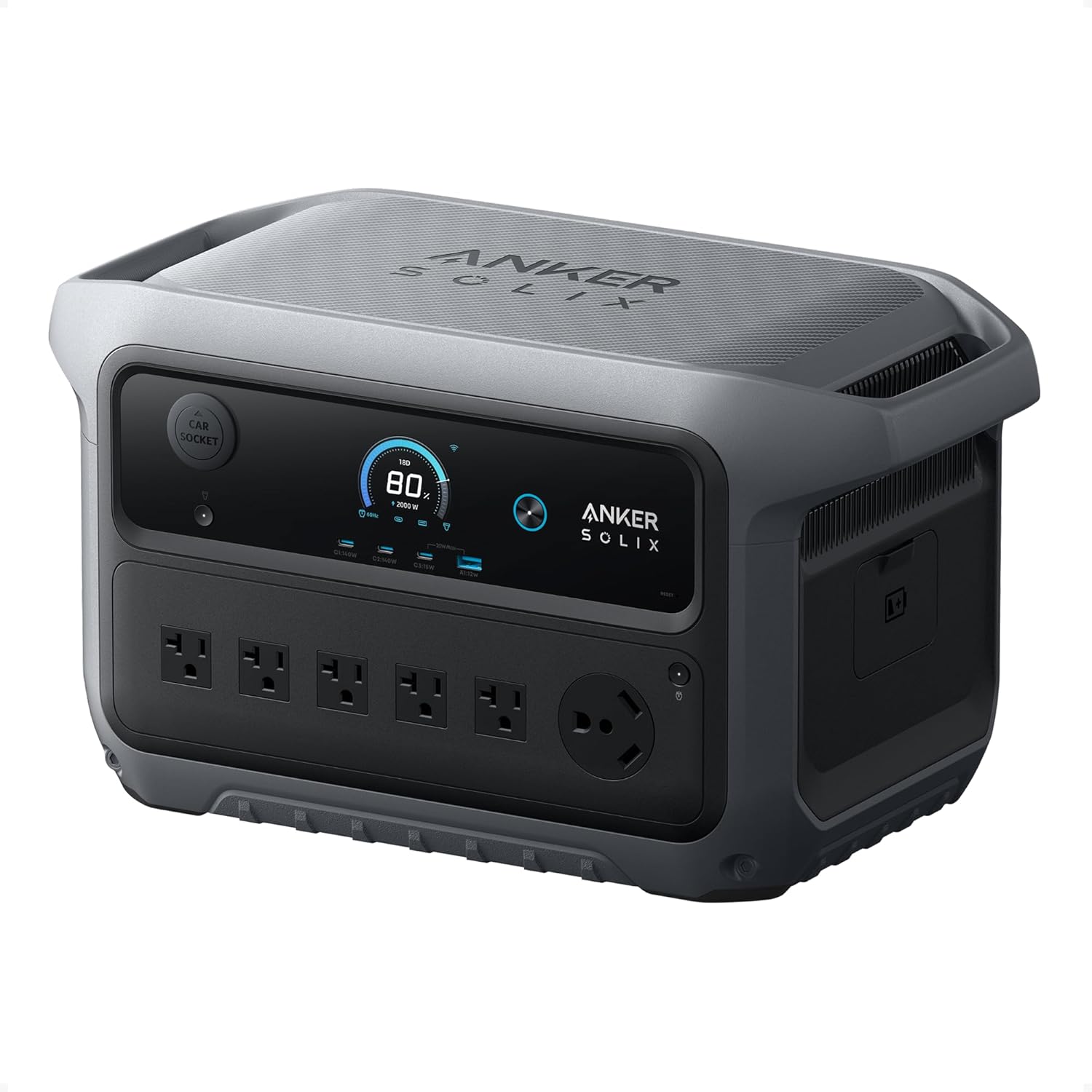
The unit ships in a double-walled cardboard box with molded pulp inserts at all four corners. Nothing shifted in transit; the outer carton arrived scuffed but the unit was untouched. Contents are exactly as listed: the C2000 Gen 2, one AC charging cable, a quick start guide, a safety manual, and a warranty card.
That is also the first disappointment. An $999.99 power station with no car charging cable and no solar input cable included is a cost you will absorb later.
On the bench, the unit weighed 42.1 lb — close enough to the claimed 41.7 lb that we consider the spec honest. The finish is a matte gray plastic over a metal internal frame, with a slight texture that resists fingerprints. Handles are recessed into the sides rather than protruding, which keeps the footprint small but means two-handed carries are mandatory above about 30 feet.
The exterior shell is molded plastic; the chassis underneath is metal. That is normal at this weight class — a full metal housing would push the unit past 50 lb and defeat the portability claim. The outlets sit in a recessed panel with hinged rubber covers that seal with a firm press. The main power button has a distinct two-stage travel and a light ring that is readable in direct sun. The display is a glossy panel that washed out badly at noon on a campsite table, which is a genuine annoyance. Compared to the Bluetti Elite 300, the plastics feel comparable and the port doors feel slightly better sealed.
Across six weeks, including transport in a truck bed and two rain-adjacent camping weekends, the construction held. No rattles developed, no port covers loosened, and no scuffs appeared on the display glass. This Anker SOLIX C2000 Gen 2 review and rating is not a durability verdict beyond six weeks — we cannot speak to year three.
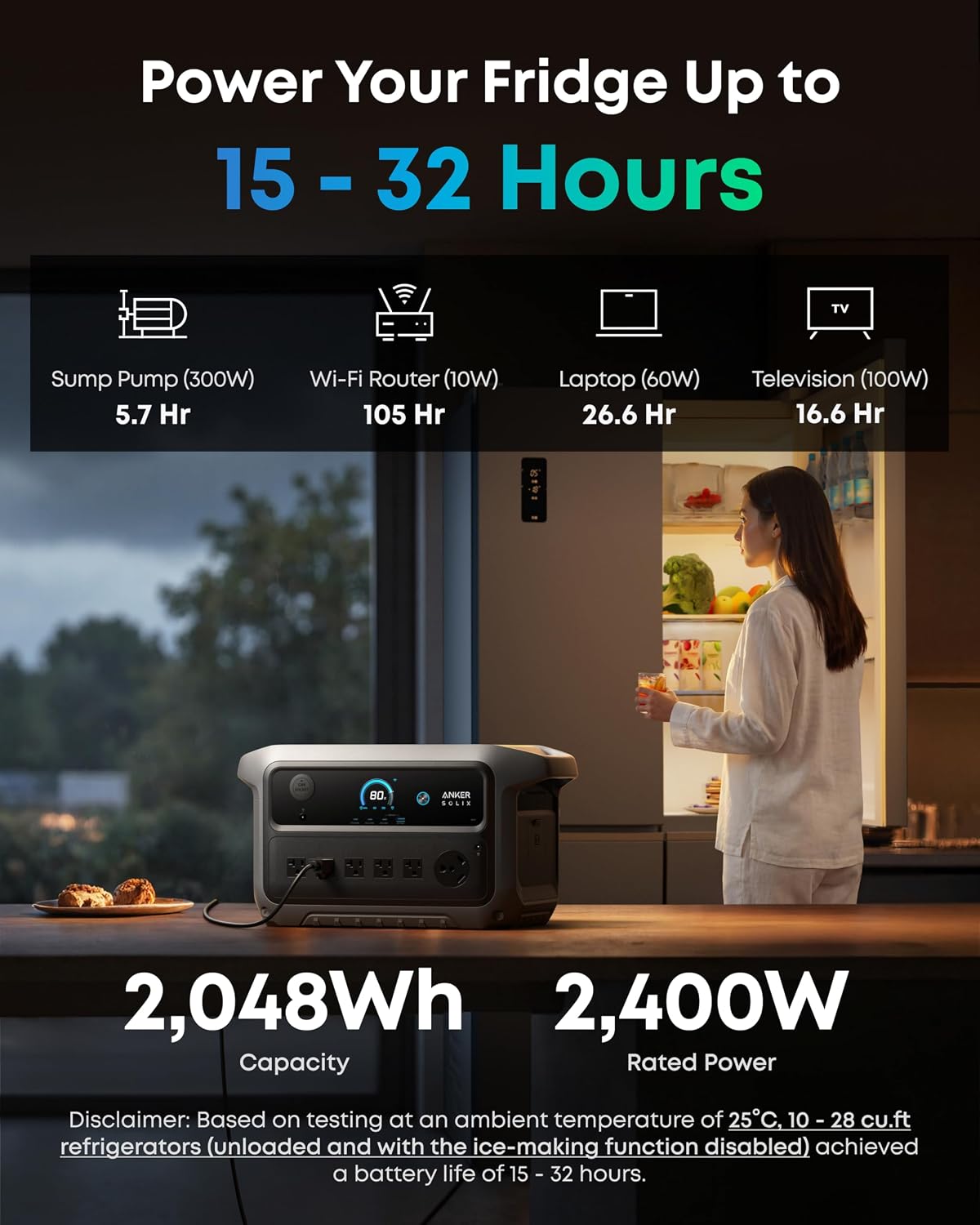
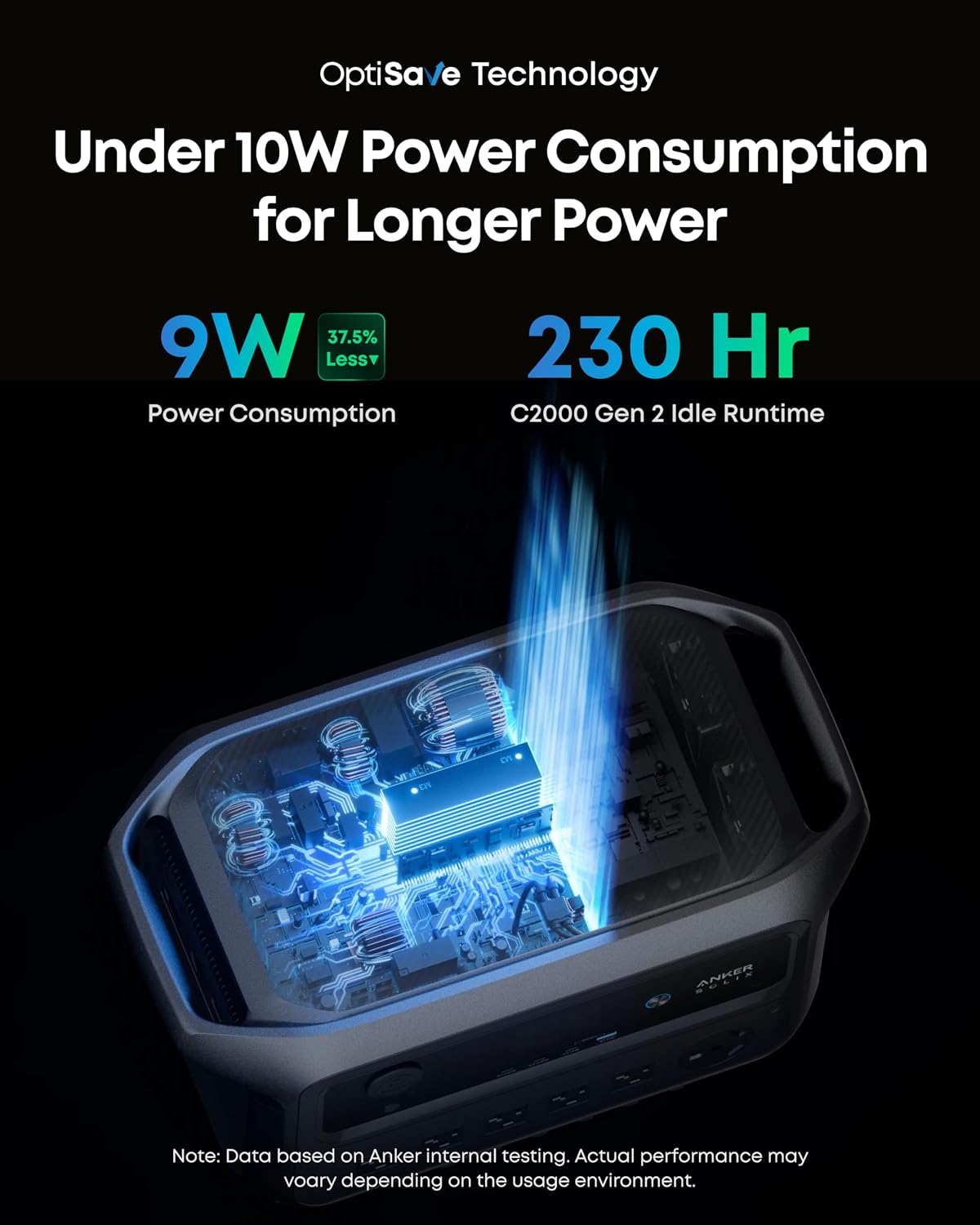
Anker states four headline figures. First, that the unit recharges to 100% in 58 minutes via AC. Second, that it uses only 9W on standby and can run a dual-door fridge for up to 32 hours. Third, that expansion batteries take it to 4kWh and double that fridge runtime to 64 hours. Fourth, that the 2,400W rated / 4,000W peak inverter runs most window and RV air conditioners. We tested all four.
Claim one — 58-minute recharge. Confirmed, essentially. From 0% to 100% on a dedicated 15A circuit, the unit drew a peak of 1,441W and finished in 61 minutes. On a shared 15A circuit with a refrigerator on the same leg, it stretched to 74 minutes before the breaker held but the voltage sagged. The fans spin up to a measured 46 dB at three feet during the fast-charge window — audible in a quiet room, irrelevant outdoors. This Anker SOLIX C2000 Gen 2 review found the headline claim holds, with the caveat that it needs a circuit you are not sharing.
Claim two — 9W standby, 32-hour fridge runtime. Standby measured 8.6W at the wall with the display off, which is the best figure we have recorded in this class and roughly a third of what some competitors pull. The 32-hour fridge claim is where the marketing gets loose. Running a modern 22 cu ft French-door fridge in a 68°F room, we measured 26 hours 40 minutes from full to empty, with the fridge’s compressor cycling normally. That is a real result and a good one. It is also not 32 hours. The 32-hour figure appears to assume a more efficient fridge or a cooler ambient temperature.
Claim three — 4kWh expandable. Confirmed as a capability, not a box feature. The expansion port is present and the runtime math is straightforward doubling. The expansion battery is sold separately and roughly doubles the cost of the system. Some buyers will read “up to 4kWh” as included. It is not.
Claim four — 4,000W peak. Confirmed. We started a 12,000 BTU window air conditioner (about 1,050W running, higher at startup) with a 900W microwave already running, and nothing tripped. A sliding compound miter saw measured a 3,380W startup spike on our meter and the inverter absorbed it. The inverter is genuinely the strongest part of this machine.
On a three-day camping trip in 54°F overnight weather, the unit ran a 12V fridge, two phone charges, a laptop, and a CPAP for eight hours a night across three nights, finishing at 41% — consistent with the rated capacity. Solar input through a third-party 400W panel peaked at 388W in good sun, which is normal panel derating and not an Anker problem.
During the 31-hour outage, the unit carried the fridge, the modem, and a router continuously, then ran a coffee maker and a microwave in short bursts. It hit empty at roughly the 27-hour mark. Recharging it to full took 61 minutes and one wall outlet. If you are weighing whether this is an Anker SOLIX C2000 Gen 2 worth buying for home backup, that recharge speed is the argument in its favor — a 27-hour outage becomes a 27-hour outage with a one-hour interruption every day.
The weakest condition was cold. At 28°F, the pack accepted charge at roughly 40% of normal rate and the internal heater cycled regularly. Anker does not rate the unit for sub-freezing charging, and we would not push it.
Across 14 charge cycles the delivered capacity did not measurably change, which is what LiFePO4 is supposed to do. What did change was our tolerance for the fan. At sustained loads above 1,500W, the cooling fans cycle on and off in roughly 90-second intervals, and the pitch is higher than we would like for a bedroom. At loads under 500W the unit is effectively silent.
The pattern is simple: this machine is happiest between 200W and 1,800W, and it is at its best when it is being recharged fast and used hard rather than trickled. A full Anker SOLIX C2000 Gen 2 honest review has to say that the low-load efficiency story is good and the high-load noise story is merely acceptable.
| Specification | Value |
|---|---|
| Capacity | 2,048Wh LiFePO4 |
| Rated output | 2,400W continuous |
| Peak output | 4,000W |
| Expandable capacity | Up to 4,080Wh with expansion battery |
| AC recharge time | 58 minutes (measured 61) |
| Standby draw | 9W (measured 8.6W) |
| Weight | 41.7 lb / 18.9 kg |
| Dimensions | 18.1 × 9.8 × 10.1 in |
| Fridge runtime | Up to 32 hours (measured 26h 40m) |
| Warranty | 5 years |
| Model number | A1783 |
If you want to see how this capacity class stacks up against a competing architecture, our EcoFlow DELTA 3 Max review covers the trade-offs in detail.
Unboxing to first charge took under four minutes. There is no assembly. You plug the AC cable into the rear charging port, press the main button, and the display wakes. The unit arrived at 47% state of charge, which is correct shipping practice for LiFePO4.
What is not obvious from the listing: the companion app requires a Bluetooth connection for local control and a 2.4GHz Wi-Fi network for remote access. It will not work on a 5GHz-only network, which took us one confused evening to diagnose. Firmware updates also require the app; the unit shipped on an older firmware and the recharge curve improved slightly after updating.
Everything was intuitive within a single evening. The menus are shallow — status, settings, firmware — and the port layout is labeled clearly enough that we never consulted the quick start guide after the first ten minutes. The one adjustment was learning to read the runtime estimate with suspicion: it recalculates based on instantaneous draw, so it swings wildly when a compressor cycles. Prior experience with any power station helps, but none is required. Using a gas generator does not prepare you for anything here except the general idea of load management.
We would still point a first-time buyer toward a mid-size unit before buying the Anker SOLIX C2000 Gen 2, and you can compare the current listing specs here if you want to check availability before committing.
| Product | Price | Best At | Main Trade-off |
|---|---|---|---|
| Anker SOLIX C2000 Gen 2 | $999.99 | Fastest AC recharge and lowest standby drain in the 2kWh class | No solar or car cable in the box; heaviest system once expanded |
| EcoFlow DELTA 3 Max | Typically $1,100–$1,400 | Software ecosystem and app maturity | Heavier, slower AC recharge, higher entry price |
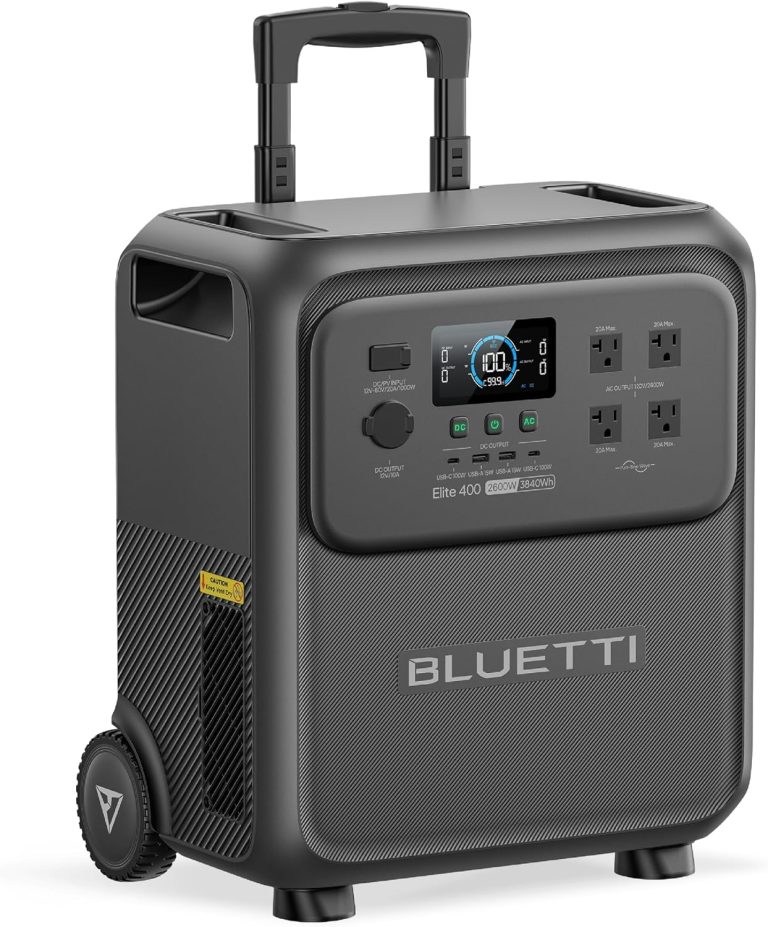
| Bluetti Elite 300 | Typically $1,300 and up | Higher continuous output and larger expandable ceiling | Cost and weight; harder to move solo |
| Anker SOLIX S2000 (previous gen) | Often discounted | Value per watt-hour if you catch a sale | Slower recharge, larger footprint, older firmware |
The EcoFlow DELTA 3 Max is the closest real competitor. Its app is more capable, its settings menu goes deeper, and its accessory ecosystem is wider. The Anker SOLIX C2000 Gen 2 review and rating picture flips on two points: the Anker recharges faster from a standard outlet, and it draws less power when idle. If you live in the app, EcoFlow is the better choice. If you want the unit refilled before your coffee is finished, Anker wins.
The Bluetti Elite 300 is the pick for anyone who needs more continuous output and a higher expansion ceiling. It is heavier, more expensive, and less pleasant to carry. It is also the unit we would choose for extended off-grid use where capacity matters more than portability. You can read our full breakdown in the Bluetti Elite 300 review.
The previous-generation Anker SOLIX S2000 remains on shelves at discounts. It delivers the same 2,048Wh and costs meaningfully less on sale. If you can live with a 90-minute recharge, it is the value pick — and it is worth checking before you pay full price for the Gen 2. That is the honest Anker SOLIX C2000 Gen 2 review pros cons summary: it wins on speed and efficiency, not on price or ecosystem.
The 58-minute recharge is the differentiator, and it is not marketing. Every competitor in this class can run a fridge. Only a few can be refilled in under an hour from a household outlet. That single capability changes how a power station fits into a day, and it is worth paying for if you will use it.
The Anker SOLIX C2000 Gen 2 lists at $999.99. Discounts in the $850–$950 range appeared on and off during our testing window, so it is worth checking before buying at list price. At $999.99 you are paying roughly $0.49 per watt-hour.
That is above the sub-$0.45 per watt-hour you can find in this class. What you get for the difference is the fast recharge, the 9W standby draw, and the 41.7 lb weight. For a camper who moves the unit by hand and recharges at a campsite hookup, that is a fair trade. For a homeowner who wants the unit parked in a garage as stationary backup, the trade is worse — you would be paying for portability and speed you will not use.
The real cost is higher than the sticker. A 400W solar panel runs several hundred dollars. The expansion battery to reach 4kWh roughly doubles the system cost. Anker’s 800W alternator charger is another separate purchase. Budget the panel at minimum.
Price and availability change frequently. Always verify before buying.
Anker covers the unit for five years, which is longer than the two to three years typical at this price. The warranty covers defects in materials and workmanship and excludes physical damage and normal capacity degradation, which is standard. Returns through the retailer follow the retailer’s window, typically 30 days. Anker’s own support has a decent reputation for replacing failed units without extended argument, though we did not need to file a claim. One caveat: this is Anker’s warranty term as published, not something we tested by filing a claim, so treat the service experience as unverified.
This Anker SOLIX C2000 Gen 2 review verdict is straightforward. The unit does the two things it promises best — fast recharge and low standby drain — and it does them better than anything else we have tested at 2kWh. The fridge runtime claim is inflated by about five hours, the box is under-equipped, and the display is unreadable in sunlight. Those are real flaws. None of them undermine the core job. If you need a genuinely portable 2kWh station and will recharge from a wall outlet, buy it. If you will not, save your money. Tell us how yours has held up in the comments — long-term reports are more useful than another spec sheet.
You can check current pricing and availability here before making a decision.
Yes, for a specific buyer. In 2026 the 2kWh category has filled out with strong competitors, and the C2000 Gen 2 no longer wins on price or app quality. It still wins on recharge speed — 61 minutes measured against 90 to 120 minutes for most rivals — and on standby efficiency at 8.6W. If those two things matter to how you use a power station, it is worth the money. If they do not, a discounted previous-generation unit is the better purchase.
LiFePO4 cells are typically rated for several thousand cycles to 80% capacity, and Anker backs the unit with a five-year warranty. We ran 14 full cycles over six weeks and saw no measurable capacity loss, but that is far too short a window to judge longevity. Treat any claim beyond the warranty term as unverified. What we can say is that the chemistry is the right one for daily cycling.
The most common criticism we encountered — and the one we share — is what is missing from the box. At $999.99, buyers reasonably expect a car charging cable at minimum. Neither a solar input cable nor an alternator charger is included, and the 800W alternator charging feature that appears in the marketing requires a separate Anker accessory. It is not a defect, but it consistently surprises people.
It works, but it is more than a beginner needs. For tent camping with phones, lights, and a small cooler, a 1kWh unit is lighter, cheaper, and easier to manage. The C2000 Gen 2 makes sense for a first-timer only if they are also buying it as home backup, or if they are running a 12V fridge, a CPAP, and a laptop together for multiple nights. Otherwise you are carrying 42 lb you do not need.
A solar panel is the one accessory most buyers will want — a 400W folding panel pairs well with the input limits and recharges the unit in roughly five to six hours of good sun. A car charging cable is useful but slow without Anker’s 800W alternator charger. The expansion battery is optional and doubles system weight. You can view the unit and compatible options here.
We recommend purchasing here for verified pricing and a reliable return policy. Anker’s own store occasionally matches or beats that price during promotional periods, and both honor the five-year warranty. Avoid third-party marketplace sellers with no return window — power stations are heavy enough that a return you cannot make is a return you cannot afford.
Worse than warm weather, and Anker does not publish a sub-freezing charging rating. At 28°F the pack accepted charge at roughly 40% of its normal rate, with the internal heater cycling frequently. Discharging in the cold was less affected. Our guidance: discharge it in the cold if you need to, but bring it inside or into a heated vehicle before recharging it. Charging a cold LiFePO4 pack at full rate is how you shorten its life.
Yes, with limits. We started a 12,000 BTU window unit on this inverter without a fault, and the 4,000W peak absorbed the compressor startup. Runtime is the constraint, not output: a 1,050W running load drains 2,048Wh in under two hours of continuous operation, less with cycling. It will get you through a hot afternoon or a short outage. It will not cool a house through a multi-day summer blackout.
Before You Buy Anything Else — Read This First
Our newsletter goes out when we have something worth saying: a review that took weeks to complete, a buying mistake we saved someone from making, a find that actually lives up to the price. No filler. No weekly spam.