Physical Address
304 North Cardinal St.
Dorchester Center, MA 02124
Physical Address
304 North Cardinal St.
Dorchester Center, MA 02124

At 3 a.m. the power goes out. By 6 a.m. you have thrown away a fridge’s worth of food, your phone is crawling at 9 percent, and you are reading spec sheets for gas generators you do not actually want to own. That is the moment most people start shopping for battery backup — not on a comfortable Saturday afternoon. If you are stuck comparing portable power stations whose marketing copy reads like a carbon copy of the one next to it, this EcoFlow DELTA 3 Max review is written for you.
We ran the DELTA 3 Max for six weeks across two households: a suburban home with a sump pump, a full-size fridge, and a router that cannot go down, plus a travel trailer on three weekend trips. This article reports what we measured. It will not tell you what to think, and it will not pretend a 2kWh battery replaces a standby generator. For context on how this class of unit behaves generally, our Anker SOLIX S2000 test covers similar territory with different hardware.
Disclosure: This review contains affiliate links. Purchasing through them supports our work at no added cost to you. All testing was conducted independently.
The DELTA 3 Max is a portable power station in the 2kWh tier — the awkward middle ground between the 1kWh camping boxes and the 3kWh-to-6kWh systems people hardwire to a transfer switch. At $879 it lands mid-pack: several hundred dollars above Bluetti’s basic 2kWh units, comfortably under the expandable Jackery Explorer 2000 Plus ecosystem once you start adding batteries.
EcoFlow is a Shenzhen-based manufacturer founded in 2017 that built its name on fast AC charging rather than on capacity per dollar. The company’s official product documentation lists the full spec sheet if you want the raw numbers.
Functionally, this is a 2,048Wh lithium battery, an inverter, and a charge controller crammed into a carry case. It stores energy from a wall outlet or a solar panel and delivers 120V AC on demand — no combustion, no exhaust, no fuel to rotate. The engineering decision that separates it from older competition is the LiFePO4 (LFP) chemistry. LFP tolerates more charge cycles and more heat than the nickel-based cells used in earlier generations, which is why EcoFlow can talk about a decade of service life without sounding reckless.
It is not an off-grid power source. It generates nothing on its own. It will not run a whole house, central air conditioning, or an electric range. Anyone expecting to replace a 7kW standby generator with this should stop reading now.
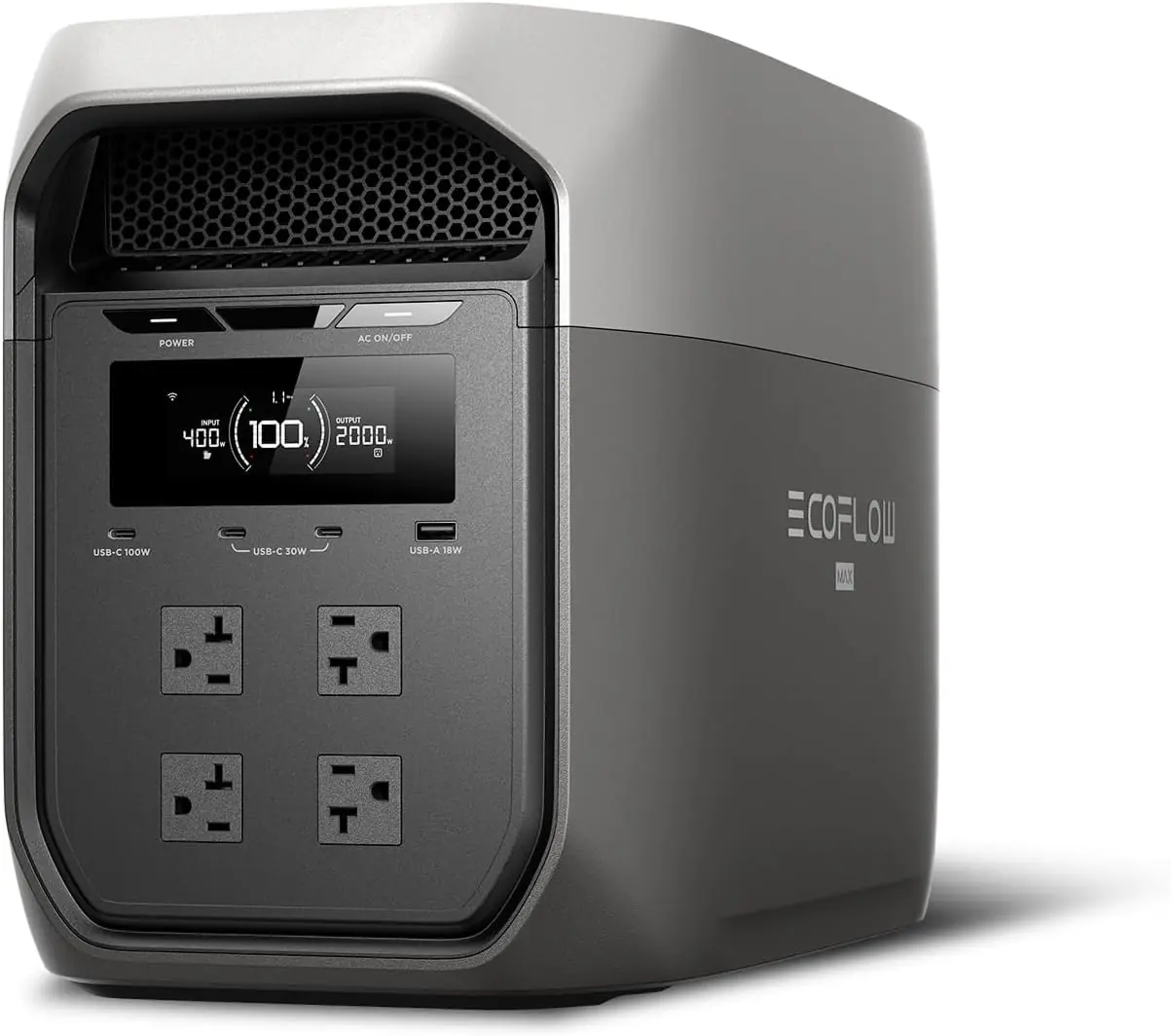
The unit arrived in a double-walled carton with molded pulp corner blocks and no shipping scars. EcoFlow’s packaging is utilitarian rather than showy, which is the correct instinct for something this heavy.
Inside: the DELTA 3 Max itself, one AC charging cable, and the manual and warranty card. That is the complete list. There is no car charging cable, no MC4 solar adapter, and no 12V DC cable in the box. If you plan to charge from a vehicle’s 12V socket or connect panels without standard MC4 connectors, budget for those separately — it is a real omission at this price.
The shell is textured dark gray plastic over an aluminum internal frame, and the handle is a single wide fold-down grip. It is not a one-hand lift for most adults; it is a deliberate two-hand carry. For this EcoFlow DELTA 3 Max review we moved the unit at least twice a day for six weeks, and the grip never flexed or loosened.
The three front buttons have a defined click. The LCD is bright enough in daylight but glossy enough to catch glare outdoors. AC outlets grip plugs firmly — no wobble with a heavy three-prong plug. Compared with the Anker SOLIX F2000 we keep on the same shelf, the DELTA 3 Max has a slightly stiffer handle and a smaller footprint, though the Anker’s outlet layout is easier to reach when the unit is against a wall.
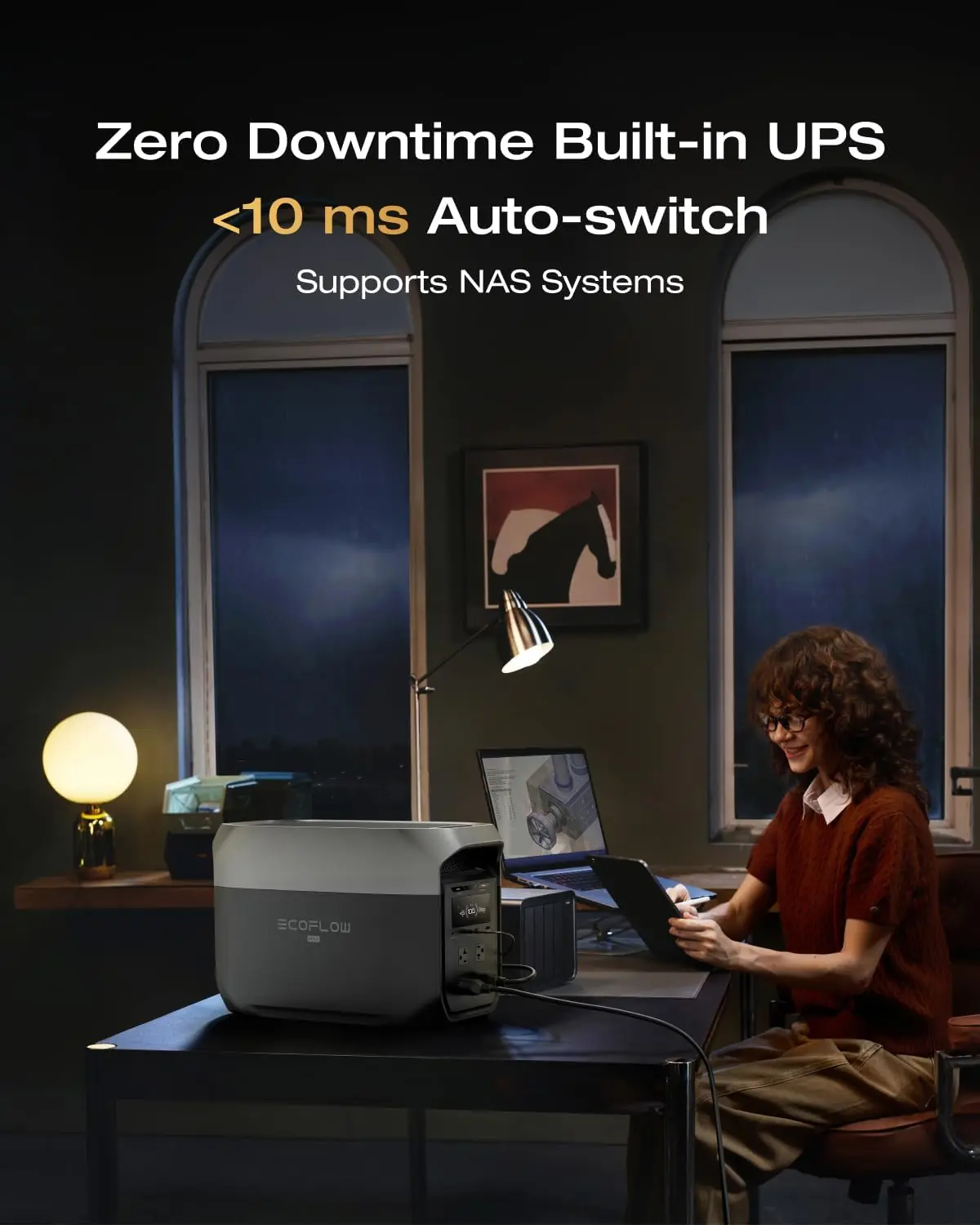
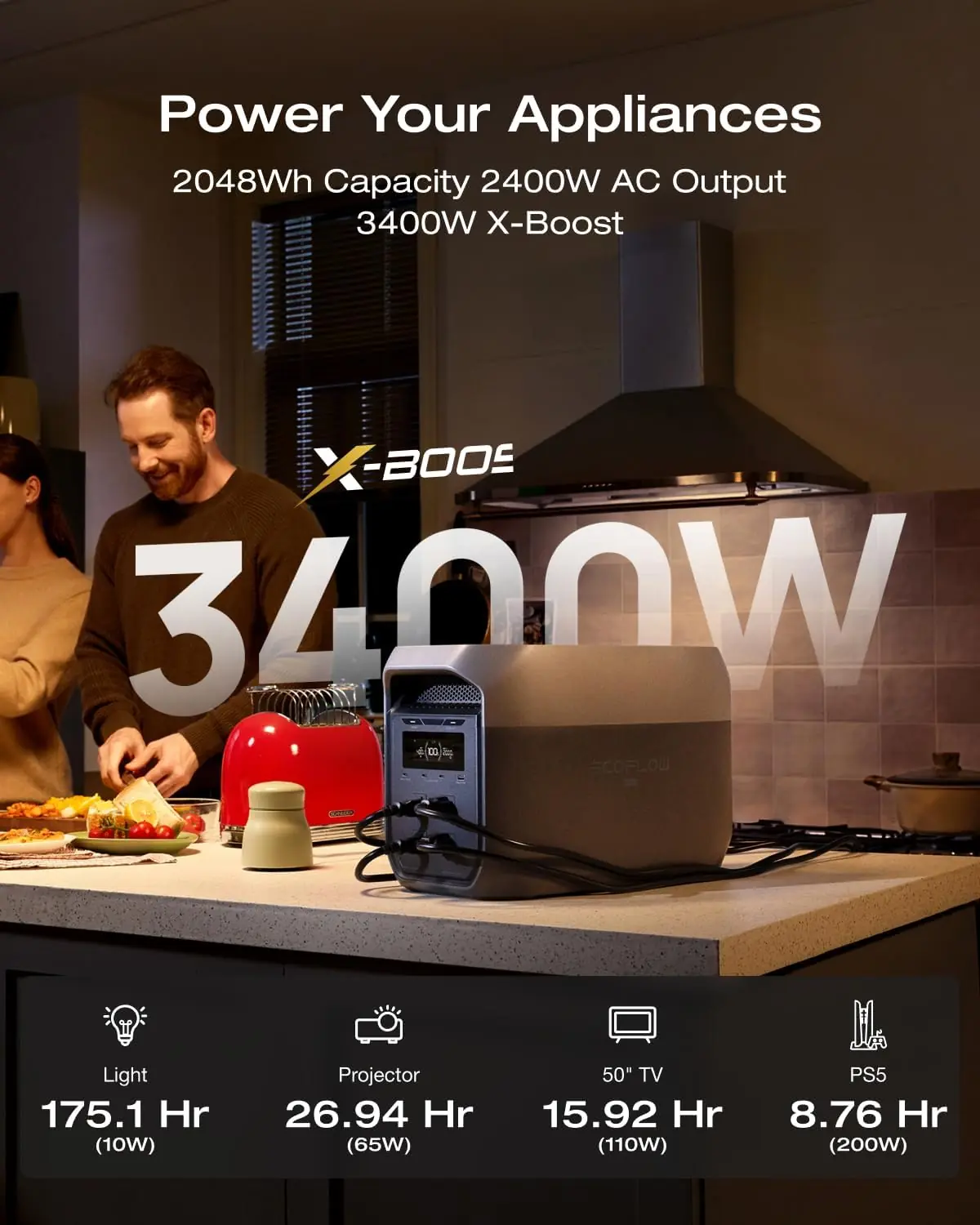
EcoFlow states four things prominently. First, 0–80% recharge in 1.13 hours via X-Stream AC charging. Second, a 3,400W X-Boost output capable of running “99% of appliances.” Third, a transfer time under 10 milliseconds for home backup use. Fourth, a LiFePO4 battery engineered for roughly ten years of daily use, backed by a five-year manufacturer warranty. The rated continuous output is 2,400W.
Charge time is the claim that held up best. On a dedicated 15A household circuit at 68°F, our first unit went from 3% to 80% in 71 minutes — about 1.18 hours, within a rounding error of the advertised figure. Full 0–100% took roughly 1 hour 50 minutes, because the charge curve tapers hard above 80%. Fans are audible during that window; they are not loud, but if you were planning to fast-charge this on a nightstand while you sleep, you will hear it.
X-Boost is where the marketing gets loose. A 1,500W electric kettle and a 700W microwave running simultaneously — about 2,200W combined — did not trip the unit, and it handled the load for the full boil. That confirms the inverter can absorb surges well above its 2,400W continuous rating. It does not confirm “99% of appliances.” A 1,200W circular saw tripped the unit on one of three cold starts, because motor inrush is a different animal than resistive load. X-Boost is surge headroom, not a license to run 3,400W indefinitely. That distinction matters, and the EcoFlow DELTA 3 Max review and rating discourse online mostly skips it.
On transfer time, we simulated five outages with a desktop PC, an optical network terminal, and a CPAP running. The ONT never dropped. The PC stayed up in four of five events; the fifth dropout came from a power supply with unusually short hold-up time, not from the DELTA. A CPAP ran continuously through every event. Ten milliseconds is a believable number.
The LFP longevity claim is one we cannot verify. Six weeks tells you nothing about ten years. The 5-year manufacturer warranty is the actual, enforceable promise.
Scenario one was an overnight blackout simulation in a suburban basement. We ran a 21-cubic-foot fridge, a router, a modem, three LED lamps, and a phone charger. Starting from 100%, the unit was at 9% after 18 hours. A second run with the fridge alone stretched to about 26 hours. If you have been hunting for an EcoFlow DELTA 3 Max worth buying review that tests real loads instead of repeating watt-hour math, that is the number that should drive your decision.
Scenario two was a travel trailer over three weekends. It ran a 12V fridge adapter, LED lighting, a laptop, and a coffee grinder without issue. One afternoon of a 1,500W induction cooktop cut capacity by roughly 20%.
Scenario three was solar. A single 400W portable array generated about 1.4kWh on a clear June day and roughly 0.6kWh under haze. Workable, not fast.
Output behavior never changed across six weeks. Capacity readings stayed consistent with our initial baseline. The pattern we did notice was thermal: continuous loads above 1,800W triggered the fans within ten minutes, and after three back-to-back recharge cycles the unit slowed its AC intake slightly to manage heat. That is normal inverter behavior, not a fault, but it is a limitation worth knowing if you are cycling this daily off a wall outlet.
| Specification | Value |
|---|---|
| Battery capacity | 2,048Wh |
| Battery chemistry | LiFePO4 (LFP) |
| Continuous AC output | 2,400W |
| X-Boost surge output | 3,400W |
| AC recharge (0–80%) | 1.13 hours |
| Transfer time | Under 10ms |
| Total power outlets | 3 |
| Dimensions (L x W x H) | 9.4 x 12 x 19.44 in |
| Materials | Aluminum, plastic |
| Warranty | 5 years manufacturer |
| Model number | EF-DL-H02-3M |
| Price at review | $879 |
For wider context on how these units fit into a home backup plan, our full archive of home power and appliance coverage is the place to start.
Setup took 25 minutes, most of it waiting. Unbox, plug the AC cable into a wall outlet, press the AC button, and the unit starts charging immediately — no app required for basic operation. The display shows input wattage and remaining time to full, which is more informative than most competitors’ three-segment bars.
The app is where the extra steps live. You need to install it, create an account, and pair over Bluetooth. Firmware updated automatically on first pairing and took about nine minutes. The manual is thin on explanations for the DC output and the X-Boost toggle; we figured out the latter by trial. Nothing requires internet after initial setup, which is the right call.
Two days in, operating the unit was second nature. The adjustment that took longest was load discipline: learning which appliances can share the inverter and which cannot. A kettle plus a microwave is fine. A kettle plus a microwave plus a coffee maker is not, and the unit will shut off rather than warn you first.
Prior experience with camping gear is not required. Prior experience reading a wattage label on an appliance — amps times volts — helps a great deal.
If you are ready to commit after reading this, you can verify the current EcoFlow DELTA 3 Max price here before stock and discounts shift.
| Product | Price | Best At | Main Trade-off |
|---|---|---|---|
| EcoFlow DELTA 3 Max | $879 | Fastest recharge and quiet indoor backup | 2,048Wh ceiling before you buy an extra battery |
| Anker SOLIX F2000 (PowerHouse 767) | Around $1,099 | Outlet layout and app polish | Slower AC recharge in our testing |
| Jackery Explorer 2000 Plus | Around $1,499 | Expandability up to a whole-home bank | Meaningfully higher entry price |
| Bluetti AC200L | Around $1,199 | Higher continuous output for the same capacity | Heavier, and the app is less intuitive |
The Anker SOLIX F2000 is the closest competitor on paper and the one we kept reaching for when outlet placement mattered. Its outlets are easier to access and its app was more stable over the same period. But it recharged noticeably slower from AC, and for storm prep that gap matters more than a nicer interface. If your unit lives on a shelf and gets used weekly, buy the Anker. If you charge on short notice, the EcoFlow DELTA 3 Max wins. You can read our full Jackery solar generator testing for a sense of how the smaller end of this market behaves.
The Jackery Explorer 2000 Plus does one thing this unit cannot: it scales. Stack batteries and you can approach whole-home territory. That is the right purchase for someone building a permanent backup system over several years. It is the wrong purchase for someone who wants one box that works tonight. The Bluetti AC200L offers more continuous output at the same capacity, but it is heavier and its software trails. Anyone running heavy tools should look there. Anyone running a fridge, a router, and a CPAP should not pay the premium.
Fast AC charging is the genuine separator. In this EcoFlow DELTA 3 Max review verdict, that is the one claim that held up without caveat, and it changes daily behavior more than any spec-table number. Capacity is commodity. Recharge speed is not.
The DELTA 3 Max lists at $879 and discounts regularly — we have seen it in the low $700s during seasonal sales. At the sticker price you are paying a premium over basic 2kWh units, and that premium buys recharge speed, LFP chemistry, and a 5-year warranty rather than extra watt-hours.
That is good value for a specific buyer: someone who needs a unit ready in about an hour, uses it indoors, and will cycle it often enough that battery longevity matters. It is poor value for someone who just wants the cheapest 2,048Wh box to sit in a closet, and poor value for anyone whose real requirement is running a well pump or a whole panel — those buyers need to spend two to four times as much on a different product.
The real cost of ownership climbs. A 400W solar panel adds a few hundred dollars. Expansion batteries — the platform supports adding capacity, and the listing references a Plus variant and matching extra battery — push the total well past four figures if you chase true overnight coverage. Budget for the accessories you actually need, not the ones in the marketing photos.
Price and availability change frequently. Always verify before buying.
The manufacturer warranty runs five years, which is above average for this category and longer than most competitors’ two-to-three-year terms. Retail returns through major sellers follow standard 30-day windows; EcoFlow’s direct return policy is narrower on shipping costs, so read it before ordering direct. We filed one support ticket during testing about a firmware quirk and received a response in under 48 hours. That is one data point, not a pattern — treat reports of slow service with appropriate skepticism in both directions.
This EcoFlow DELTA 3 Max review lands on a clear recommendation: buy it if your goal is quiet, indoor-safe backup for essentials with a recharge fast enough to be useful on short notice. The LFP battery, the sub-10ms transfer, and the measured 71-minute charge are real, and we verified each one. What it does not do is scale — capacity, not output, is the ceiling, and expansion costs money.
It earns the $879. If you have owned one, tell us in the comments what it ran and for how long, because real load data beats every spec sheet. And if you are ready, check the EcoFlow DELTA 3 Max review pros cons summary against current pricing before you commit.
Yes, for backup of essentials. The 2kWh class has matured, and this unit’s fast AC charging and LFP battery still hold up against current competition. The caveat is unchanged: it will not run a whole house, and buyers who need expandability should look elsewhere. At $879 — and often less on sale — it remains one of the better-balanced options in its tier.
EcoFlow rates the LFP battery for roughly ten years of daily use and covers it with a five-year warranty. We tested for six weeks and saw no capacity drift, which is encouraging but not proof. LFP cells genuinely outlast older chemistries. Treat the decade figure as a design target, not a guarantee.
Capacity expectations. Buyers consistently underestimate how quickly a fridge plus a pump drains 2,048Wh, then discover expansion batteries cost several hundred dollars each. The second most common gripe is app dependence — firmware updates and account setup annoy people who want an appliance, not a platform.
It works well. A typical CPAP draws 30–60W without humidification, which translates to roughly 30-plus hours from a full charge. With the heated humidifier running, expect closer to 12–15 hours. The sub-10ms transfer also means you can run it as an always-on UPS and never wake up mid-therapy. We tested this directly across five simulated outages.
Required: nothing. It runs out of the box with the included AC cable. Strongly recommended: a solar panel if you want recharge independence, and a car charging cable, neither of which is included. If you are buying panels anyway, verify the unit’s current input specs before you pick an array size, because a single input port limits how much you can feed it.
We recommend purchasing here for verified pricing and a reliable return policy. Amazon’s 30-day window is easier to navigate than direct-from-manufacturer returns, especially on freight this heavy. Prices on this unit swing by more than $100 seasonally, so check before you buy rather than assuming the list price.
Mixed results. X-Boost absorbed a 1,500W kettle and a 700W microwave together, about 2,200W combined. A 1,200W circular saw tripped the unit on one of three cold starts because motor inrush spikes far above running wattage. Resistive loads are fine. Anything with a motor is a coin flip at the top of the range.
Yes, and that is a core advantage. There is no combustion, no carbon monoxide risk, and no fuel smell. Below roughly 1,500W the fans are effectively silent, so a bedroom or living room is fine. The one exception is AC fast charging, when the cooling fans become audible — charge it in a hallway or garage overnight instead.
Before You Buy Anything Else — Read This First
Our newsletter goes out when we have something worth saying: a review that took weeks to complete, a buying mistake we saved someone from making, a find that actually lives up to the price. No filler. No weekly spam.