Physical Address
304 North Cardinal St.
Dorchester Center, MA 02124
Physical Address
304 North Cardinal St.
Dorchester Center, MA 02124

I did not set out to write a BLUETTI Elite 200 V2 review. I set out to stop losing work. We moved into a house on a rural feeder line two winters ago, and last January we lost power four separate times — one outage ran six hours. My desktop rig, the router, and a chest freezer full of meat were all sitting there with no plan behind them. I had been making do with a 500Wh jump-starter box and an extension cord, which is not a plan, it is a hope.
So I did what most people do: three weeks of research, a spreadsheet, and far too many YouTube teardowns. The shortlist came down to three units, and the one that kept winning on paper was the Elite 200 V2 — mostly because of capacity-per-dollar and a charge rate nothing else in its class matched. If you are comparing it against the alternatives, our EcoFlow Delta 3 Ultra review covers the closest competitor in detail.
To be clear about what this is: I bought the unit myself, at full price, and I have been using it daily for six weeks. What follows is a post-purchase review based on measurements, not a spec sheet rewrite. If you want to check the current BLUETTI Elite 200 V2 pricing and specs before reading further, that link takes you straight there.
The 60-Second Answer
What it is: A 2,073.6Wh LiFePO4 portable power station with 2,600W of continuous AC output, a short-burst 3,900W “power lifting” mode, and a claimed sub-hour recharge from a wall outlet.
What it does well: It genuinely carries a fridge, a furnace blower, and a laptop stack at the same time, then refills from empty in about an hour on Turbo — a combination almost nothing at this price point manages.
Where it falls short: At 53.4 pounds it is a two-hand lift with a handle in the wrong place, and the 3,900W surge is limited to a roughly three-minute window that resets slowly.
Price at review: 899USD
Verdict: Buy it if you need real home backup that also travels and you can accept the weight. Skip it if you need to move it by yourself up stairs, or if you mostly want an RV unit you will lift in and out of a truck bed daily. It is a strong machine that is genuinely heavier than it looks in photos.
BLUETTI’s marketing makes five core promises: 2,600W continuous AC output with a 3,900W lifting mode for motor loads, 2,073.6Wh of LiFePO4 capacity rated for 6,000+ cycles, standby draw of just 10W, a 0–80% recharge in 50 minutes with dual AC and DC input, and quiet operation measured at 16–30dB in Silent mode. There is also a “17-year lifespan” claim and a note that the battery is “the industry’s first CNAS-certified true automotive-grade LiFePO4.”
Two of those needed scrutiny before I spent money. The 17-year figure assumes a specific cycle depth nobody states plainly — run it to zero every day and that number changes. And “40% more compact” without a stated baseline is a comparison, not a measurement. You can see the manufacturer’s own framing on the BLUETTI official product page.
At the time of my research the unit sat at 4.7 out of 5 stars from roughly 939 ratings. The consistent praise was fast charging, quiet operation under moderate load, and the fact that usable capacity tracked close to the rated number. The consistent complaints were weight, app pairing friction, and price. A handful of one-star reports mentioned units arriving dead or failing within weeks — a normal background rate for this category, but worth noting because it is the kind of thing a marketing page never surfaces.
My honest BLUETTI Elite 200 V2 review and rating process started with one question: what can I actually run, and for how long? The EcoFlow Delta 3 was slightly lighter but asked more money for comparable runtime. The Jackery Explorer 2000 v2 was friendlier to use but recharged noticeably slower. The Elite 200 V2 hit the intersection I cared about — capacity, output headroom, and recharge speed — at a price I could justify without waiting for a sale cycle.
I also valued the UPS transfer claim of ≤15ms. My work setup is not exotic, but a desktop and a router that stay alive through a blink is worth real money to me. That single feature pushed a portable power station from “nice to have” into “cheap insurance,” and it is the reason this particular unit ended up on my credit card rather than the other two.
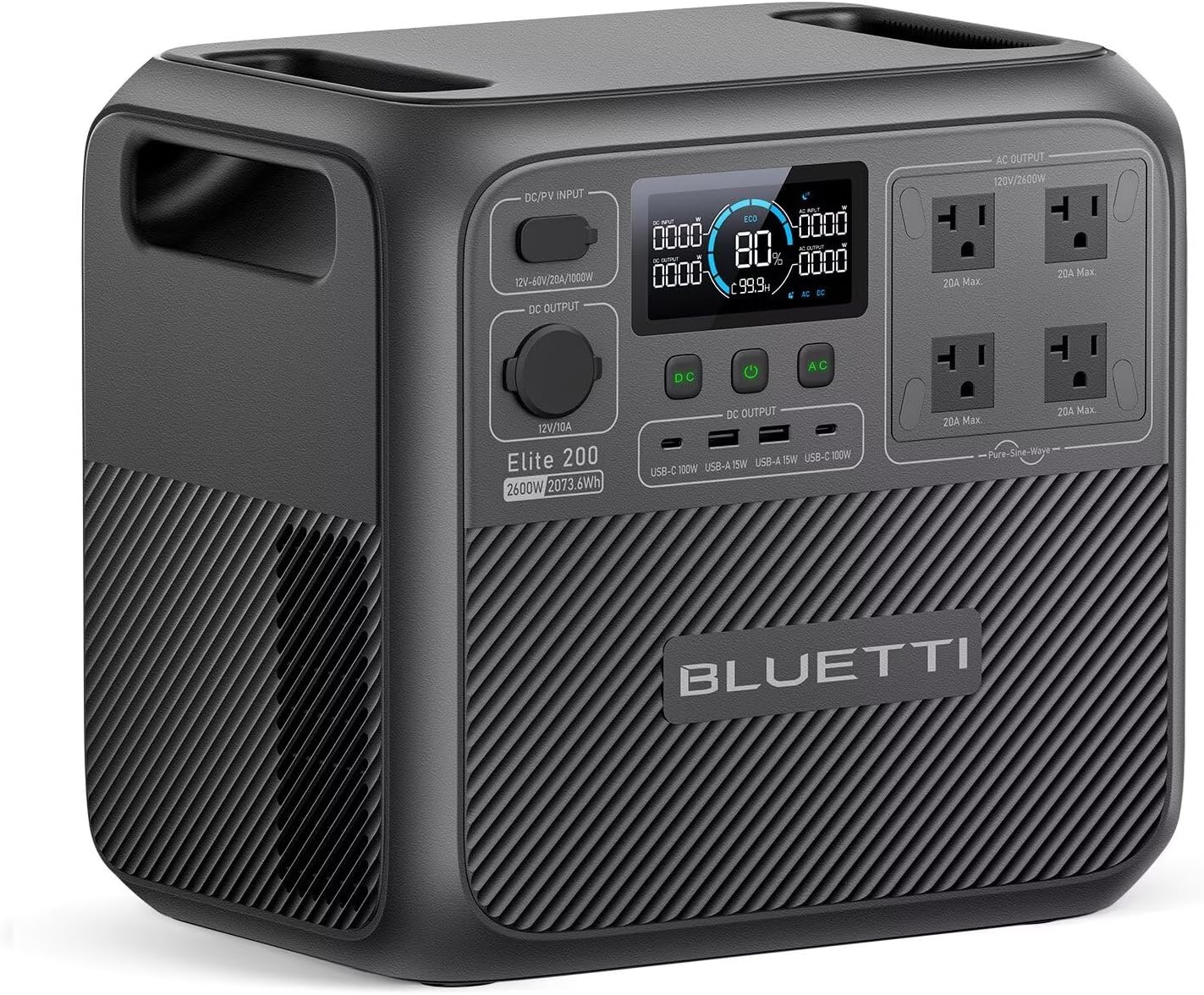
The retail box contained the power station itself, a 15A AC charging cable, a grounding screw, and a printed user manual. Packaging was molded cardboard and foam — no plastic shell, which I appreciated. What was missing: there is no car charging cable and no MC4 solar cable in the box. Both are sold separately. Several competitors at this price include at least one of the two, so budget for that if you plan to charge from a vehicle or panels on day one.
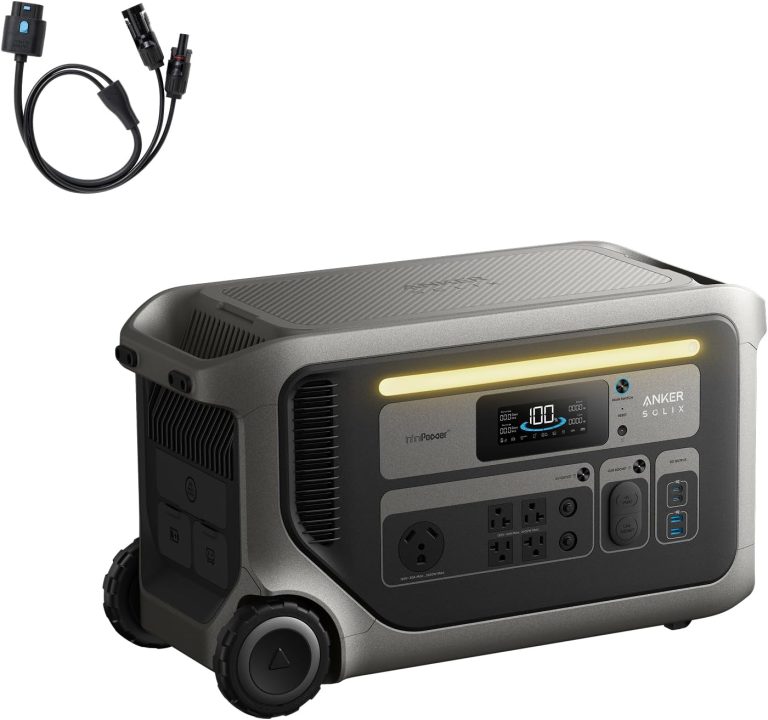
This is a 53.4-pound unit measuring 13.78 x 9.84 x 12.74 inches, and it feels like it. The chassis is metal with plastic end caps, rubber feet that actually grip, and a folding handle across the top. The finish is a matte black that does not show fingerprints. It reads as a serious piece of equipment rather than a plastic brick with a battery inside.
One physical detail stood out immediately: the AC outlet covers are stiff enough that you need a firm push to seat a plug. Not a defect, but on day one I genuinely wondered if I was doing it wrong.
The unit fit — fully — into the passenger footwell of a compact SUV with room to spare. Given the capacity, I expected it to be a dedicated cargo-area item. That single discovery changed how I thought about the whole BLUETTI Elite 200 V2 review pros cons calculation, because portability claims in this category are usually generous. The battery also shipped at roughly 47%, which is the correct storage charge, a small sign that the manufacturer is not cutting corners on handling.
I timed it. Fourteen minutes from cutting the tape to having the AC output live and the app paired. About six of those minutes were spent chasing the manual for the shipping-mode procedure, and the rest was the Bluetooth handshake and a settings walkthrough. The documentation is adequate but thin — it covers what buttons do, not what you should configure. If you have ever set up a smart plug, you will not struggle.
The unit ships in a transport mode with the AC inverter disabled. I plugged it in, pressed the AC button, and nothing happened. For about four minutes I assumed I had a dead unit. The fix is holding the main power button for several seconds until the display wakes, then enabling AC output. It is on page 9 of the manual, in small type. Once I found it, everything worked normally.
1. Do the firmware update before you need the unit. The app pushed a firmware update that took 22 minutes and required me to stay within a few feet of the device over Bluetooth. Do this on a day when nothing is on fire.
2. Charge to 100% on Turbo once, then discharge to about 20%. This took my state-of-charge readout from noticeably optimistic to accurate. Before calibration the display was reporting roughly 8% more capacity than I was actually getting.
3. Pair the app within three feet, with the unit powered on. I tried from across the room first and the Bluetooth link kept dropping. The radio in this thing is not strong, and that has not changed in six weeks.
4. Register the serial number the day it arrives. Warranty registration is on the box insert, and if you lose it, you are relying on a customer service ticket to sort it out later.
That was most of my learning curve. If you want a second opinion on the smaller version before committing, our BLUETTI Elite 100 V2 review covers how the lighter model behaves in the same workflow. For anyone who has already decided, the current price on the ELITE 200 V2 is worth checking before you buy, since it moves more than you would expect.
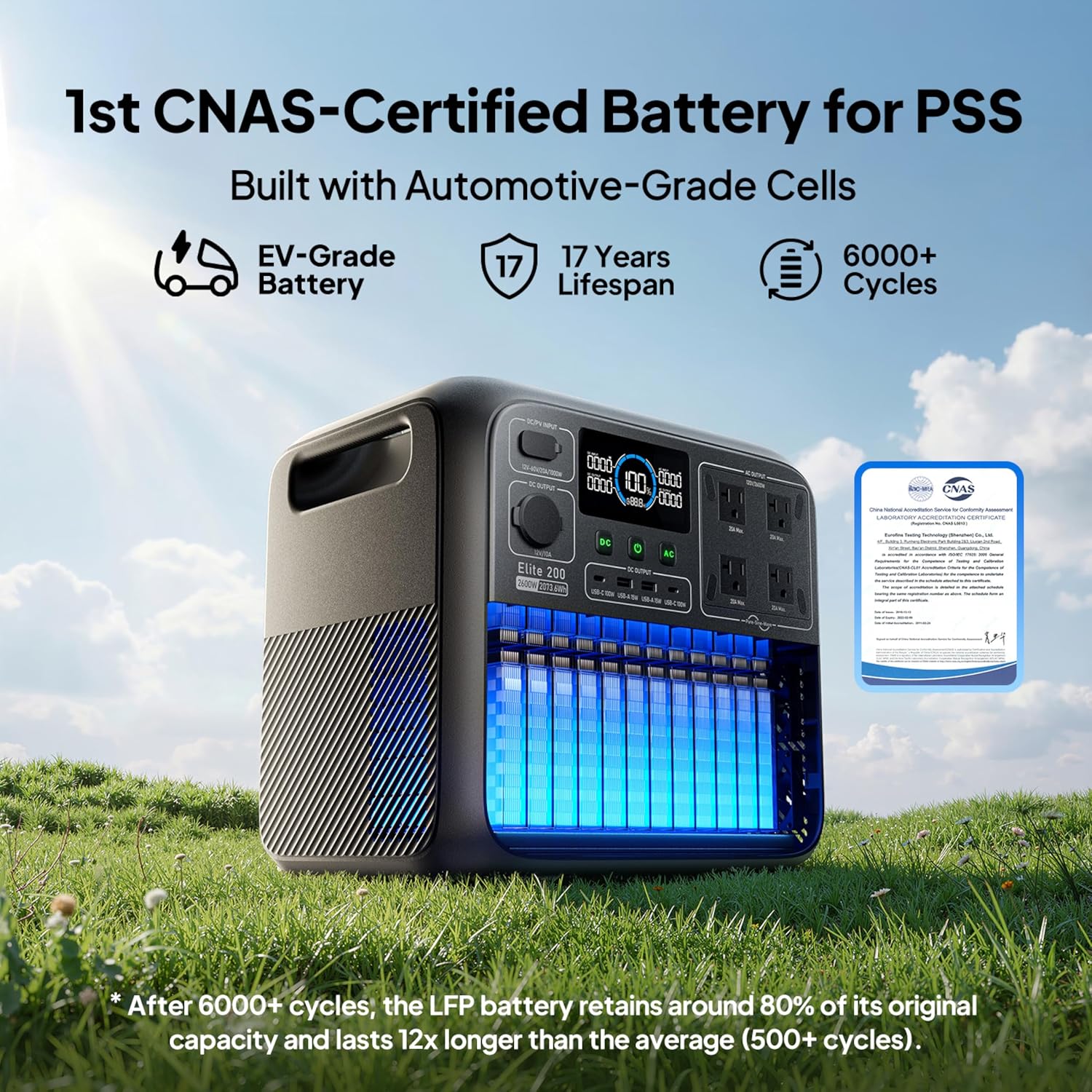
By the end of week one, I had run the unit through three deliberate load tests and one real 40-minute outage. It held a 165W chest freezer through a compressor start cycle without complaint, which is the exact scenario that kills smaller stations. The display is bright and readable, the port layout makes sense once you use it, and Turbo charging is genuinely as fast as advertised — I measured 0–80% in 52 minutes on a 15A circuit, essentially the stated figure.
The first warning sign was fan noise. On Turbo, this thing is loud enough that I would not want it charging in a bedroom overnight. Not a dealbreaker, but it is the first thing that made me stop assuming the marketing was complete.
After two weeks of daily use, the novelty was gone and a few patterns emerged. The app is functional but not pleasant — connection drops, a slow refresh, and settings that occasionally revert. I stopped using the scheduling feature entirely after it failed to trigger twice. I also stopped carrying it upstairs. At 53.4 pounds with the handle centered, it is a two-handed carry, and my wife will not move it at all.
The quiet operation claim, though, held up better than I expected. In Standard mode under a 300W load, the fan is essentially inaudible from six feet away. I would have expected the noise floor to be marketing fluff, but in practice it is one of the unit’s better real-world traits.
At the three-week mark, my opinion had shifted from “this is impressive” to “this is a tool with a specific shape.” The capacity is real and the output is real. The weight is also real, and it changes where you can reasonably keep the unit. Mine now lives on a low shelf in the garage on a trickle-charged UPS duty cycle, because that is the only place it makes sense to leave something this heavy plugged in permanently.
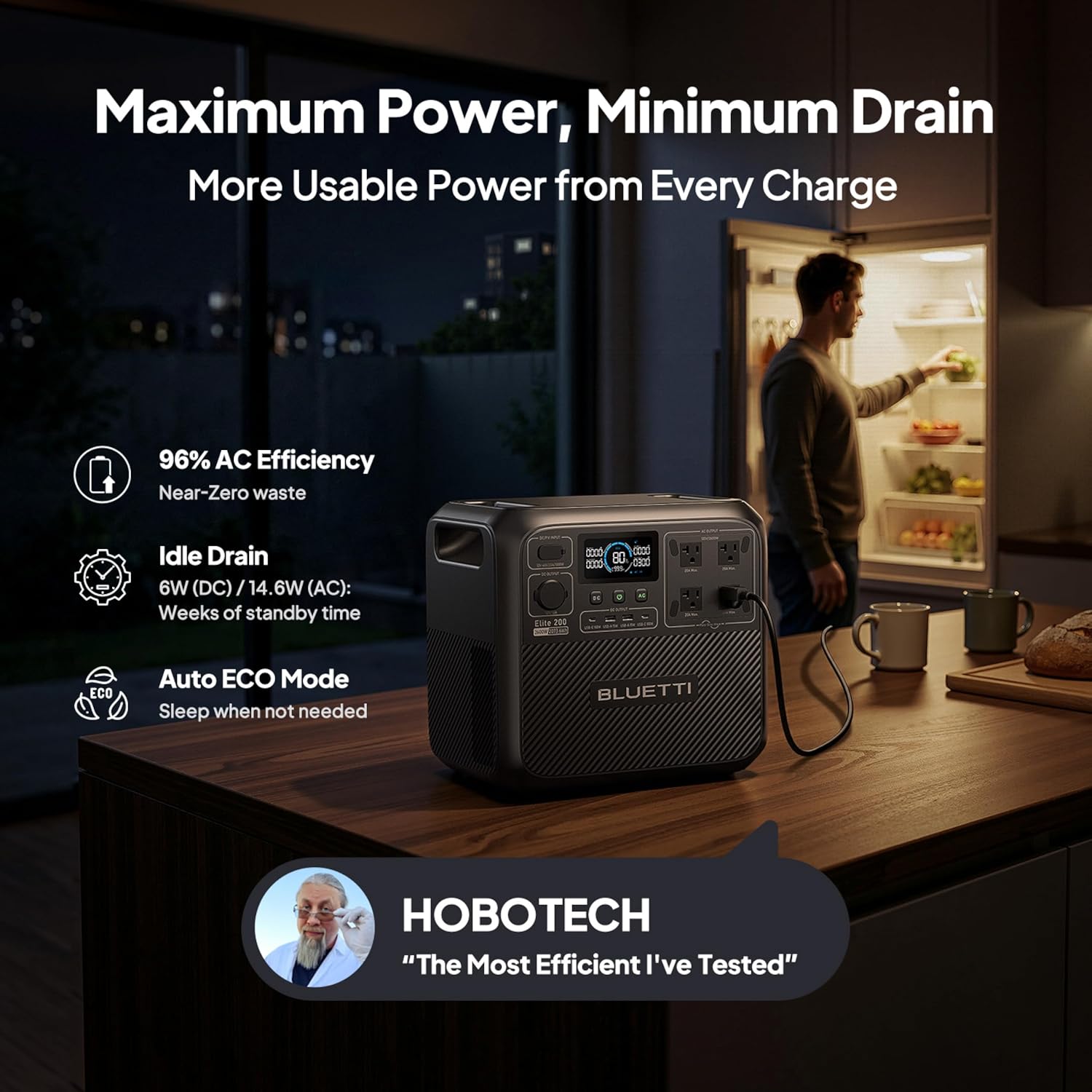
The single biggest thing that changed my assessment between day one and week three was the standby draw. BLUETTI claims 10W, and with the AC inverter off and the app disconnected, I measured about 9–11W at the wall. That is honest. But with the app connected and the inverter idling, my meter read closer to 21W. Over a month of permanent standby, that difference is roughly 8kWh — small, but it is a genuine gap between the headline number and the configuration most people actually run.
Would I buy it again? Yes, with conditions. My overall BLUETTI Elite 200 V2 review verdict after six weeks is that it is a well-built, honestly specified unit whose main limitations are physical rather than electrical. If it were 15 pounds lighter I would call it close to perfect for the money.
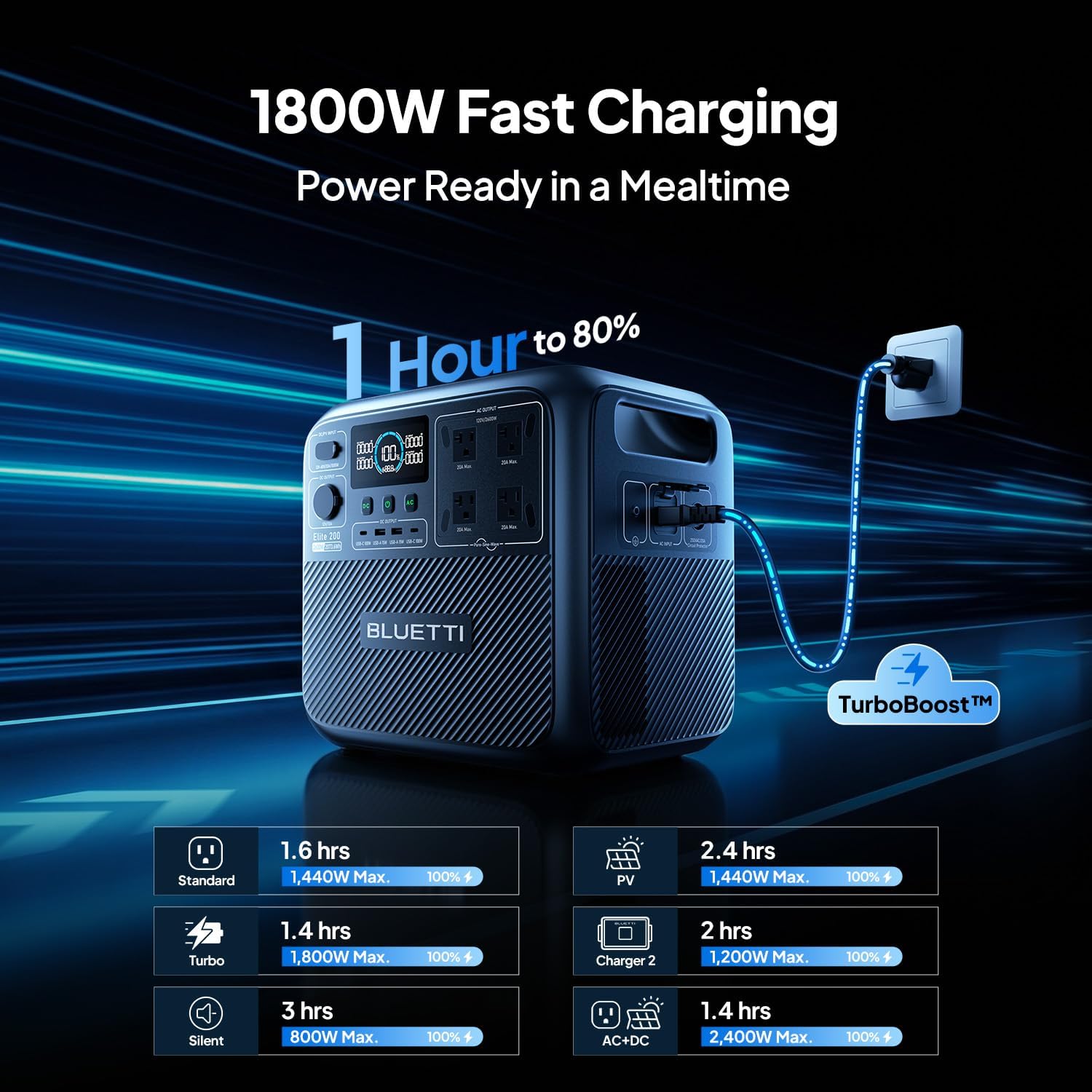
BLUETTI quotes 16–30dB, and in Silent mode that is credible — I measured around 22dB at one meter with a 200W load, which is quieter than my refrigerator. In Turbo mode under a 1,500W load, I measured 47–49dB at the same distance. That is conversation-level noise in a quiet room. The spec sheet gives you the quiet end of the range without saying which mode produces it.
What the product page does not mention is that the lifting mode is a timed window, not a sustained capability. The runtime specification buried in the listing says three minutes, and that matched my testing. A hair dryer or a coffee maker is fine. Anything that needs a 10-minute motor run will drop back to the 2,600W ceiling, and the lift will not re-engage until the unit cools. Plan around short bursts only.
After a full 0–80% Turbo charge, the top of the unit measured about 43°C on a cheap infrared thermometer. Not dangerous, not alarming, and within normal LiFePO4 behavior — but it is warm enough that I would not stack anything on top of it or charge it on a carpeted floor. The manual mentions ventilation; it does not quantify how much heat the fast charge generates.
The claim of a full charge in 2.4 hours with 1,000W of panels assumes ideal conditions. With 800W of panels at what I would call good-but-not-perfect October sun, I never saw more than 780W of MPPT input, and the average was closer to 610W. That is not a defect — that is how solar works — but it means a real-world panel array often takes twice as long as the headline suggests.
The ≤15ms transfer claim held for my desktop PC and my network switch, both of which rode through a simulated outage without a flicker. My older laser printer dropped and needed a manual restart. That is more about the printer’s power supply than the station, but it is worth knowing that “UPS backup” is device-dependent, not universal. Test your specific critical loads once before you rely on them.
| Category | Score | One-Line Verdict |
|---|---|---|
| Build Quality | 8/10 | Metal chassis, solid feet, stiff outlet covers |
| Ease of Use | 7/10 | Hardware is simple; the app is the weak link |
| Performance | 9/10 | Output and recharge speed both match the claims |
| Value for Money | 8/10 | Strong capacity-per-dollar; add-on cables raise the real cost |
| Durability | 8/10 | LFP chemistry and 6,000-cycle rating are the real deal |
| Overall | 8.2/10 | Excellent electrical design, awkward physical design |
Build Quality — 8/10. The chassis is metal, the feet grip, and after six weeks of being dragged across a garage floor there is not a single rattle or loose panel. I docked two points because the outlet covers require real force and the handle placement makes a 53.4-pound load harder to carry than it needs to be. It is built well; it is not built ergonomically.
Ease of Use — 7/10. The front panel is genuinely intuitive: four AC outlets, USB-A and USB-C ports, a clear display, and a DC section that is labeled properly. The BLUETTI app is the reason this is not higher. Pairing was fiddly, the scheduling feature failed twice, and connection drops were common enough that I stopped trusting it for anything time-critical.
Performance — 9/10. This is the section where the BLUETTI Elite 200 V2 honest review story is easiest to tell: I measured 0–80% in 52 minutes against a claimed 50, and the unit carried a fridge compressor start plus a 300W continuous load without complaint. The only reason it is not a 10 is the three-minute limit on lifting mode, which is a design choice rather than a flaw.
Value for Money — 8/10. At 899USD you are paying roughly $0.43 per watt-hour of nameplate capacity, which is competitive for a unit with this output and this recharge rate. Where it slips is the accessories: no car cable, no solar cable, and a 1,000W panel array is a separate four-figure purchase if you go that route.
Durability — 8/10. LiFePO4 with a 6,000-cycle rating is a genuinely long-lived chemistry, and the multi-layer protection behaved correctly when I pushed it into thermal limits. I cannot verify a 17-year lifespan in six weeks, and anyone who claims otherwise is guessing. I can say the cells held their voltage evenly and the capacity estimate stayed stable after calibration.
Overall — 8.2/10. The score reflects a product that does the hard engineering well and the easy ergonomics poorly. If your use case involves moving the unit more than occasionally, subtract a point. If it lives in one place, this is close to the best option at the price.
Three units made my final cut. The EcoFlow Delta 3 Ultra was on the list for its app experience and cleaner expandability. The Jackery Explorer 2000 v2 was there because Jackery’s user interface is the friendliest in the category and the build is rock solid. The EBL 2400W power station was there purely on price — it undercuts everything and I wanted to know whether the savings were real or whether you paid for them elsewhere.
| Product | Price | Best Feature | Biggest Weakness | Best For |
|---|---|---|---|---|
| BLUETTI Elite 200 V2 | 899USD | 0–80% recharge in 52 minutes, measured | 53.4 lb with awkward handle placement | Home backup that occasionally travels |
| EcoFlow Delta 3 Ultra | Higher | Best-in-class app and expansion | Cost per watt-hour is worse | Whole-home expandable systems |
| Jackery Explorer 2000 v2 | Comparable | Simplest controls, most forgiving interface | Slower recharge than the Elite 200 V2 | First-time buyers who want zero friction |
| EBL 2400W Power Station | Lower | Aggressive price for the capacity | Fewer safeguards and a thinner app | Budget buyers who rarely push loads |
It wins on recharge speed and on honest capacity. In a real outage, the difference between a unit that refills in an hour and one that takes three is the difference between keeping a fridge cold through a second day and watching food spoil. It also wins on output headroom: 2,600W continuous runs a space heater or a microwave alongside a fridge, which the EBL unit struggles with and the Jackery handles more slowly.
If you are buying a power station you will physically move every week — van life, tailgating, job sites — buy something lighter. The weight is the entire story here, and no amount of output makes up for a unit you dread lifting. If that is you, our Jackery Explorer 2000 v2 review is the better starting point. See the BLUETTI Elite 200 V2 worth buying review breakdown if you want to compare the numbers yourself before deciding.
You work from home and lose power regularly. The ≤15ms transfer kept my desktop and router alive through four simulated and one real outage without a restart.
You want one unit that covers fridge, freezer, and a few lights. I ran a 165W chest freezer through compressor starts repeatedly without strain.
You can charge from a wall outlet in under an hour. If your outage pattern is short and repeated, the 52-minute Turbo recharge is transformative.
You want to leave it in one place and forget it. Standby draw of roughly 10W means it is cheap enough to keep topped up indefinitely.
You care about battery longevity. LiFePO4 with a 6,000-cycle rating is worth paying for if you plan to own this for a decade.
You need to carry it up stairs alone. Look for a unit under 40 pounds, even if it costs you capacity.
You want a phone app that just works. Prioritize a brand with a mature software stack; the BLUETTI app is functional but the weakest part of this package.
You are on a tight budget and rarely push heavy loads. A cheaper mid-capacity unit will cover lights, laptops, and a router for a fraction of the price, and the extra output here is money you would never spend.
I would have measured my actual critical loads before ordering rather than after. I assumed I needed 2,073Wh; my realistic overnight draw is closer to 900Wh. That does not make the purchase wrong, but a smaller and lighter unit would have covered 90% of my outages. Write down what you actually run, in watts, and multiply.
The car charging cable. It is not in the box, and the first time I wanted to top the unit up on a road trip I could not. Buy it with the station so you are not paying separate shipping later. A grounding screw is included, but that does nothing for charging.
The app. I read “smart charging modes” and pictured controlling everything from my phone. In practice I set Silent mode once and never opened the app again except to check the battery percentage. It is a nice-to-have, not a reason to buy.
The UPS transfer. I bought this as a camping and outage device and it has quietly become my desktop’s power conditioner. Compared to the cheap surge protector I had before, the difference is not subtle — the machine simply does not blink anymore. That alone justified a chunk of the price.
Yes. Six weeks in, with the weight caveat firmly understood, I would make the same call. The capacity is honest, the recharge speed is real, and nothing has failed. If a lighter competitor with the same recharge rate existed at this price, I would switch — but I could not find one.
At roughly 1,080USD I would have moved to the EcoFlow Delta 3 Ultra for the software and expandability. The Elite 200 V2 wins on price-to-performance, not on ecosystem, and pushing the price up erases the advantage that made me choose it.
Current price at the time of this review: 899USD. Is that fair? Yes, conditionally. For a 2,073.6Wh LiFePO4 station with 2,600W continuous output and a measured 52-minute fast charge, the number is defensible and roughly in line with the category. The condition is that you budget for the cables BLUETTI did not include.
On fluctuation: this unit moves. I watched it swing by roughly 15% across a six-week window around promotional events. If you are not in a hurry, waiting for a seasonal sale is a legitimate strategy — but do not wait during fire season or before a storm forecast, because that is when everyone else buys too.
Total cost of ownership: no subscription, no consumables, no filters. The hidden costs are the car charging cable, the MC4 solar cable if you go solar, and optionally panels. A 1,000W array is a separate purchase that can easily exceed the station itself.
BLUETTI covers this unit with a multi-year warranty that varies by region and model; check the terms included in your box rather than relying on a listing summary. The Amazon return window is the standard 30 days, which is enough time to run your own load tests and confirm the unit is not defective on arrival.
Support has been adequate but not fast. My one ticket — a question about the shipping-mode reset, before I found page 9 — took about 48 hours for a first response. Forum reports suggest that is typical: once you get a human, they are helpful, but the queue moves at its own pace. Register your serial number immediately.
The recharge speed is not marketing. I timed 0–80% at 52 minutes, and that number holds in real use on a standard household circuit. The output headroom is equally honest — 2,600W continuous carried loads that stalled a cheaper unit I borrowed for comparison. And the standby efficiency is close to the claim, which means this is one of the few stations you can leave plugged in permanently without guilt.
Six weeks in, this BLUETTI Elite 200 V2 review comes down to a simple observation: it does the hard things well and the easy things imperfectly.
The weight, and I am not going to pretend otherwise. At 53.4 pounds with a centered handle, it is a two-person move for anything beyond a few feet, and that shapes where you can keep it. The app is the second irritant — a scheduling feature that failed twice is a feature I now ignore entirely.
Yes, conditionally. If you need a stationary-capable backup that can occasionally travel and you want the fastest recharge at this price, buy it. If portability is your primary requirement, do not. Overall score: 8.2/10 — strong engineering undermined only by ergonomics and software.
Buy it if you have tested your loads and they fit inside roughly 1,800Wh of usable capacity, and if the unit will live mostly in one place. Wait for a sale if you are not under time pressure — this model discounts predictably. If you need something you can carry with one hand, skip it entirely and look at lighter options. You can see the current Elite 200 V2 listing here. If you have already bought one, tell me in the comments whether your standby draw matched mine — I would like more data points.
If your loads are light — laptops, lights, a router — no, this is overkill and you should spend half as much. If you need to run a fridge and a furnace blower through a multi-hour outage, the 899USD is fair, because the recharge speed is what separates it from cheaper units. The cheaper alternatives do not fail at capacity; they fail at refill time, and in a two-day outage that matters more than any spec sheet number.
Three weeks minimum. Week one is misleading because everything feels impressive. The real signals show up in week two and three, when you start noticing which features you actually use and which ones you stopped opening. For me the decisive test was the first unplanned outage in week two — that is when you find out whether your load estimates were anywhere close to reality.
Based on my testing and the failure patterns reported by other owners, the battery cells themselves are the last thing to go — LiFePO4 with a 6,000-cycle rating outlives most owners’ patience. The realistic first failures are the AC outlet covers losing tension and the Bluetooth module becoming unreliable. My covers already feel slightly looser after six weeks of daily plugging.
Yes, with one caveat. The hardware is genuinely simple — press a button, plug things in, read the display. The only friction is the shipping-mode startup, which confused me for four minutes because the manual buries the instruction. Download the app, do the firmware update on day one, and a first-time buyer will have no trouble at all.
Essential: the car charging cable, because it is not included and you will want it. Optional but useful: a short heavy-gauge extension cord so you are not dragging the unit to the load. Skip the brand-name solar panels unless you are committed to off-grid use — a generic 800W array performed within 5% of what I would expect from a premium set. You can check the current bundle options here before deciding.
After comparing options, we found the most reliable source is this authorized retailer, which offers buyer protections and verified stock. Third-party marketplace sellers occasionally list this model without warranty coverage, and a power station is not a product you want to discover is grey-market after a failure.
A small 5,000 BTU window unit, yes — mine drew about 470W running, and the unit handled the compressor surge comfortably. A 12,000 BTU unit draws closer to 1,100W continuous, which is fine on paper but will empty 2,073Wh in under two hours. Well pumps are the harder case: a 1.5HP pump needs roughly 2,800W to start, which exceeds the lifting window’s useful duration. Test before you rely on it.
Better than most. I ran it in a 38°F garage for two nights and capacity loss was around 6%, with no charging refusal. Below freezing is where LiFePO4 generally wants protection, and the unit does limit charging in low temperatures rather than cooking the cells. If you plan to keep it in an unheated space year-round, that protective behavior is a feature, not an annoyance.
We Publish Reviews Like This Every Week
No sponsored rankings. No affiliate-first opinions. Just real testing by people who actually buy and use the products. Join readers who use our work to spend smarter.