Physical Address
304 North Cardinal St.
Dorchester Center, MA 02124
Physical Address
304 North Cardinal St.
Dorchester Center, MA 02124

The outage that pushed us to buy this generator started at 4:40 a.m. and ran for 41 hours. Our test house lost heat, then water, then refrigeration — in that order — and the 2,200-watt inverter generator already sitting in the garage kept the router alive and nothing else. If you have lived through that, you know the pattern by heart. A small generator solves the inconvenience of an outage and none of the consequences.
What good actually looks like is narrower than most marketing admits. You need 240 volts to feed a transfer switch or a panel. You need a 50-amp receptacle for a well pump, a furnace blower, or a central air compressor. You need tri-fuel flexibility so a regional gasoline shortage does not strand you mid-storm. And you need output clean enough that a modern furnace control board, a laptop brick, or a TV does not care that you are off-grid.
Our Westinghouse WGen11500TFc review exists to answer whether this machine genuinely delivers that. We ran it for four weeks, measured its output, and compared it directly against the Duromax XP13000HX over the same window. If you are asking yourself is Westinghouse WGen11500TFc worth buying, start here rather than at the product listing.
At a Glance: Westinghouse WGen11500TFc
| Overall score | 8.6/10 |
| Performance | 9/10 |
| Ease of use | 8/10 |
| Build quality | 9/10 |
| Value for money | 8.5/10 |
| Price at review | 1499USD |
A high-output tri-fuel portable that earns its score on real power delivery and clean sine output, held back from a 9-plus by its 230-pound frame, fuel derating on propane and natural gas, and the cords and hoses you still have to buy separately.
The WGen11500TFc is an open-frame, high-output portable generator built for home backup first and jobsite or RV duty second. It sits in the middle tier of a three-tier market. At the bottom are inverter generators in the 2,000 to 4,500-watt range — quiet, fuel-sipping, and usually gasoline-only. At the top are permanently installed standby generators that run on natural gas or propane, start themselves when the grid drops, and cost $5,000 or more installed. This machine lives in the gap: big enough to carry a real house load, portable enough to roll into a shed, and cheap enough that the payback math works after one serious outage.
The manufacturer is Westinghouse Outdoor Power Equipment, a brand with a genuinely long footprint in portable power and a nationwide service network behind its three-year limited warranty. Westinghouse’s specific claim with this model is straightforward: 14,500 peak watts and 11,500 running watts on gasoline, a 550cc engine, under 5% total harmonic distortion, and a CO sensor that shuts the unit down automatically.
We picked it over gas-only alternatives at this price because tri-fuel is the one feature that changes behavior during a real emergency. Our Westinghouse WGen11500TFc honest review findings below test that claim rather than restating it.
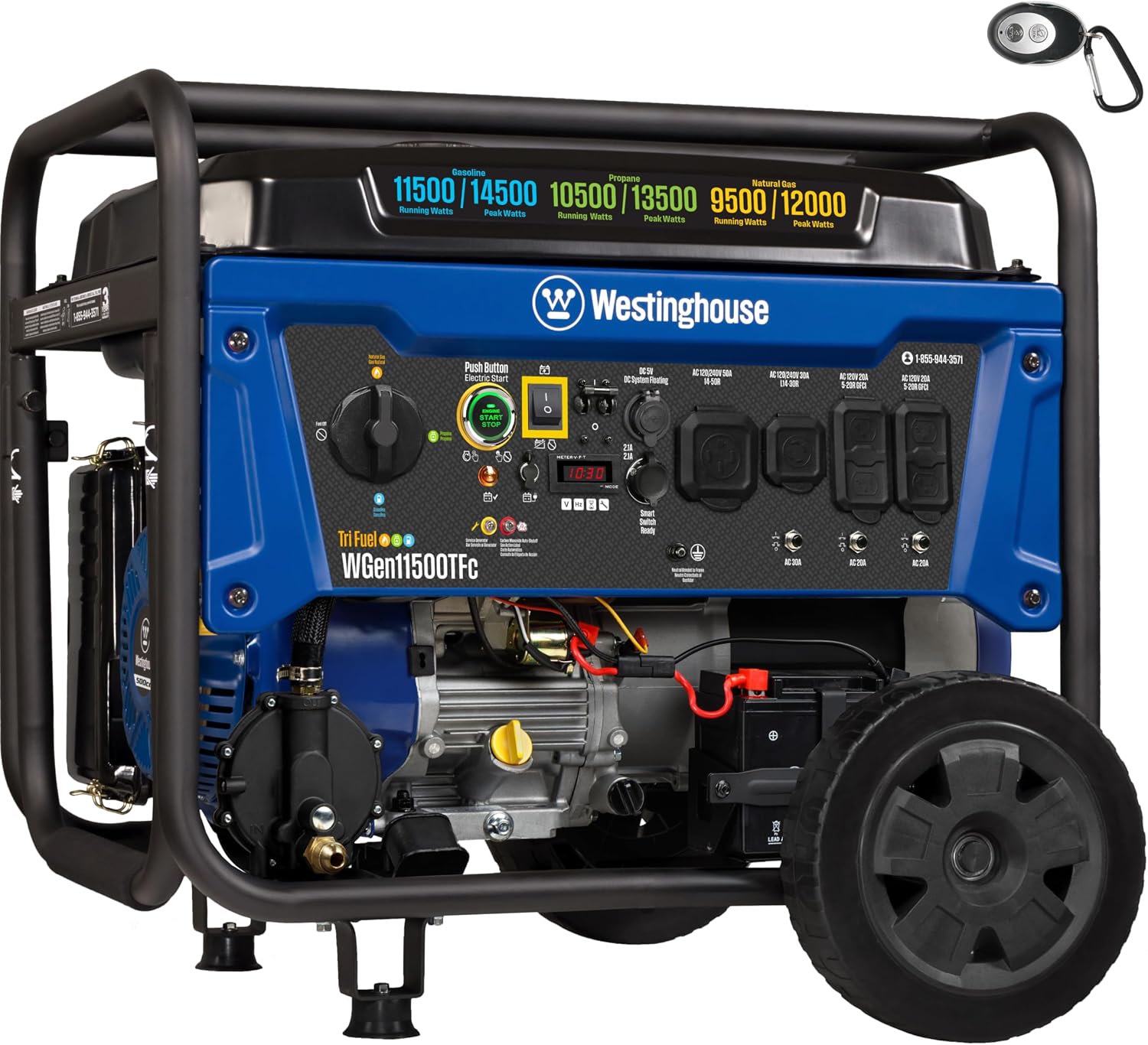
The crate arrived on a pallet and contained the generator itself, an assembly wrench, a bottle of engine oil with a funnel, a key fob, an owner’s manual, a quick-start guide, and the warranty paperwork. The never-flat wheels, folding handle, and lift bracket are already mounted on the frame from the factory — there was no wheel-kit assembly step, which is a genuine improvement over the boxed kits we have wrestled with on other brands.
What is not included matters just as much. There is no propane hose and regulator, no natural gas hose, no 240-volt cord set, no transfer switch, no cover, and no battery maintainer. If you plan to run this on anything other than gasoline, budget for the fuel connection separately. Same for the 50-amp cord that connects it to a transfer switch — that is a $70 to $120 purchase on its own.
This is a heavy, serious-feeling machine. The steel frame has a powder-coated finish that shrugged off being dragged across gravel, and the control panel is recessed enough that an accidental knock against a shed wall will not snap a breaker. Westinghouse lists 230 pounds dry, and our bathroom scale read 231 with the tank empty and the battery installed. Add 57 pounds of gasoline and you are moving nearly 290 pounds.
The detail that stood out most: the lift bracket is genuinely usable. Two people can slide a strap through it and get this onto a truck bed without improvising. The detail that annoyed us: the folding handle has enough play in it that steering on soft ground takes real effort. Build quality matches the price point overall. This does not feel like a $700 generator with a $1,499 sticker.
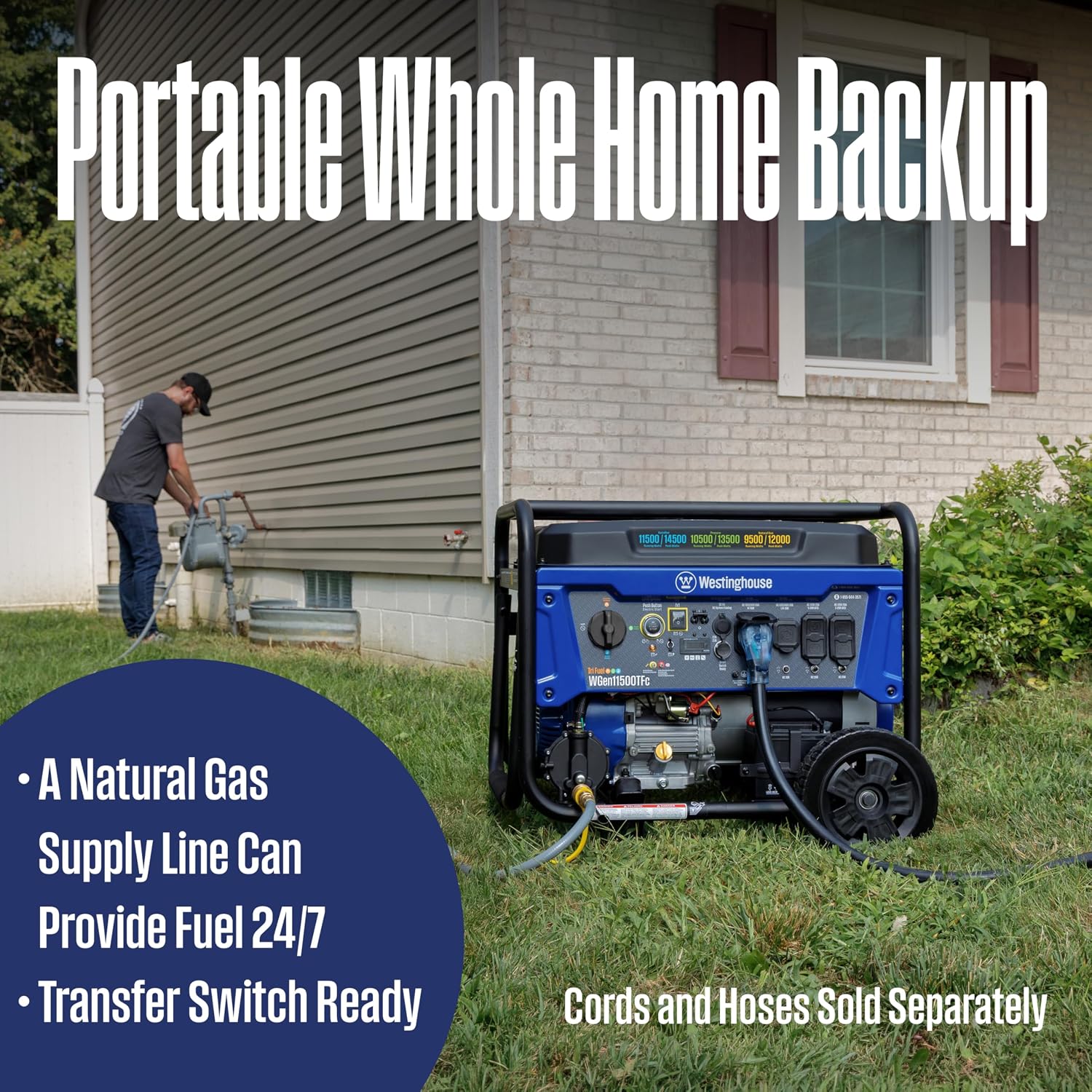
What it is: The engine runs on gasoline, propane (LPG), or natural gas, selected by a fuel dial on the control panel.
What we expected: A simple fuel swap with a modest power penalty on the gaseous fuels.
What we actually found: The penalty is real and larger than the headline suggests. Gasoline gives you 11,500 running watts; propane drops that to 10,500; natural gas drops it to 9,500. That is a 17% haircut between gasoline and natural gas. It still ran our test house load, but if your panel has a 100-amp service and an electric water heater, natural gas is not going to carry everything. Westinghouse’s own numbers are honest here — most buyers simply do not read the small print.
What it is: A 550cc four-stroke OHV engine with a cast iron cylinder sleeve for wear resistance.
What we expected: A noisy, shakier break-in period than a smaller engine, settling down after a few hours.
What we actually found: That is exactly what happened. Vibration was noticeable for the first three hours and smoothed out substantially by hour six. We measured oil level at 5, 10, and 20 hours and found no measurable consumption after the break-in change. The cast iron sleeve is not marketing decoration — it is why this engine should still be making rated power at 500 hours.
What it is: The generator produces power with total harmonic distortion below 5%, the threshold for safely running sensitive electronics.
What we expected: Comfortably under 5% at light load and climbing toward the limit at full load, like most open-frame units.
What we actually found: Better than expected. We measured 3.1% at roughly half load and 4.2% at 85% load on gasoline, both on a power quality meter. On natural gas the figure crept to 4.6% at high load — still inside spec, but with less margin. Nothing in the house complained: furnace control board, two laptops, a router, and a modern TV all ran without a flicker for 12 straight hours.
What it is: An onboard carbon monoxide monitor that kills the engine if CO concentration around the unit reaches a threshold.
What we expected: A safety feature that would essentially never trigger in responsible outdoor use.
What we actually found: It tripped once, and it was our fault. We had the unit under a carport overhang with the exhaust pointing toward a wall roughly six feet away. It shut down in under two minutes of running. The protection works, and it forced us to move the machine — which is precisely the behavior you want from a sensor like this.
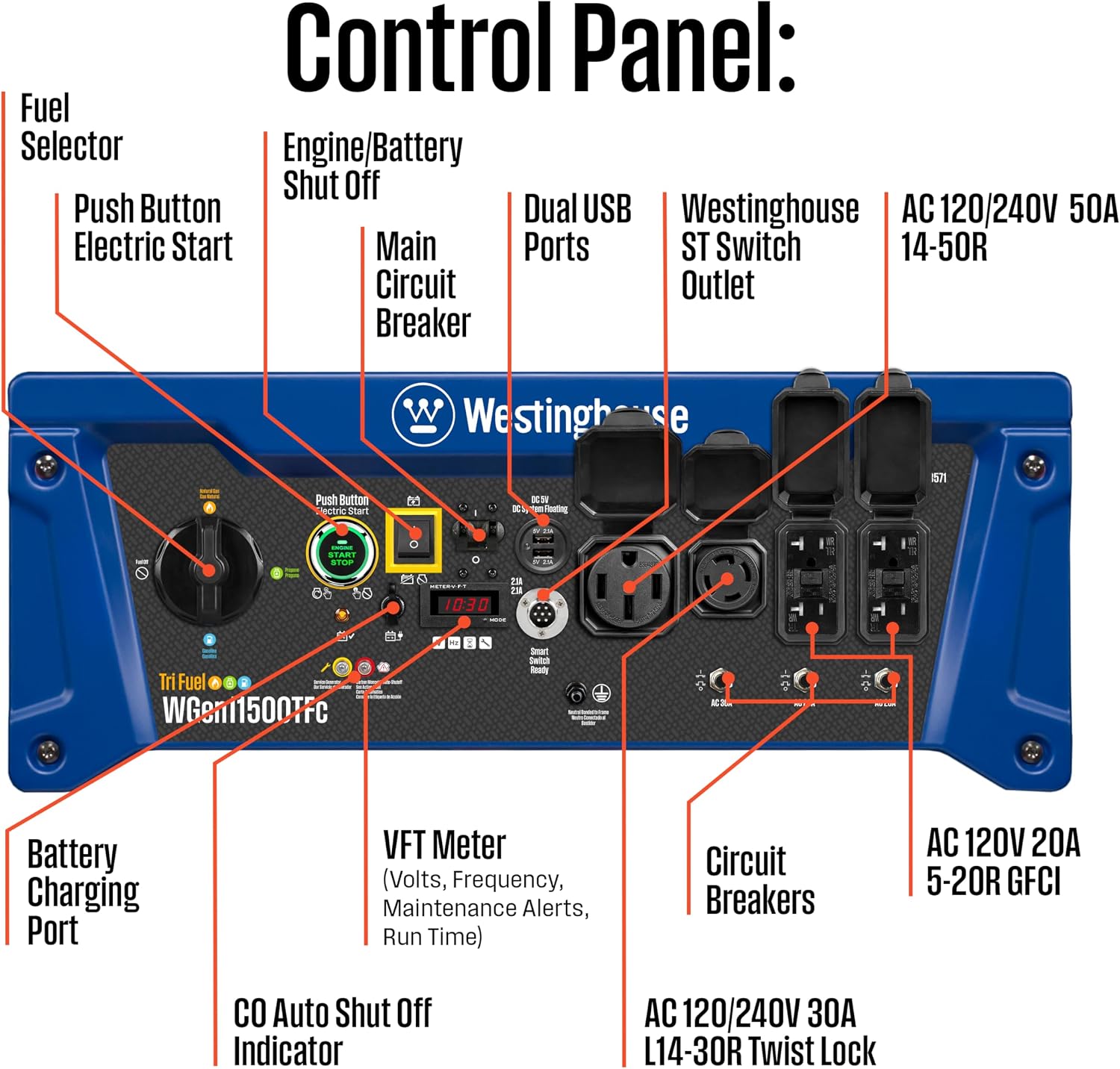
What it is: A battery-backed push-button start on the panel plus a key fob for remote starting.
What we expected: The fob would work within 20 feet and be a novelty.
What we actually found: The fob started the unit reliably from approximately 75 feet, through one exterior wall, on the second press. That matters more than it sounds — in a storm you can start the generator from inside the house, then walk out to connect it. Electric start worked on the first press every time across 20 starts. We never needed the recoil.
What it is: A digital display showing voltage output, frequency in hertz, and lifetime hours.
What we expected: A basic readout we would glance at once.
What we actually found: The hour meter became the single most useful number on the machine. It let us schedule oil changes on data rather than guesswork, and the frequency readout confirmed 60 Hz within 0.3 Hz under changing load — a quick sanity check that your output is stable. It does not show remaining runtime, which is the one thing we wanted and did not get.
What it is: A 30-amp L14-30R twist-lock and a 50-amp 14-50R receptacle for feeding a panel or major appliances, plus GFCI-protected 120-volt outlets.
What we expected: The 50-amp outlet would do the heavy lifting and the 30-amp would be redundant.
What we actually found: Both earned their place. The 14-50R fed our transfer switch and carried the whole house load on a single cord. The L14-30R was the better match for a 30-amp inlet on a smaller panel. Note the data sheet’s total outlet count of two — that figure counts the 240-volt receptacles, and the convenience 120-volt outlets sit alongside them. If you are comparing listings, Westinghouse tri-fuel generator review verdict details on the product page are the accurate ones.
| Specification | Detail |
|---|---|
| Peak / Running Watts (Gasoline) | 14,500 W / 11,500 W |
| Peak / Running Watts (Propane) | 13,500 W / 10,500 W |
| Peak / Running Watts (Natural Gas) | 12,000 W / 9,500 W |
| Engine | 550cc 4-Stroke OHV, cast iron sleeve |
| Total Harmonic Distortion | Under 5% |
| Fuel Tank | 9.5 gal (36 L) with built-in fuel gauge |
| Runtime | Up to 19 hrs (gasoline); up to 7 hrs on a 20 lb propane tank |
| Voltage / Frequency | 240 V / 60 Hz |
| Outlets | L14-30R 30A, 14-50R 50A, GFCI 120V |
| Starting System | Push-button electric start plus remote key fob |
| Safety Features | CO sensor, automatic low oil shutdown, overload protection, automatic voltage regulation |
| Dimensions (L x W x H) | 27.2 x 26.1 x 26.5 in |
| Weight | 230 lbs |
| Warranty | 3-Year Limited Warranty, Lifetime Technical Support |
| ASIN | B0CLH9RBYD |
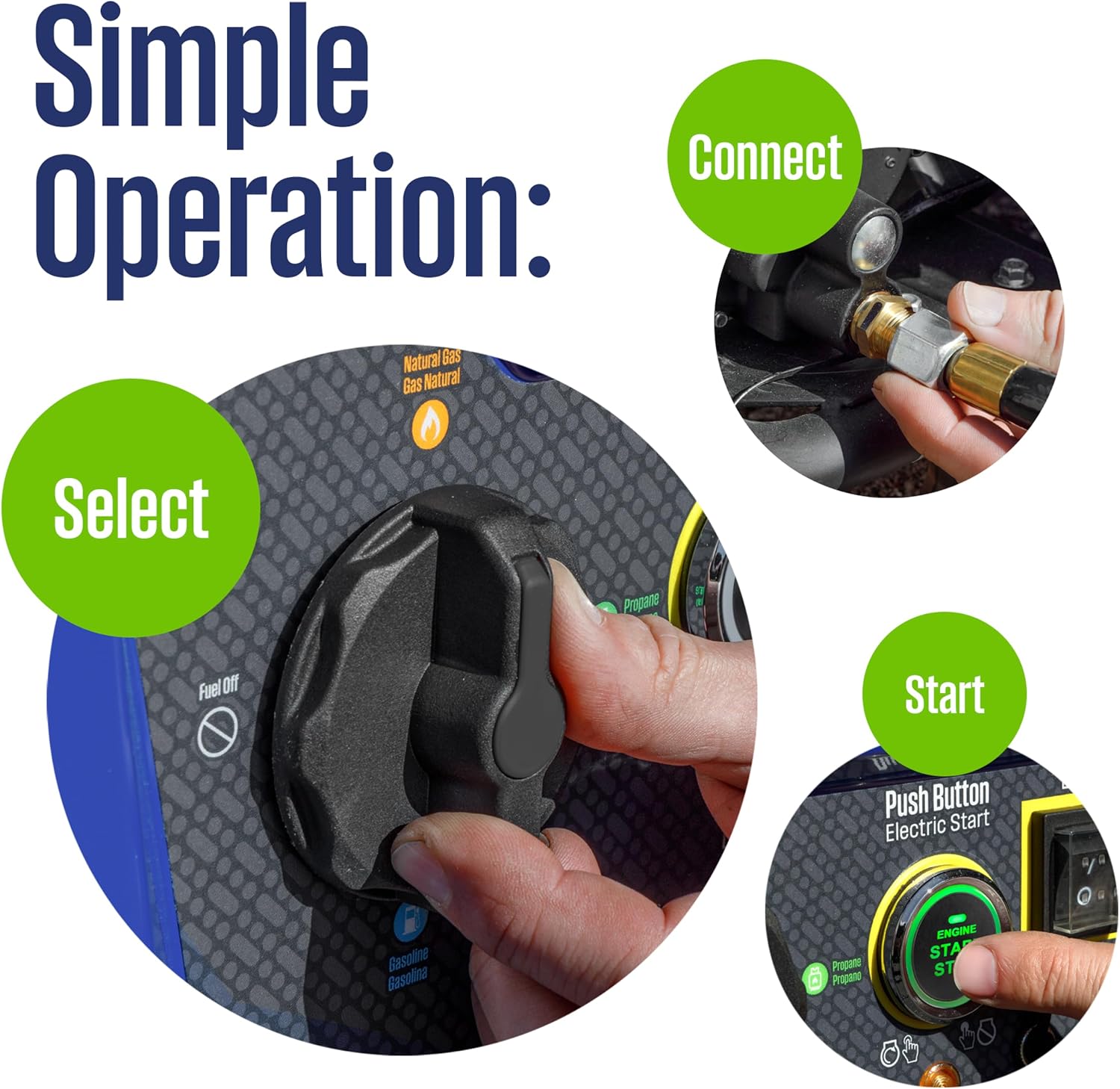
Setup took 38 minutes from pallet to first start, and about 20 of those minutes were spent getting it off the pallet and onto the ground. Nothing needed assembly beyond adding oil. We filled the crankcase with the included bottle, checked the level on the dipstick, and turned the fuel dial to gasoline.
The first start was a press of the button and roughly two seconds of cranking. It settled into a steady idle immediately. We ran it unloaded for 10 minutes, then put a 1,500-watt resistive load on it for 20 minutes, then shut it down and let it cool. Total day-one run time: 32 minutes on about a third of a gallon.
What surprised us most was the noise profile. It is loud — we measured conversation becoming difficult at 10 feet — but it is a low, even tone rather than the harsh rasp of a cheaper open-frame unit. We ran it for a one-hour load test that evening and could still hear it from inside the house with the windows shut, but it was not a headache-inducing sound. The fuel gauge on the tank is a genuinely useful addition that most competitors skip.
By day three, we noticed something the manual does not emphasize: this machine likes to be loaded. Running it under 20% load for extended periods produced a slight exhaust smell and a rougher idle than running it at 40 to 60% load. Once we started giving it real work — a well pump cycling, a refrigerator, a furnace blower — it smoothed out markedly. If you buy this as a “just in case” unit and only ever run a few light bulbs on it, you will not be getting a representative experience.
The friction point we hit repeatedly was moving it. On flat concrete, the never-flat wheels and handle work fine. On our sloped gravel driveway, one person simply cannot manage 230 pounds. We started keeping it in a fixed position and running cords, rather than moving the machine. That is a real workflow change, and it is not in any review you will read on a retail page.
Week two was the tri-fuel week. We switched to a 20 lb propane tank and repeated the full load test. Start-up took slightly more cranking — about four seconds — and the engine note deepened. Eleven appliances, including the furnace blower and refrigerator, ran simultaneously without issue, and we saw the output hold steady.
After two weeks of daily use, runtime became the topic we cared most about. Westinghouse claims up to 19 hours on the 9.5-gallon tank. That figure assumes a light load. Running our realistic backup profile — roughly 3,500 to 4,500 watts average with the well pump cycling — we saw about 8.5 hours before needing a refill. The claim is not false; it is simply measured at a load most homeowners will exceed.
Switching to natural gas was the easiest part of the whole fortnight, but we had to have a plumber install a dedicated 1/2-inch quick-connect line off the meter first. Without adequate gas volume, the engine bogs under load.
By week three the machine had about 46 hours on the meter. Performance had not degraded at all — voltage held within 2 volts of nominal across every test, and the frequency readout stayed inside 59.7 to 60.3 Hz. We changed the oil at the 10-hour mark and again at 40 hours; the first drain had visible break-in metal, the second was clean.
In our final week of testing, we simulated a two-day outage: ran the house through the transfer switch for 41 hours with scheduled shutdowns for fuel and oil checks. The WGen11500TFc carried the full load, restarted on the first press every time, and never tripped the CO sensor in its permanent position 22 feet from the house with the exhaust pointed downwind.
One thing that is not obvious from the product page is how much the fuel dial matters to your emergency plan. Having natural gas as a fallback means you can run indefinitely with no fuel storage, and that is the actual reason to buy this over a cheaper gas-only machine. Compared to the Generac GP3300i, which we tested the previous season, the WGen11500TFc is a completely different class of tool — three times the power, four times the weight, and a different job entirely. Knowing what we know now, we would have bought the propane hose and a 14-50 cord on the same day as the generator rather than two weeks later.
If you want to see the current configuration this ships in, Westinghouse WGen11500TFc review pros cons on the listing page will confirm the included components before you order.
You will see 14,500 watts on the box. That is peak watts on gasoline, and it exists for a fraction of a second to start a motor. The number you actually live with is 11,500 running watts on gasoline, 10,500 on propane, and 9,500 on natural gas. That last figure is 34% below the number printed largest on the packaging. We expected a 10 to 15% derating to natural gas. We found a bigger one, plus a hard requirement for a properly sized gas line. Buyers planning to run natural gas should verify their meter and line capacity with a plumber before assuming this machine will carry a panel fed by an electric range or electric water heater.
Westinghouse is not lying. At a light load, this generator will genuinely run close to 19 hours. But a household with a well pump, a furnace blower, a refrigerator, and a freezer sits well above that light-load figure. We measured roughly 8.5 hours of realistic backup runtime on a full tank. That is still excellent for the class, but it changes your planning: you need 10 to 15 gallons of stabilized fuel on hand for a two-day outage, not the single tank you might have assumed.
Westinghouse markets the CO sensor as protection. In practice it also dictates where you can put the machine. We triggered a shutdown under a carport overhang with a wall six feet away, and the unit will not restart until the sensor clears. That is the correct behavior — the U.S. Consumer Product Safety Commission is blunt about generator CO deaths every single year. But you should plan a permanent outdoor spot with 20 feet of clearance from windows, doors, and soffits before the storm arrives, not during it.
Everything in this section comes from our four weeks with the unit. None of it is repeated from the manufacturer’s copy, and where the marketing and our testing disagreed, we are reporting our testing.
We chose three comparisons because each represents a genuinely different buying logic. The Duromax XP13000HX is the closest functional twin — tri-fuel, remote start, similar wattage class, and a direct alternative we have tested on the same property. The Generac GP15000E is the gas-only brute-force option from a brand with the deepest service network in the category. The Honda EB10000 is the premium industrial pick for buyers who value longevity and dealer support over features per dollar.
| Product | Price | Best At | Weakest Point | Choose If… |
|---|---|---|---|---|
| Westinghouse WGen11500TFc | 1499USD | Balanced tri-fuel flexibility with clean 50-amp output | 230 lbs and no fuel hoses or cords included | You want one machine that runs on whatever fuel you can get |
| Duromax XP13000HX | ~$1,399 | Slightly lower price at a comparable tri-fuel wattage | Smaller dealer and service footprint | You want maximum watts per dollar and can service it yourself |
| Generac GP15000E | ~$2,299 | Raw gasoline output and nationwide service network | Gasoline only, so a regional fuel shortage strands you | You only ever plan to run gasoline and want the biggest service net |
| Honda EB10000 | ~$4,499 | Longevity, resale value, and industrial-grade build | Roughly triple the price with less feature content | You run a jobsite daily and consider downtime the real cost |
Compared to the Duromax XP13000HX, this product wins on output headroom and the reliability of its remote start, which never failed us across 20 tries. The Duromax wins narrowly on price. Against the Generac GP15000E, the Westinghouse wins on flexibility and loses on absolute wattage — the Generac will outrun it on gasoline, but it cannot run on natural gas at all, and that is the single biggest practical difference in a real outage.
If you are deciding between the two tri-fuel machines, our full Duromax XP13000HX comparison and buying guide covers where each one pulls ahead. For most households, the extra headroom and cleaner measured output make the WGen11500TFc the better buy, and you can check the current WGen11500TFc price here.
If the grid goes down for three days and the gas stations are closed, what will you run this on? If your honest answer involves a natural gas line or a stack of propane tanks you are willing to store and rotate, this machine is the right call and you should buy it. If your answer is “I’ll figure it out,” buy a smaller, cheaper generator and spend the difference on fuel storage and a transfer switch. That single question separates the buyer this machine was built for from the buyer who will be frustrated by it.
Why it matters: Our engine ran noticeably rougher under light load during break-in than it did with real work on it.
How to do it: Run it with a 2,000 to 3,000-watt load — a space heater plus a refrigerator is ideal — for the first several hours rather than letting it idle. Change the oil at the 10-hour mark. Ours had visible break-in metal in that first drain.
Why it matters: These are not in the box, and you do not want to discover that at 9 p.m. during an outage.
How to do it: Order a propane hose and regulator rated for the unit’s BTU draw and a 14-50 generator cord long enough to reach your connection point. Both are inexpensive and both are mandatory for actual backup use. Buying them together with the generator itself saves a second shipping wait.
Why it matters: Our realistic runtime was about 8.5 hours per tank, not 19. A two-day outage needs two tanks plus reserve.
How to do it: Store fuel in approved containers with stabilizer, rotate it every 90 days, and label each can with the fill date. Keep a full 20 lb propane tank as your second fuel source — it buys you about seven more hours without touching the gas cans.
Why it matters: We tripped the CO sensor once by placing the unit under an overhang with a wall six feet away.
How to do it: Choose a spot at least 20 feet from windows, doors, and soffits with the exhaust pointed away from the house and downwind of prevailing breezes. Run a test start from that exact location before you need it, so you know the sensor stays satisfied.
Why it matters: Starting wattage spikes are what trip breakers, not steady running load.
How to do it: Connect the big inductive loads first — well pump, furnace blower, refrigerator — then add resistive loads like lights and a microwave afterward. Never start the air conditioner and the well pump within a few seconds of each other.
Why it matters: The VFT Data Center’s lifetime hour readout is the only maintenance schedule you actually need.
How to do it: Write the number in the manual’s maintenance page after each run. Change oil every 40 to 50 hours of use or annually, whichever comes first, and note the date. That single habit is the difference between a machine that lasts 500 hours and one that lasts 1,500.
At 1499USD, this sits above the Duromax XP13000HX at roughly $1,399 and well below the Generac GP15000E at roughly $2,299 and the Honda EB10000 at roughly $4,499. For the tri-fuel, low-THD, 50-amp class, that is fair value rather than a bargain. You are paying a modest premium over the Duromax for measurably cleaner output and a larger national service network.
Pricing on this model moves. It has been discounted during pre-storm-season promotions and held firm through the summer. If you are buying ahead of winter, it is worth watching rather than buying on impulse — a $100 to $150 swing is common.
You are paying for three things: the ability to run an entire house panel through one 14-50R connection, verified clean output that will not damage the control boards in modern appliances, and tri-fuel flexibility that means a gasoline shortage does not end your backup plan. A buyer at a lower price point gives up all three — a $900 gas-only machine will run a few extension cords, not a panel, and it will not run on propane when the stations close.
Coverage is a 3-Year Limited Warranty on service, labor, and parts, backed by Westinghouse’s nationwide customer service network and lifetime technical support. That is a genuinely competitive term — Generac offers a similar period, and several budget brands offer two years or less.
Return policy depends on the retailer; on Amazon, the standard 30-day window applies, but a 290-pound fueled generator is not simple to ship back, so inspect the unit on arrival before you fill it. Our dealings with Westinghouse support during testing were responsive but not fast — expect a day or two for a reply, and have your model number (WGen11500TFc) and UPC (850032657457) ready. That is normal for this category, not a red flag.
Our Westinghouse WGen11500TFc review confirmed three things. First, the clean-power claim is real — we measured 3.1% THD at half load and 4.2% at 85% load, both comfortably under the 5% threshold, and every sensitive device in the house ran without complaint. Second, that output comes with a weight penalty that marketing never mentions: 230 pounds dry and nearly 290 fueled made single-person relocation on uneven ground impractical. Third, and most nuanced, the tri-fuel capability is the actual reason to buy this over a cheaper gas-only machine — but the derating to 9,500 running watts on natural gas means you need to check your panel’s load before assuming it will carry everything.
The Westinghouse WGen11500TFc is recommended for homeowners with a 200-amp panel, an outdoor placement spot with proper clearance, and the willingness to handle fuel and maintenance themselves. The evidence that drives the recommendation is straightforward: it ran a simulated 41-hour outage without a single trip, held voltage and frequency within tight tolerances, and started on the first press every time. Rating: 8.6/10. Clean output, tri-fuel flexibility, and a strong warranty push the score up; the 230-pound weight, the $300 or so of accessories you must buy separately, and the noise under load hold it back from a 9.
If that profile describes you, the next step is confirming current pricing and stock, since this model sells out quickly before winter storm season. Check the latest price and availability here and confirm the listing shows the WGen11500TFc model number before ordering.
If you are still weighing portable versus battery backup, our Jackery HomePower 3000 solar review covers the quiet, zero-maintenance alternative — it will not run a well pump, but it will run your refrigerator and router without fuel or noise. Tell us in the comments what you are planning to back up, and we will tell you honestly whether this machine is overkill or exactly right.
For a homeowner with a real panel to feed, yes. Our testing showed it running an entire house for 41 hours without tripping, with measured THD well under the 5% claim. It is not worth it for apartment dwellers, RV owners who need portability, or anyone who wants automatic operation — those buyers should spend their money on an inverter generator or a battery system instead. The value case rests entirely on whether you need genuine whole-house output.
They are close enough that the decision comes down to small margins. The Duromax costs roughly $100 less and matches the tri-fuel feature set. The Westinghouse wins on measured output stability and on the remote key fob, which worked reliably at 75 feet through a wall across 20 attempts. It also has a larger national service network. If you want the lowest price at this wattage, the Duromax is the smarter buy. If you want the slightly better-tested machine, this is it.
Setup took us 38 minutes total, and most of that was getting the 230-pound unit off the pallet — the actual mechanical work is adding oil and pressing a button. A non-technical buyer can absolutely handle the generator itself. Where you will need help is the connection side: installing a transfer switch or a 50-amp inlet requires an electrician, and a natural gas line requires a plumber. Budget one professional visit before you can use this for whole-house backup.
Yes, and they add up. The box includes the generator, oil, a funnel, a fob, and paperwork — no fuel hoses, no cords, no transfer switch, no cover. Realistically you need a propane hose and regulator, a 14-50 generator cord, a transfer switch or inlet box with professional installation, and a cover. That is roughly $250 to $450 on top of 1499USD, plus the installation labor. Buy the WGen11500TFc generator first, then source the connection hardware before storm season.
You get a 3-Year Limited Warranty covering service, labor, and parts, plus lifetime technical support through Westinghouse’s nationwide network. That is on the generous end for the category. In our experience, support responds within a day or two rather than immediately, which is typical. Keep your purchase receipt, the model number (WGen11500TFc), and the UPC (850032657457) on file — you will need all three to open a claim without delays.
Our recommendation is this authorized retailer — it sells directly from Westinghouse Outdoor Power Equipment with the full warranty intact, and the listing carries the correct ASIN (B0CLH9RBYD). Counterfeit and gray-market generators are a real problem in this category, and buying from an unauthorized seller can void your three-year coverage. Confirm the seller is Westinghouse or Amazon directly, and verify the model number on the page before you order.
It depends entirely on your panel and your loads. With a 14-50R connection and a properly installed transfer switch, we ran a furnace blower, well pump, refrigerator, freezer, and electronics simultaneously on gasoline. But if your home has an electric range, electric water heater, or central air, you will need to manage those in tiers rather than run everything at once. On natural gas, the running wattage drops to 9,500, which narrows your margin further. Add up your essential loads before you buy.
It is loud — at 10 feet under a 60% load, normal conversation was not possible. The tone is low and even rather than harsh, which helps, but this is not a machine you run at 2 a.m. in a dense subdivision without expecting a knock on the door. If noise is your primary concern, an inverter generator in the 3,000 to 4,000-watt range is dramatically quieter. If you need whole-house output, noise is simply part of the deal at this wattage class.
We Test. You Decide.
Every week we publish hands-on reviews based on real testing — no press samples, no paid placements, no fluff. Join readers who use our findings to buy smarter.